Daniel Danilatos’s route into electricity infrastructure began close to home. His wife had founded an engineering consultancy. He watched the work of planning and designing power networks, saw the software involved, and began building something better. Before there was a company with customers across continents, there was a working engineer with a problem that another working engineer could recognise.
That is a pleasingly modest beginning for Neara. Power lines rarely appear in the glamorous part of a technology pitch. They stand beside roads, cross paddocks and do their best to escape our attention. Yet designing them requires a precise account of the world: distances, loads, clearances, terrain. A line on a drawing has to become a line that behaves properly in wind and heat.
Danilatos had spent years making software respond to people. Now he was entering a field where software also had to answer to gravity. The change of subject was considerable. The underlying difficulty was familiar: how do you make a computer represent what is actually happening closely enough that somebody can rely on it?
The browser was his first difficult customer
His earlier career helps explain the approach. Danilatos studied computer science at the University of New South Wales and worked at Google, where his work included real-time collaborative editing. He was part of a team assembled by Lars Rasmussen, the co-inventor of Google Maps. Later came work at Dropbox and Canva, and the software consultancy Helix Collective.
Collaborative editing has become ordinary enough to be taken for granted. Several people open a document, type, and expect their changes to coexist. The pleasant simplicity of that experience conceals a demanding engineering problem. People do not pause politely while a server decides whose sentence came first.
At Google I/O in 2010, Danilatos presented a session on testing applications built with Google Web Toolkit. The subject included unit tests, code coverage and browser-based integration testing. It was a talk about giving developers ways to check that complicated applications worked. A career can be described through company names; this recording offers a more useful glimpse of the work inside them.
His public browser discussions reveal another corner of that work. In 2009, he reported a Firefox input issue involving Chinese text entry on a Mac. The question concerned when an application received notice of a keystroke as characters were being composed. In 2010, he proposed a change to the specification for composition events. In 2011, he joined a discussion about the distinction between visual cursor directions and logical text movement.
These are small matters until you try to write a sentence and the software gets them wrong. They also make an instructive prehistory for an infrastructure founder. Long before whole networks entered the picture, Danilatos was already dealing with the inconvenient distance between a tidy abstraction and a user’s actual experience.
A power line refused to stay a drawing
He co-founded Helix Collective in 2012, building software for startups and larger businesses. Consulting brought him into contact with his wife’s engineering company. The work exposed a set of problems with immediate physical consequences, and the first version of the business that became Neara emerged from that encounter.
The early company was called Power Lines Pro. The name was admirably direct: you could reasonably guess what was on the screen before opening the application. In 2021, it became Neara, alongside a Series A investment led by Square Peg. The broader name reflected an ambition to serve more kinds of infrastructure.
There is a temptation to tell this as a founder discovering an overlooked industry and arriving with all the answers. The documented story gives his wife’s engineering work a much more consequential place. It provided access to the problem itself. Danilatos could build software; the people doing the engineering could show what the software needed to understand.
That relationship matters because an electricity network is full of local details. A useful system needs to preserve them while making a large network manageable. Each span of wire belongs to a bigger system, yet its particular geometry still counts. The challenge is to keep the detail without making every question an entirely new project.
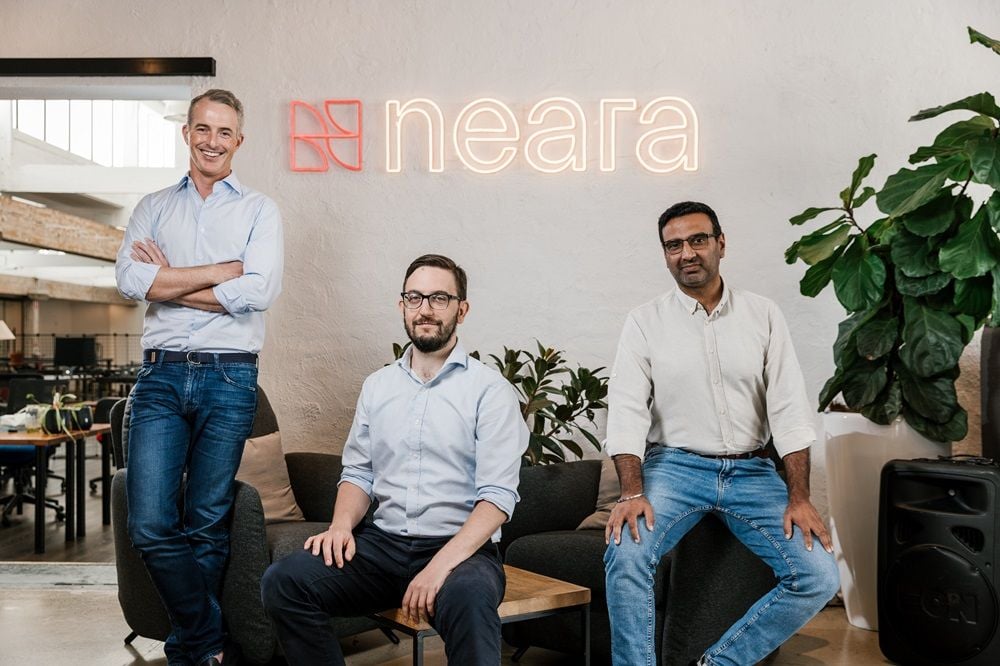
Three different kinds of experience
Danilatos brought in Karamvir Singh and later Jack Curtis. Singh’s background combined software engineering with product work, including enterprise systems in banking. Curtis had spent more than a decade at First Solar, working on the international commercial development of a solar business. The founding group joined software, product and energy experience.
The mix is worth lingering over. A technical model has to work. It also has to become something engineers and operators can use, and something a utility can adopt. Those demands arrive together, however neatly a company might separate its job titles.
In their 2021 founder podcast, the three discussed the origins of the business, choosing co-founders, their first customer and company culture. The conversation placed the domestic beginning alongside the commercial questions that followed it. Solving a recognisable problem was the opening move. Building a business around it required other people and other skills.
A second grid, inside the computer
Neara builds physics-enabled digital twins: three-dimensional models of infrastructure designed to represent how assets behave. The distinction between appearance and behaviour is crucial. A convincing picture of a pole does not, by itself, tell you how it bears a load. A model becomes useful when an engineer can ask a question and examine the consequences.
The company combines network information with engineering analysis. Its current description of the platform includes modelling line sag in heat, structural loads and the response of a network to outside forces. The point is to make those questions practical across many assets, rather than reserve detailed analysis for a few selected locations.
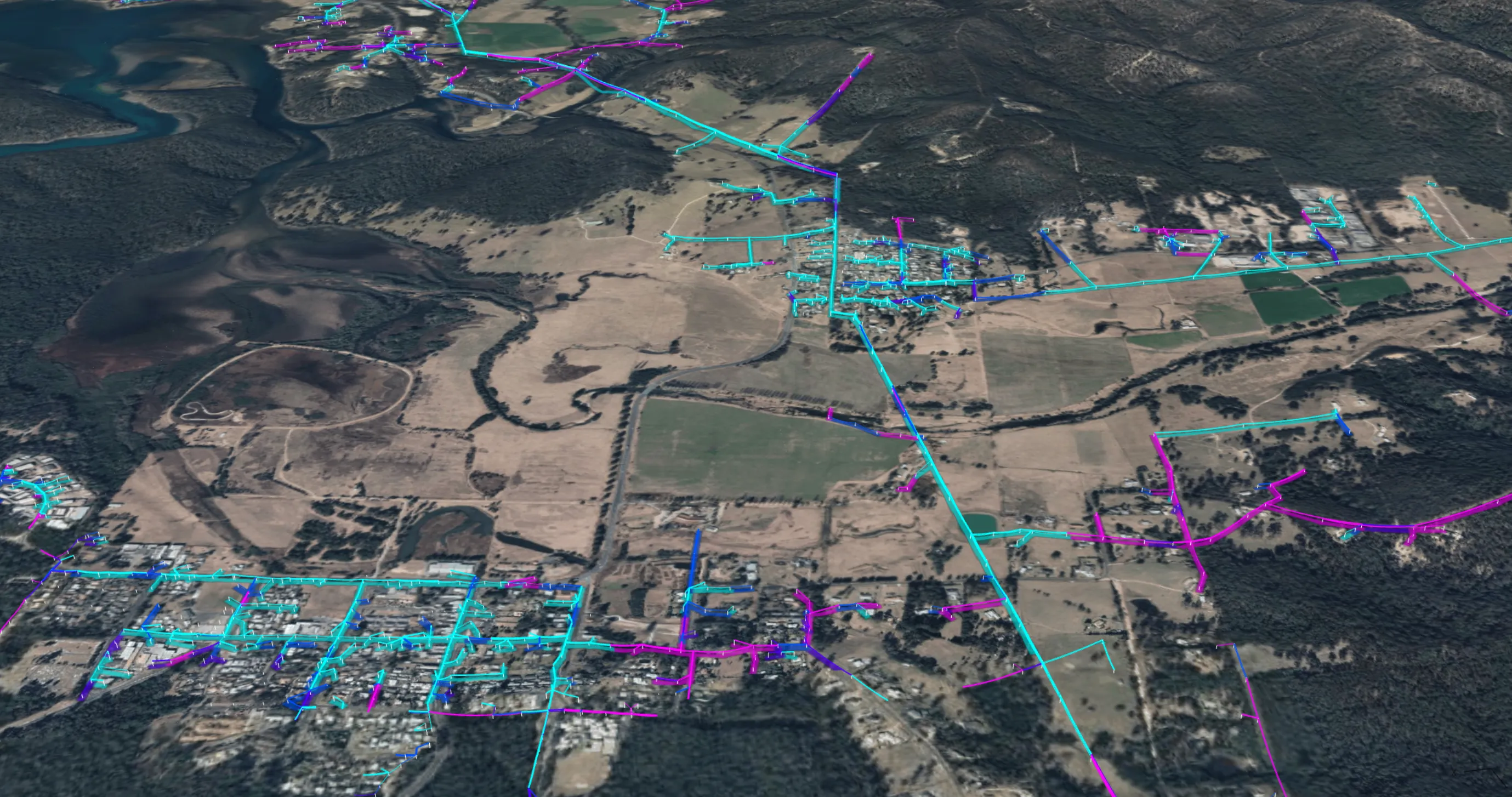
Conceptual workflow - a model supports an engineering decision.
This also connects back to Danilatos’s earlier software work. Shared editing gives people a common object to work on. An infrastructure model offers a common representation of the network. The connection is an interpretation of his career, but it helps explain why a browser engineer might find poles and wires an absorbing next subject.
The capacity hiding in plain sight
Essential Energy provides one concrete example. Its network includes 183,612 kilometres of power lines and supplies nearly 900,000 customers. Using individual-span modelling, the utility found that capacity in many parts of the network was twice what it had previously understood.
The finding came from looking more closely at the existing infrastructure, including the temperatures at which lines could operate. A broad standard had given way to a more specific account of individual spans. The result was room that had been difficult to see under the earlier assumptions.
Capacity identified in many parts of Essential Energy’s network through individual-span modelling. A case-specific finding, rather than a promise for every grid.
For a software founder, that is an unusual kind of achievement. The visible object may look exactly as it did yesterday. The wire has not become thicker because a better model exists. What changes is the operator’s understanding of what that wire can support. Better information can alter a building decision before anybody orders a new pole.
When the river supplied the deadline
The River Murray floods gave the modelling a different test. SA Power Networks used Neara to analyse 21,000 power-line spans in a fifteen-minute report. The work helped the utility track water levels and clearances, decide when power needed to be disconnected, and plan its return as the water receded.
The utility described re-energising lines within five days, against an anticipated three weeks using traditional manual methods. These are results from a particular flood response, involving the utility’s own staff and decisions. They give the software a measure beyond the elegance of its interface.
Electricity has a habit of making software’s usefulness very plain. A household experiences a restoration as the return of ordinary things: a light, a refrigerator, a charged phone. The engineering and analysis remain largely out of sight. In this business, disappearing into everyday life is a respectable outcome.
“Now back to coding :)”
When Power Lines Pro became Neara in 2021, Danilatos posted about the team, its customers and the investors supporting the next stage. He finished with five words and a smile: “Now back to coding :)”.
It is a small public detail, but an expressive one. A funding announcement usually invites a founder to rehearse a vision of the future. His closing line returned to the workbench. It gives the announcement the texture of somebody who still finds the making of the thing interesting.
“Now back to coding :)”
Daniel Danilatos, on the 2021 rebrand and Series A
By 2024, Neara had appeared on TIME’s list of 100 influential companies, and Danilatos was included in The Australian’s Top 100 Innovators in the energy category. Recognition had caught up with a business whose work took place largely behind the scenes.
The scale continued to change. In February 2026, Neara announced an A$90 million Series D led by TCV. The funding was intended to support technical hiring and international expansion. Customers included utilities in Australia, the United States and Europe. The initial engineering problem had acquired a much larger audience.
The next problem is making room
In September 2026, Neara appointed Ian Wang, previously a product leader at Adobe, as chief product officer. Singh moved into the chief strategy officer role. Danilatos said the company had more than doubled its headcount over the preceding twelve months and was preparing to grow across broader critical infrastructure.
Wang was already an early collaborator with a connection to the company stretching back a decade. The appointment adds another chapter to a story built through working relationships: the engineering consultancy, the complementary co-founders, the customers, and now an expanded leadership team.
Danilatos’s stated ambition extends beyond electricity. The practical question remains close to the one that first drew him in: can people understand the infrastructure they have well enough to decide what to do next? More demand, more assets and more complicated conditions make that question harder, and more useful.
There is a quiet pleasure in the trajectory. An engineer notices a tool that makes another engineer’s work harder. He starts building. Years later, the subject is still a stubborn piece of the physical world, and the task is still to represent it faithfully enough to help. A power line may be an unshowy place to begin a software company. It does, however, connect to rather a lot.