Eugene Varricchio has spent much of his working life helping people choose things. Groceries. Magazines. Somewhere to have dinner. The objects change; the awkward moment before the purchase remains. A customer has money, limited time, and a suspicion that the person doing the selling may be rather more enthusiastic than the product deserves. Varricchio's career lives in that gap between a promise and a decision.
His most recent decision was his own. After building Franki in the United States, he announced in April 2026 that he would step down as chief executive and return to Australia. In July, he announced his appointment as CEO of Brands & Marks. The restaurant-discovery co-founder was going back to consumer goods, the industry he knew before video recommendations became his business. There is something pleasingly circular about it: after years helping other people decide where to go, he chose home.
The interesting part is what he carried back. Franki had turned a familiar social question - where shall we eat? - into a product linking diners, creators, and restaurants. Before that, he had worked through the machinery of retail and publishing. Across those settings, he kept returning to the customer's point of view. A business can admire its own complexity indefinitely. The customer still needs a reason to walk through the door.
Before the feed, the shelf
Varricchio started on the retail shop floor. He moved into senior management, then into sales and marketing at Nestlé, and later into print media. That sequence matters because it put him on different sides of the same purchase. Working with customers teaches you what they ask for. Working with a supplier teaches you how much has to happen before the answer reaches a shelf.
In 2000, he joined ACP Magazines, later known as Bauer Media, as director of retail sales. His responsibilities expanded through retail, distribution, and operations. By June 2016, he was also taking charge of BauerWorks, the group's customer-content business, while retaining his operations role. A career that began near the till had reached the place where editorial work, commercial partnerships, and delivery systems met.
His publishing experience included scaling the magazine subscription business Magshop and launching Reader Rewards, a mobile loyalty card for magazines. Both are useful details in a story about a restaurant app. Subscriptions ask how you keep a customer coming back. Loyalty schemes ask what makes returning worthwhile. Distribution asks whether the product arrives where demand exists. These are questions with long working lives, even when the screens become smaller.
Dinner should not require a dossier
By September 2020, Franki was introducing its video-based review app in Austin. Its launch announcement described more than 500 local video reviews and a commitment exceeding $100,000 to support competitions that paid people to try venues and share their experiences. Nick Bennett, then described as director of strategy, spoke about helping businesses stand out. The premise was already there: let the customer show the place.
Think of the ordinary dinner decision. One friend wants somewhere lively. Another would like to hear a complete sentence. A third is studying the menu as though a hostile takeover might follow. A star rating has to squeeze all those preferences into one number. Video can leave more of the room intact: the tables, the noise, the portions, the people. You can make your own judgment about whether you belong there.
Varricchio's early retail background gave that problem a practical setting. He described Franki as a response to local businesses struggling to connect with their audiences. The aim was to make restaurant discovery feel more personal and to help venues build community around actual experiences. A recommendation should lead somewhere beyond the recommendation itself. Ideally, everyone gets to stop researching and order something.
“At a higher level, I consider myself a builder.”
Eugene Varricchio
The cautious customer builds a recommendation app
One of Varricchio's more revealing admissions concerns novelty. In his writing about trust, he places himself among people who, as they grow older, prefer a recommendation before trying something new. The founder of a discovery business understands the reluctance to discover. That is a useful complication, and rather more recognizable than the entrepreneur who is apparently thrilled by every unknown doorway.
His argument is that local businesses should begin with the people who enjoy going first. Those customers investigate, then tell their more cautious friends. He also warns that intrusive advertising can damage the trust it is meant to build. The thread is respect for attention: help somebody make a decision, and give them a reason to recommend you afterwards.
He has made a related distinction between people creating content out of enthusiasm and influencers chiefly concerned with compensation. It is his view of intent, rather than a universal rule about either group. He argues that unpolished footage can communicate a place more persuasively than heavily managed imagery. For a restaurant, a customer showing the room may do work that a beautifully arranged promotional photograph leaves undone. The photograph has impeccable manners; the video might tell you where the chairs actually are.
Turning an opinion into a visit
Varricchio's case for video also came with numbers. Franki's 2023 recommendation study surveyed 560 people in the United States who visited restaurants at least monthly and used online recommendation or review sites. He reported that 75% ranked word of mouth as most influential, compared with 47% for star ratings and 39% for reviews. These are company research findings, with a defined audience, rather than a verdict on every diner.
The study gives shape to his commercial problem. Personal recommendations carry context. Somebody who knows you can distinguish your idea of a good evening from theirs. A platform has to work harder to preserve that context, while keeping the decision easy. Otherwise it has merely moved the paperwork into a more fashionable format.
Franki's development proceeded in stages. Varricchio described beta testing in November 2020, an initial product launch in Los Angeles in the third quarter of 2021, and commercialization beginning in June 2023. His ambition was a service that could personalize recommendations and connect discovery with action. OpenTable integration was one practical part of that: the diner could move from considering a restaurant to booking it inside the app.
There are three parties at that table. The diner wants a useful suggestion. The creator wants an audience for their judgment. The restaurant wants customers who actually arrive. Keeping all three interested creates an operating problem as much as a storytelling opportunity. A charming clip is a beginning; somebody still has to make the product work around it.
Which voices carried the most influence?
Trust needs colleagues, too
Building the app required people far from the restaurants appearing on it. Franki worked with Alcor to recruit mobile engineers in Mexico. The partner's account describes an initial seven hires covering iOS, Android, and quality control, with average hiring times of four to five weeks. Varricchio praised the advance information about market conditions and pay, and spoke about finding talent in Mexico and Colombia.
This is the less photogenic side of restaurant discovery. Behind a clip of dinner sits recruiting, testing, equipment, and a team capable of maintaining the experience. A founder's enthusiasm has to survive contact with an actual release schedule. The work is a reminder of Varricchio's earlier operations roles: people need enough clarity and support to deliver what the customer has been promised.
In a 2026 conversation with John Register, Varricchio reflected on how his understanding of leadership had changed. Earlier, he associated leading with greater control and involvement. Later, he came to value removing fear, clarifying accountability, and giving people room to work. That shift makes sense alongside his concern with customer experience. An organization cannot respond intelligently to customers if everyone inside it is waiting for permission to think.
His colleagues' accounts add texture. Luke Abbott, who worked for him for fourteen years, described constructive challenges and being trusted with growing responsibilities. Tony Edwards, a colleague across more than sixteen years at ACP and Bauer, emphasized strategy and support. Their recollections suggest a manager whose interest in the team includes both expectations and the means to meet them.
A group photograph, then a flight home
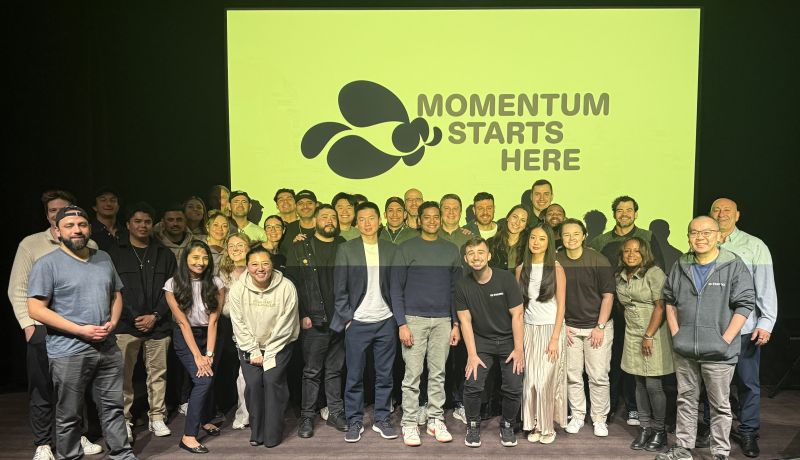
The photograph accompanying Varricchio's departure announcement shows members of the Franki team beneath the words “Momentum Starts Here.” He explained that the entire company could not gather in the same room for the 2026 kickoff. In his farewell, he singled out Bennett's contribution to the product and strategy, thanked the wider team, and said he would help through the transition as executive advisor for the following months.
The image is a useful change of scale. Founder stories often narrow towards one person until the company appears to have been assembled by sheer force of biography. Here are the other people, standing in an admittedly crowded frame. The sign talks about momentum. The people beneath it are the more convincing explanation.
Family also figures in his account. In 2024, he credited his wife, Lee, with support and encouragement during the Franki journey. When he announced his return to Australia, he said he wanted to be present for important family moments ahead. That decision supplies its own measure of success: being able to hand over a business and choose where to spend the next part of your life.
Franki continued to develop its public identity. Its 2026 work with Koto organized the brand around “Make Time Dance,” with a character symbol, rounded typography, and motion. The studio described a community built around people sharing places and experiences. It is a playful expression of a familiar commercial aim: help someone spend their evening well. Even an operations veteran can appreciate a little dancing, provided the booking goes through.
Back where the customer can reach the shelf
At Brands & Marks, Varricchio now leads a business helping consumer goods brands enter and grow in Australia and New Zealand. Its work covers market insight, commercial planning, sales, importing, and distribution. Those are recognizable components of his earlier career. The platform has changed again; the need to connect a product with a willing customer has followed him back.
He has said that the appeal was a business with established relationships and room to grow. He acknowledged founder Mark Okeby and looked ahead to working with Kody Okeby and the wider team. The next chapter therefore begins with something already built, and with people who understand it. His stated ambition is to help local and international brands succeed in the Australian market.
Seen across the whole career, the move has a steady logic. Retail taught proximity to customers. Publishing added distribution, loyalty, and content. Franki asked whether people could recommend local experiences to one another through video. Now he is back among brands and retailers, bringing those accumulated questions with him. What does the customer need to know? Who do they believe? What has to work behind the scenes?
There is no need to make choosing dinner sound grander than it is. It is already a small act of trust, performed millions of times, often by hungry people with diminishing patience. Varricchio has made a career of attending to that moment. His own latest choice brings him back to Sydney, family, and the business of getting something useful in front of somebody who wants it.