The trouble began with apartments that had no useful memory. In 2011, several of Jindou Lee’s investment properties turned over at once. He had no adequate paper trail to recover resident deposits or get the units repaired and rented again quickly. The building was still there. The evidence had gone missing.
Lee and software developer Andrew Mackenzie-Ross built an inspection tool to address the problem. They called it Happy Inspector. It is an unusually plain origin for a technology business: an owner needed to know what had happened inside his own properties. Fifteen years later, HappyCo’s ambition still rests on that small, stubborn question.
- The work: inspections, repairs, apartment turns, asset planning and vendor sourcing for multifamily portfolios.
- The buyer: owners and property managers; the daily user is often a maintenance technician.
- The distinction: field records connect to operational workflows, with remote technicians available through Happy Force.
- The lesson: measure the delay between finding a problem and handing someone enough information to fix it.
The second visit is where the money goes
Take an apartment inspection. Someone enters the unit, finds a problem and records it. Someone else must decide what to replace. A third person may approve the expense. If the record is vague, the conversation travels back down the chain. Perhaps someone visits the apartment again. All this activity can look like work. Some of it is simply the cost of asking the same question twice.
That is the mechanism described in HappyCo’s Maxus Properties customer story. Before the software, turning an apartment required repeated visits to assess and approve repairs. With inspection photographs available remotely, colleagues could review the evidence without another trip. Maxus reported saving about a day of labor per move-out, plus 10 to 20 minutes on move-in inspections.
“We save about a day of labor for every move-out.”Rae Schnabel, Maxus Properties
In HappyCo’s published customer story
Maxus put its annual move-in labor savings at $50,000 to $70,000. That is a customer estimate, not a promise for the next buyer. It does, however, give the apparently minor act of documenting a room a financial consequence. Better information lets a paid employee spend time elsewhere. Whether that becomes a smaller bill, a faster turn or more capacity depends on how the operator uses it.
Customer-reported figures from HappyCo’s Anchor NW story. Results reflect that operator’s wider processes.
Anchor NW offers another version of the same story. It reported cutting inspection time from 90 minutes to 45 minutes and increasing monthly turns from 50 to 160 while keeping a three-day standard. Its account also describes specialized teams and systematic scheduling. The software sits inside an operating model; crediting an app with the entire outcome would give it rather too much applause.
A game designer meets a maintenance technician
Lee had worked at Midway Games on titles including Mortal Kombat and Gauntlet Legends. In a PropTech Pulse interview, he connected that experience to a practical design rule: users should be able to understand the software without a person beside them explaining it. A maintenance technician standing in an apartment has as little use for a lengthy software lesson as a gamer holding a controller.
The early inspection app put photographs, ratings and notes at the point of work. The products subsequently followed the information into other tasks. HappyCo added work-order tools, reporting and integrations with property management systems. Its company history dates the first Yardi Voyager integration to 2016 and the Freddie Mac Multifamily inspection partnership to 2018.

The distinction matters in the property software market. A PMS holds the leasing, payment and resident records that an operator already depends on. HappyCo sells a connected layer for the people inspecting rooms, assigning repairs and preparing apartments for the next resident. The existing system supplies context; the field team supplies evidence about what is happening now.
That puts HappyCo beside providers such as Yardi, RealPage, Entrata and AppFolio. Their own operational features may be alternatives for a particular buyer; they can also be integration partners. HappyCo’s pitch is strongest when the inspection, the work order and the asset decision need to travel across teams. Its expertise is the unglamorous detail of multifamily work: unit conditions, make-readies, technician assignments and repair histories.
The phone call that changed the pilot
At The Dinerstein Companies, the problem included after-hours calls. John Barr, its director of leasing and innovation in the published case study, was initially skeptical about centralized maintenance. The company tried Happy Force, HappyCo’s remote maintenance service, in a pilot. Positive feedback from onsite staff helped turn the trial into a broader rollout.
Dinerstein reported a 50-60% decline in after-hours calls across its portfolio. In its account, fewer unnecessary calls meant less overtime and a better experience for maintenance teams. Here, the scarce resource was someone’s evening. A service that distinguishes a request needing immediate local attention from one that can be handled remotely has a concrete use.
Happy Force gives the business a service component alongside its software. Remote technicians can help with triage and support; local teams still perform physical repairs. That combination is distinctive because it reaches beyond recording the request. An operator can buy tools for coordinating work and help handling the incoming workload.
Follow the repair into the budget
HappyCo’s current platform groups its offer into maintenance operations, maintenance services, asset management, asset evaluation and sourcing. The first covers inspections, work orders, preventive maintenance and apartment turns. The asset side covers capital budgets, renovation projects, inventory and vendor compliance. Evaluation supports due diligence, lease file audits and site visits.
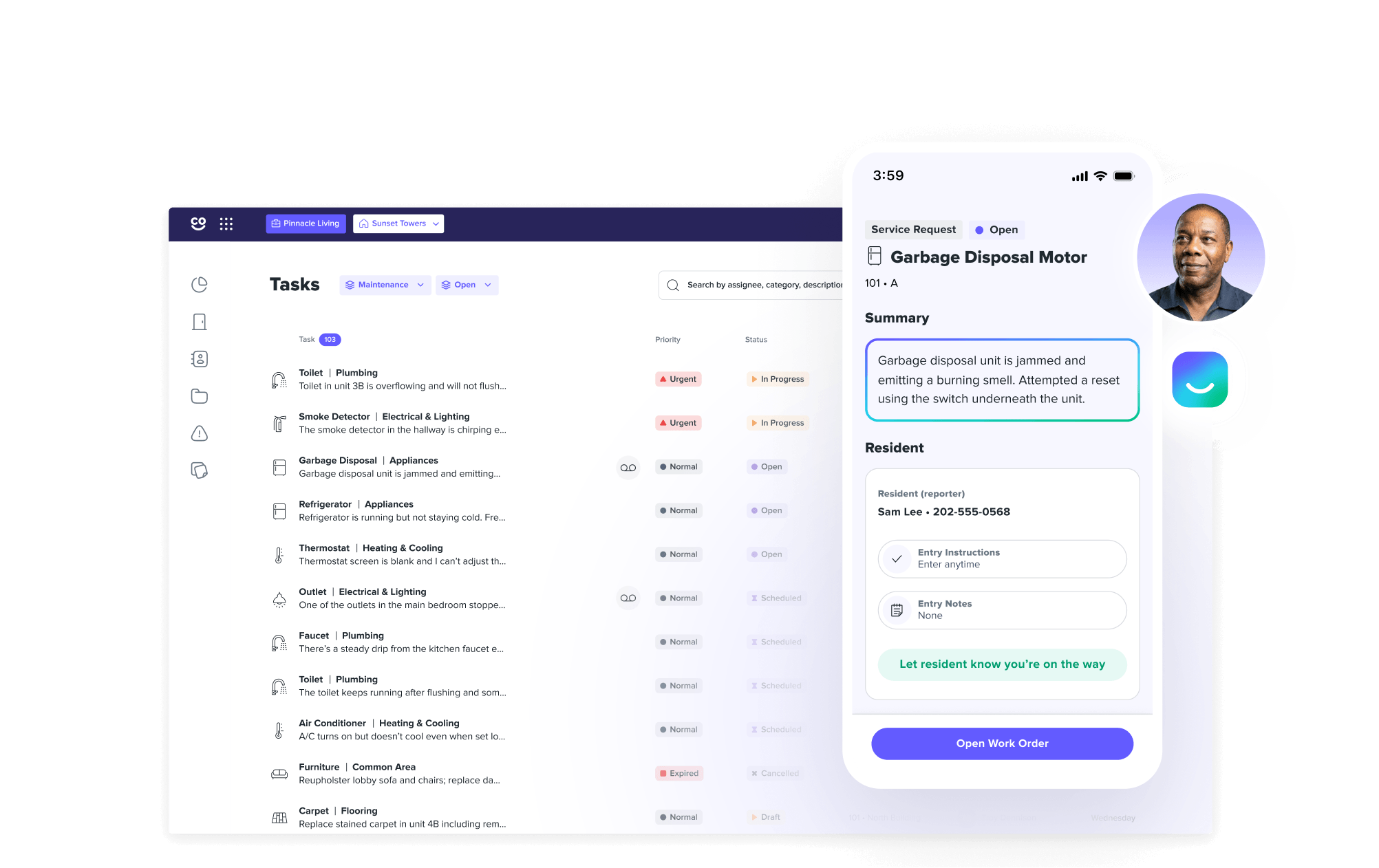
In June 2026, Sourcing by HappyCo extended the company’s AI into vendor bidding. The announced workflow can create scopes of work, research vendors, solicit bids and compare responses. The commercial logic is easy to follow: an inspection identifies a need; a repair or renovation creates a buying decision. HappyCo wants the information to survive that journey.
Its business model is subscription software with modular packages and associated services. The current pricing page invites buyers to start in one operational area and add others. Pricing requires a sales discussion. For a buyer, the sensible cost question extends beyond the subscription: how much configuration, integration and staff time will it take to make the workflow useful?
There is a concrete adoption example at Tarragon Property Services. Its customer story says sites already had iPads, avoiding a new hardware purchase. Staff used a webinar and onsite training to begin. That circumstance is worth copying only where it applies: available devices and a straightforward process make a different starting point from a portfolio that must acquire equipment and standardize inspections first.
Joy needs someone who can fix the pipe
JoyAI supports routing, scheduling, documentation and insights inside HappyCo. Voice Assist, announced in November 2025, lets technicians dictate completion notes. The system extracts repair details, materials and time into structured records. A ticket marked complete can then tell the next person what actually happened, rather than offering the wonderfully unhelpful news that something is over.
There is a limit here that HappyCo itself has investigated. Research it commissioned from Freed Vance Research Group, released in December 2025, found that 82% of surveyed residents preferred human-first contact for urgent maintenance. Comfort with AI was higher for general questions. Residents with human support available also reported higher renewal intent than those with AI as the primary channel.
Those survey associations do not prove that replacing people causes residents to leave. They do warn against treating every interaction as an identical automation opportunity. Scheduling a routine task and reassuring someone during an emergency require different judgments. The useful deployment keeps escalation clear, gives supervisors control and makes human help reachable.
The same operational discipline applies without AI. Photograph consistently. Define who receives the record. Track how long the handoff takes. Pilot a change and ask the technicians what happened. If nobody acts on the findings, a prettier inspection record merely gives the backlog better stationery.
Another investor, the same missing handoff
HappyCo raised $52 million in January 2022 in funding led by Camber Creek. That year it also acquired Yuhu, the Canadian rental lifecycle platform. On September 22, 2026, it announced investment from Lone View Capital, with Lee and the management team continuing to lead. The stated priorities include product innovation, AI and customer success.
For all that expansion, the company’s most persuasive idea remains small enough to fit inside an apartment: let the person who sees the problem leave a record that the next person can use. The repair starts sooner. The supervisor makes one fewer call. An employee goes home without another unnecessary interruption. Those are modest ambitions for software, and very good reasons to buy it.