Lavanda's first useful piece of property technology was a bag of dirty washing. In 2014, founder Guy Westlake set out to build an on-demand laundry service, borrowing from his experience at delivery startup Shutl and from his wife's work with laundry brands at Unilever. Consumers could summon a pickup. Clean clothes came back. The proposition was tidy enough. The customer list was not.
Airbnb hosts and short-term rental operators kept appearing among the heaviest users. They did not merely have sheets to wash. They had apartments turning over at hospitality speed, residential rules written for year-long leases, and an improvised stack of booking sites, spreadsheets and point solutions that rarely agreed. Lavanda's team asked why these businesses were ordering so much laundry. The answer eventually made the original company look like a courier riding alongside a much larger truck.
The business closed the laundry operation and began building software. Lavanda launched as a short-term rental operator in 2015, started developing its flexible-living property management system in 2016, and gradually moved upmarket. Today the London company sells an API-first platform to institutional owners and operators in student accommodation, multifamily housing, co-living and serviced apartments. The old name stayed. Almost everything else changed.
The vacancy has an expiry date
Lavanda's sharpest insight is less glamorous than the phrase “flex living.” An empty apartment tonight cannot be stored and sold next Tuesday. Student rooms left vacant during summer, new multifamily units waiting for long-term tenants and gaps between leases are perishable inventory. Hotels built systems around that fact. Conventional residential software largely did not.
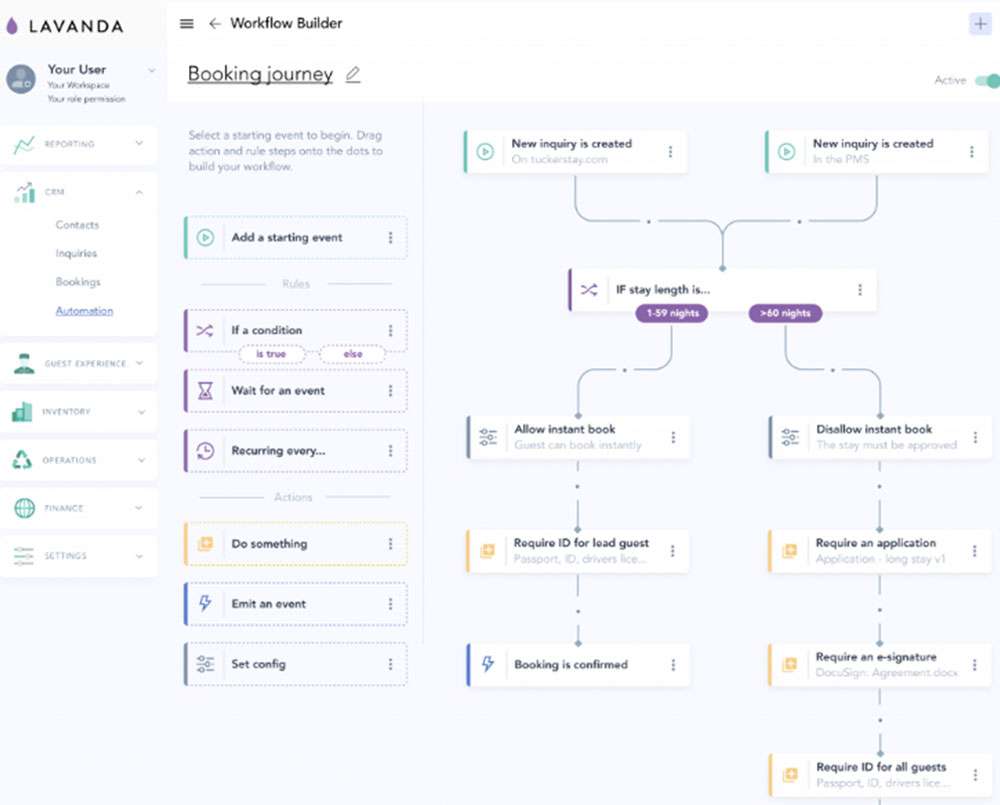
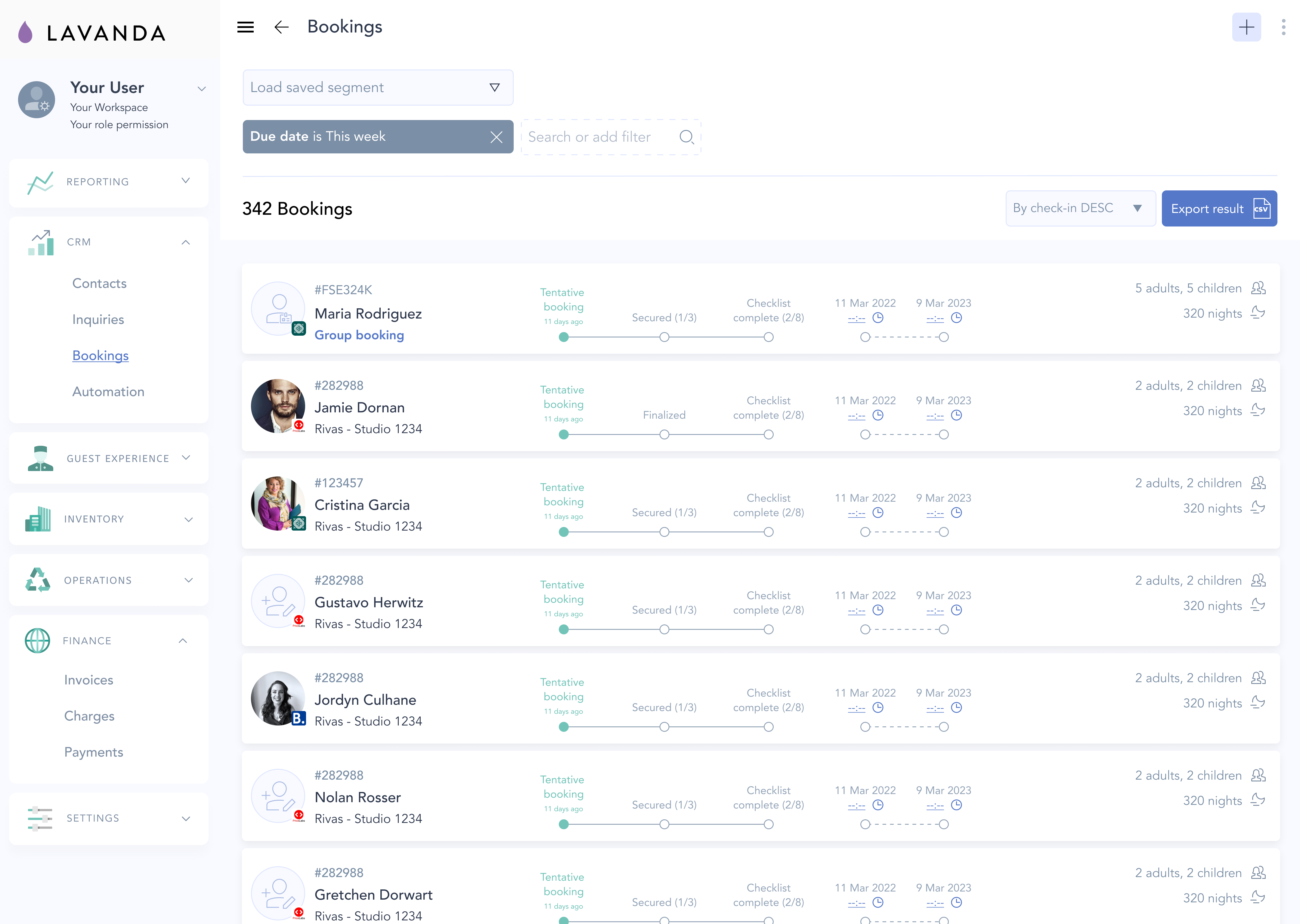
OpenPMS, Lavanda's main product, tries to reconcile the two operating traditions. It puts marketing, booking, leasing, resident communications, maintenance, finance and reporting in one system while allowing inventory to be offered for a day, a week, a month or a year. A channel manager distributes available rooms to hundreds of online travel agencies and specialist marketplaces; direct-booking tools let an operator keep the customer relationship; vetting, payments and check-in workflows bring the guest through the door.
One inventory ledger / three rental clocks
The customer is not the traveller tapping “book.” It is the company responsible for the building and the investors watching its income. Lavanda names Unite Students, iQ, Homes for Students, Greystar, Blackstone, Hines, Brookfield and Starwood among its customers or partners. That is a revealing roster: the sale depends on persuading operations, technology, finance and asset-management teams that flexibility can add revenue without smuggling hotel chaos into somebody's home.
A pivot you can actually diagnose
The laundry service did not collapse in a cinematic heap. Something more instructive happened: its usage revealed that the intended consumer market was not the most valuable one. Business customers dominated demand, and interviews uncovered the job behind the job. Operators did not need a slightly cleverer linen run. They needed a compliant way to manage frequent stays at scale.
Regulation helped focus the opportunity. London was tightening rules around short-term rentals, while tenants were often subletting without permission. Institutional landlords could see demand created by Airbnb and Booking.com but lacked visibility and control. Lavanda's proposal was to bring that activity into the building's official operating system, where an owner could set rules, approve inventory, screen guests and see the numbers.
“Surprisingly, Lavanda began as a laundry app.”Frederik Lerche-Lerchenborg, CEO
What changed the founders' minds was not a brainstorm but a customer pattern. They spoke with institutional landlords, tested whether the pain extended beyond the early hosts and found appetite for a dedicated product. This is the copyable part: identify the users who return most often, ask what larger workflow surrounds your small service, then test that workflow with buyers who can fund it. The pivot followed observed behaviour before it followed a category label.

The expensive distance between demo and infrastructure
Following the signal did not make the next part cheap. Lerche-Lerchenborg has described the company's hardest lesson as the cost of moving beyond a “string and sticky tape” pilot. Enterprise buyers require permissions, integrations, auditability, security, reporting, implementation and support. Every extra customer can introduce another accounting system, resident app or operating convention. A prototype can prove the idea; it cannot carry 68,000 student beds through move-in weekend.
Capital paid for that distance. Henley Ventures led a $5 million Series A in 2019, when Lavanda reported more than 10,000 units on its platform. In February 2022, Finch Capital led a $7.25 million growth round with participation from Starwood Capital through Concrete VC. Reporting at the time placed total funding above $15 million. The company said the money would strengthen the product and add staff in product, sales, customer success and marketing.
The pandemic supplied the ugliest stress test imaginable for a company exposed to short stays. Management later said the business should not have survived the period. Yet the company reported fivefold growth by its 2022 round as landlords accelerated digital projects and Lavanda widened its geographic reach into Europe, Australia, the UAE and the United States. The crisis hurt travel demand while making operational flexibility more legible to asset owners. Survival depended on both market timing and a team willing to keep rebuilding.
That experience shaped the public culture pitch: accept change, give people autonomy and treat culture as infrastructure rather than office decoration. Lavanda's recruiting material has advertised flexible working, employee equity, a wellbeing allowance, choice of equipment and a year-end break. One team member described strong work-life balance and unusual collective enthusiasm for the product. These are company accounts, but they are at least concrete enough to be tested by a candidate.
Software, service or both?
Lavanda sits across a market seam. A conventional residential PMS is good at leases, ledgers and maintenance. A hotel or vacation-rental system is good at rates, channels and rapid turns. Flexible accommodation needs pieces of both, plus the governance expected by institutional owners. Lavanda's differentiation is not an isolated feature. It is the promise that these pieces share one inventory model and one reporting layer.
Enterprise subscriptions for OpenPMS, configured around portfolio size, modules and integrations.
Channel and direct-booking connections that turn authorised vacancies into sellable stays.
Optional revenue management and short-stay support when an owner does not want every task in-house.
Public pricing is not disclosed, which is normal for configurable enterprise software. The commercial model is B2B SaaS supplemented by services: an operator can use the platform in-house, outsource parts of short-stay operations, or mix the two. That flexibility is strategically useful and commercially complicated. Services bring domain expertise and implementation muscle; software brings recurring revenue and scalability. Lavanda has to avoid letting the former swallow the economics of the latter.
Distribution becomes the moat
Booking.com awarded Lavanda Premier Partner status in 2023, describing the tier as its top class of connectivity providers. For Lavanda, the distinction mattered because the platform was built around institutionally owned apartments rather than hotels or holiday homes. In 2025 it added Student.com, giving clients a channel aimed specifically at students alongside broader marketplaces such as Airbnb, Booking.com and Expedia.
Large deployments make the claim tangible. iQ expanded Lavanda from six sites to 30 sites in nine cities, targeting summer occupancy. Homes for Students selected it across a reported 39,000-bed portfolio. Unite Students announced the platform for resident-facing and back-office workflows across more than 68,000 beds. Node chose it to replace a legacy PMS and combine different tenancy lengths in Spain. In 2026, London co-living operator AndSoul selected OpenPMS for a model that mixes residential, hospitality and community under one roof.
These programmes work best where three conditions meet: meaningful portfolio scale, visible periods of vacancy and enough short- or medium-stay demand to justify the operating complexity. Regulation must permit the stay, the building must be suitable for guests, and staff or service partners must handle cleaning, access, support and turns. A fully occupied single-tenure property gains less from flexibility. A small landlord may find a lighter vacation-rental tool cheaper. A city with strict limits, weak demand or hostile lease terms can erase the revenue case before software enters the room.
Now the spreadsheet can talk back
Lavanda's latest product turn is toward AI, though its chosen use case is pleasingly administrative. In October 2025 the company launched a Model Context Protocol server that connects authorised AI assistants to OpenPMS tools. It says operators can upload annual sales plans, change availability and pricing rules, query portfolio data and configure new properties through conversational interfaces. The goal is not a robot concierge with jokes. It is fewer days of repetitive setup.
The risk is also ordinary: property data contains personal, financial and access-sensitive information, and a conversational shortcut is only useful when permissions, approval steps and audit logs remain firm. Lavanda says authorised users choose their AI system and activate the connector. The product will be judged less by demo speed than by whether enterprise teams can tell exactly what changed, who approved it and how to undo it.
What another founder can borrow
- Segment actual usage before polishing the customer story. Lavanda's accidental business users carried the better clue.
- Ask which expensive workflow surrounds the feature customers love. Laundry turnover exposed an entire property operation.
- Validate the larger problem with larger buyers before rebuilding the company around it.
- Budget for the dull enterprise layer: integrations, permissions, reporting, implementation and support.
- State the conditions for value. Flexible inventory needs lawful demand, operational capacity and enough scale to beat complexity.
Lavanda's story is not that every awkward startup should pivot into SaaS. It is that a small transaction can reveal a larger system failure if a team watches closely enough. The company began by returning clean sheets to hosts. It ended up trying to give landlords a clean ledger for every night, month and year those sheets spend on a bed.
Keep digging
Lavanda publishes product updates, flexible-living analysis and partnership news on its own channels. The help centre shows the booking journey at operator level; its social feeds carry newer research and team updates.