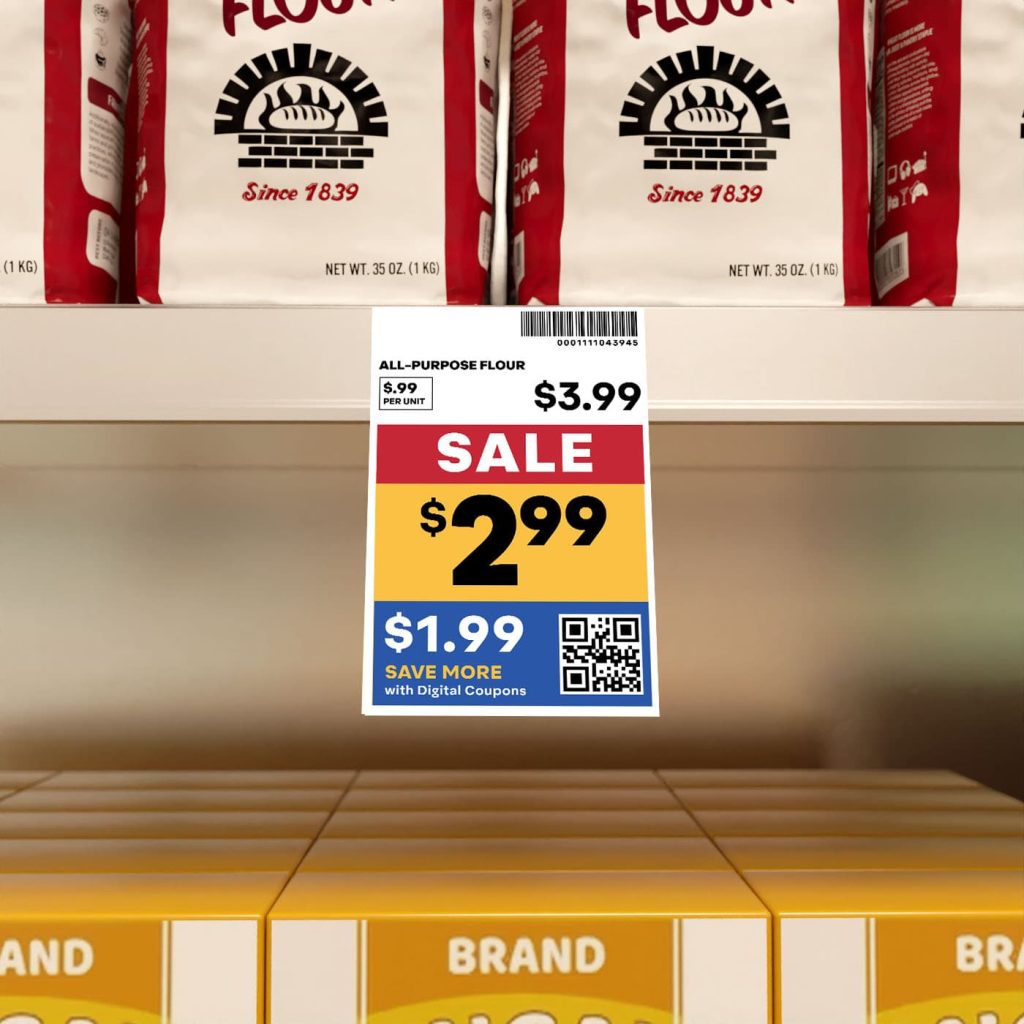
Look closely at Vestcom’s photograph of a bag of flour. Beneath it hangs a tag carrying a regular price, a sale price and a lower price with a digital coupon. There is a barcode at the top and a QR code at the bottom. This little rectangle has quite a workload. It must identify the product, explain the offer and give the shopper a reason to stop.
- Retailers use Vestcom to turn store data into labels, signs and digital displays.
- Brands buy shelf-edge messages beside the products shoppers are considering.
- The same business connects printing, software, installation workflows and campaign measurement.
That is where Vestcom lives: between the retailer’s records and the shopper’s hand. Founded in 1985, the business has spent decades making that connection usable. Its expertise spans data composition, physical production and merchandising execution. A correct price in a database is the beginning of the job. Someone still has to make it legible beneath the right bag of flour.
First, fix the walk
Consider the store employee changing promotional labels. The task includes finding the right shelf, matching the item and attaching the new message. Multiply those actions across aisles and stores, and preparation becomes a serious operating question. Vestcom’s stackz labels arrive pre-cut and self-adhering, arranged on its speedBoard in the sequence an employee walks the store.
The clever detail is the order. Store-specific planogram data - the map of where products belong - helps organize the work before the shipment arrives. shelfStrips brings product, price and placement information to shelf resets. adSigns packages customized store signage. These products address a shared problem: headquarters can design a promotion faster than a busy store can put it into place.
- 01Store dataItem + price + layout
- 02ComposeMatch message to store
- 03DeliverPrint + labels + screens
One offer. Several formats. The details must agree.
Vestcom reports reductions of more than 50% in tag turnover time with stackz and more than 30% in shelf-set time with shelfStrips. Those are company performance claims, rather than promises for every shop. The operational lesson travels well: arrange information around the person doing the task. Even an ordinary label can remove several small decisions from a shift.
For a buyer, the sensible starting point is a modest operational audit. How many labels need replacing? How much time goes into sorting them? Does the actual shelf match the planogram? These questions make a labor-saving claim testable against the store’s own starting conditions.
The advertising space hiding in plain sight
Once a retailer has a reliable way to put information beside a product, another possibility appears. The price tag becomes media. Vestcom’s shelfAdz combines store-level pricing with brand and promotional content. A manufacturer can introduce a product, explain a benefit or connect an offer to a digital experience where the customer can immediately act on it.
The business serves two buyers. Retailers need accurate execution and productive store teams. Consumer packaged goods companies want attention that leads to purchases. Vestcom sells retail execution capabilities and media campaigns across those needs. Its public materials describe more than 70 retailer relationships and 800 CPG companies; those figures describe the wider business, not the reach of every individual campaign.
A correct price in a database is the beginning of the job.
THE EXECUTION PROBLEM
Measurement makes the pitch more interesting. In 2022, Vestcom expanded its collaboration with Kroger’s data science business, 84.51°, gaining direct access to Collaborative Cloud for sales attribution. The useful question is how much spending the campaign added. A customer buying something after seeing a tag does not, by itself, establish that the tag caused the purchase.
A July 2026 desserts case study reports average incremental return on ad spend of $3.35. It includes both tagged products and related, or halo, products. That scope matters. Readers should treat the number as a reported category result with a defined measurement boundary, rather than a forecast for their next campaign.
The distinction also changes campaign planning. A manufacturer should ask which stores carry the item, what the message adds and whether the product will be available when the sign appears. An attractive promotion cannot rescue an empty shelf. Execution and measurement belong in the brief alongside the creative.
The screen still needs a brain
Electronic labels introduce a new version of the same coordination problem. Vestcom launched storeLink in January 2024 to manage print and digital execution centrally. The platform can update electronic shelf labels, schedule screen content and handle printed materials. Its hardware-agnostic approach lets retailers choose display suppliers while coordinating the information those displays receive.
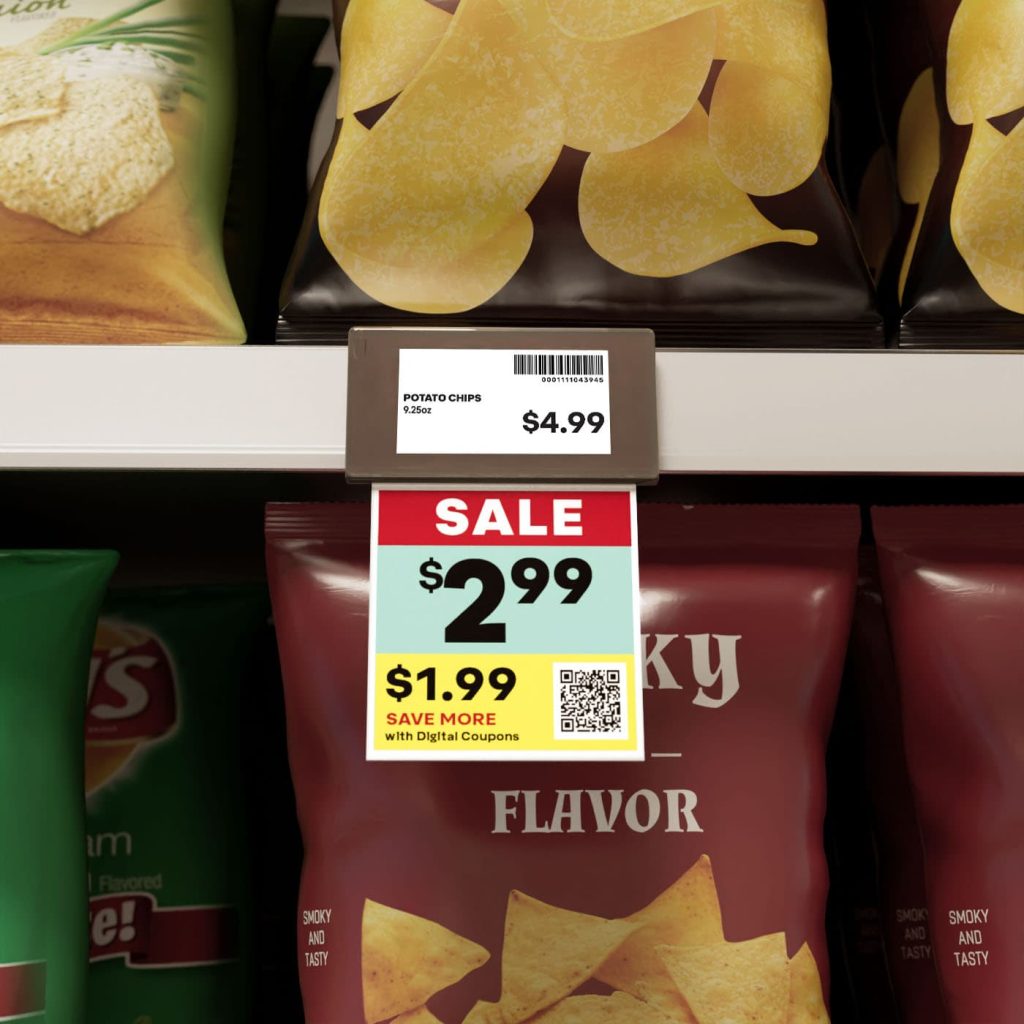
Currys supplies a concrete example. Its September 2025 announcement described electronic labels already available in more than 150 UK and Ireland stores. Solum supplied the label technology; Vestcom supplied data integration and software. Manual paper labelling had become a pain point during busy trading periods. The move was inspired by Elkjøp, Currys’ Nordic business, which already used the technology.
This explains the attraction of a mixed store. flexStackz adds a printed promotional tag beneath an electronic label, expanding the space for offers and brand information. Retailers can choose formats by purpose and location. The practical constraint remains accurate product and pricing data, plus a shelf layout that matches reality. Automation can distribute an error efficiently, too.
A billion-dollar bet on the connection
Avery Dennison announced its agreement to buy Vestcom for $1.45 billion in July 2021; the acquisition closed that August. Final purchase consideration was approximately $1.47 billion. At announcement, Vestcom’s annual revenue was roughly $400 million. These are historical deal figures. The buyer emphasized retail access and data management alongside labeling - a useful clue to what made the business valuable.
Retailers have alternatives. Last Yard also coordinates pricing and promotional publishing across print and electronic labels. A chain can manage printing internally or assemble separate suppliers. Vestcom’s proposition combines physical delivery, store data, software and brand media relationships. The comparison depends on which work a retailer needs somebody else to own.
The economics need the same discipline. A retailer comparing suppliers should count preparation, delivery, installation and ongoing data management, alongside materials or hardware. A brand should compare campaign spending with added sales. Neither calculation improves merely because the display happens to be digital.
In October 2026, Vestcom reported an OmniShopper award with Haleon for a Walgreens campaign combining posters, in-aisle Blades and shelfAdz. Different formats, one shopping trip. For anyone copying the approach, start by following a single offer from its data record to its shelf position. Check the installation work. Then test additional sales against a credible comparison. The small rectangle earns attention when the whole journey holds together.
Go to the shelf
Product photography: Vestcom.