Seven thousand people needed to order marketing materials. They did not all need the same things. They did not all have the same permissions. And, in a case described by Archway Marketing Services, their different ways of ordering had become a problem of their own. Forecasting was difficult. Inventory accumulated. The process was making the merchandise more expensive before anyone had even opened a box.
- Archway connects print, merchandise, fulfillment, and campaign software.
- Its sweet spot is the enterprise brand with many locations and many exceptions.
- The practical lesson: fix ordering rules before buying more inventory.
Seven thousand people ordering things
The client was a global food and beverage company. Archway had handled fulfillment for it since 2001. The intervention was remarkably specific: examine aging stock, simplify the online store’s categories, and assign business units so users could see and order what they actually required. A pre-order tool replaced a manual bottom-up build process.
Archway reports that inventory fell 5% during 2018, while storage fell 8% between January and August 2019. Those are different measures over different periods. Together, they suggest a useful possibility: some warehouse problems begin at the ordering screen.
This is the territory Archway occupies. A marketing department decides what it wants customers to see. Archway handles much of the machinery required to make that happen: procurement, production, storage, assembly, transport, and increasingly, the instructions and checks inside the store.
A store is a set of instructions
Consider a promotion across a restaurant chain. A kit is a collection of assumptions: how many windows the restaurant has, which displays it uses, what promotion applies, and which materials belong there. Multiply the assumptions by thousands of addresses and a printing job becomes a coordination problem.
For an unnamed quick-service restaurant client with more than 7,500 locations, Archway describes surplus print, inventory inaccuracies, and high kitting costs. Its response included individual store profiles, forecasting, freight management, and automated annual ordering. The company reports a 65.8% reduction in kit costs. That is a result from one engagement, rather than a savings promise for the next buyer.
Lower kit costs across a restaurant program serving 7,500+ locations.
Another case turns on knowing the destination. A consumer packaged goods client struggled with grocery freight deliveries: long waits, carrier restrictions, and carriers reluctant to serve grocery distribution centers. Archway collected delivery requirements, built routing guides in its transportation system, and selected carriers with relevant experience.
On-time performance rose from 80% in the fourth quarter of 2021 to over 95% a year later, according to Archway. The telling detail is the routing guide. A carrier’s suitability depended on where the shipment was going, not simply whether it could move a pallet.
The box has arrived. Has the campaign?
Archway’s Marketing Execution Platform, or MEP, brings this operational thinking into software. Store profiling sits alongside campaign management, budgeting, inventory, tracking, and analytics. The platform connects with vendors and business systems. Archway markets AI and machine-learning capabilities, but the buyer’s practical questions remain wonderfully concrete: which store needs which item, who approved it, and where is it?
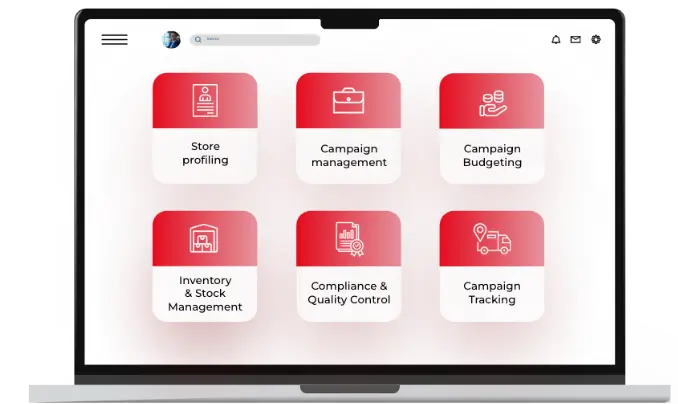
The In-Store App extends the process beyond delivery. Staff can record damaged materials, follow setup checklists, track shipments, and reorder missing items. Archway describes image-based AI checks for placement, appearance, and text, plus geofenced access intended to keep activity tied to the location.
A delivery receipt answers one question. A correctly installed display answers another.
That distinction explains the company’s position between marketing services and third-party logistics. A printer can make the sign. A carrier can deliver it. Archway offers to coordinate the steps around both, then help the store execute the plan.
The price is in the handoffs
Archway sells businesses an outsourced operation combining services and technology. Its procurement work covers print and branded merchandise; fulfillment adds inventory, kitting, and distribution. Its card business includes gift cards, loyalty cards, hotel keys, and other physical credentials. Omnichannel services extend into business-to-business and direct-to-consumer orders.
A sensible buyer compares the whole campaign bill: production, storage, assembly, freight, obsolete materials, and replacements. Cutting a shipping rate helps little if the wrong kit has to travel twice. The commercial attraction is coordinated responsibility across those costs. The alternative is managing a printer, a fulfillment provider, software, and the connections between them.
A logistics company with a marketing problem
Archway lists 1952 as its founding year. Its ownership has changed: Investcorp announced a roughly $300 million acquisition in 2012; current company materials place it within Growth Catalyst Group. CEO Manish Kapoor’s background includes Amazon and FedEx. In a public interview, he describes a consulting relationship with Archway that developed into bringing the businesses together.

The organization also depends on people doing physical work. Its careers materials describe a “People First” culture, development opportunities, employee recognition, and benefits. In April 2024, an alliance with Swiirl added another input: community- and school-created content prepared for local retail campaigns, with Archway providing print and distribution. In May 2026, GCG appointed Maia Benson its chief commercial officer.
Operational dependence has consequences. A December 2025 company notice disclosed unauthorized server access that September and inaccessible systems affecting operations. Archway said it secured systems, investigated, and offered affected people credit monitoring.
The lesson for a buyer is practical: examine data quality, integrations, and continuity alongside freight rates. Store profiles need upkeep; setup checks need participation. A small, simple network may need less machinery. For a sprawling one, Archway makes a persuasive case for treating the campaign as a sequence of tasks, each with an owner. The poster earns its keep when somebody puts it up.