A room can look clean and still leave a manager with a surprisingly difficult question: what happened here? Someone had to request the job, assign a person, find the supplies, and record the result. The floor offers few clues. The paperwork may offer too many. CleanMaint lives in that gap between doing the work and being able to reconstruct it.
- Built on eMaint’s maintenance management system for in-house cleaning teams.
- Connects cleaning schedules, crews, supplies, locations, and work history.
- Published Base pricing starts at $99 monthly for three users.
Its premise is appealingly practical. A cleaning operation has many of the same administrative needs as a maintenance department: recurring jobs, urgent requests, limited resources, and a history worth keeping. CleanMaint takes that existing machinery and applies it to custodial work. The result is cloud software for the people who clean facilities and the people responsible for knowing whether the cleaning happened.
01 / The borrowed engine
CleanMaint comes from the makers of eMaint, the computerized maintenance management system within Fluke’s software business. That ancestry matters more than a shiny feature list. Work orders, scheduling, inventory, and reports were already the underlying platform’s business. CleanMaint gives those capabilities a cleaning assignment.
The timing helps explain the choice. An August 2020 Accelix article described organizations trying to manage more detailed sanitization routines with paper and spreadsheets. In September, Fluke Reliability solutions engineer Michael Mills presented a CleanMaint webinar. The product addressed in-house crews facing more demanding cleaning schedules and supply requirements during the pandemic.
Then came a revealing explanation from Ankush Malhotra, writing as president of Fluke Reliability: “customer insights and feedback convinced us to develop and launch CleanMaint.” The lesson is modest but useful. An existing customer can reveal another job for a system you already know how to build.
The floor is clean. The useful question is what the record remembers.
The operating idea
02 / Put the job on the map
Consider a routine cleaning request. CleanMaint lets an organization configure request forms, fields, and workflow actions. Staff can submit a request and view its status. Schedules connect jobs to available resources. Cleaning procedures can accompany the work order, giving the person doing the job a reference at the point of work.
The more distinctive detail is geographic. Its Interactive Plans tool lets a user upload a floor plan, schematic, or site map, then place pins linked to locations, service requests, or inventory records. Clicking a live pin exposes the associated detail. A building becomes an interface. For someone responsible for multiple rooms or zones, that is a useful translation of a list into a place.
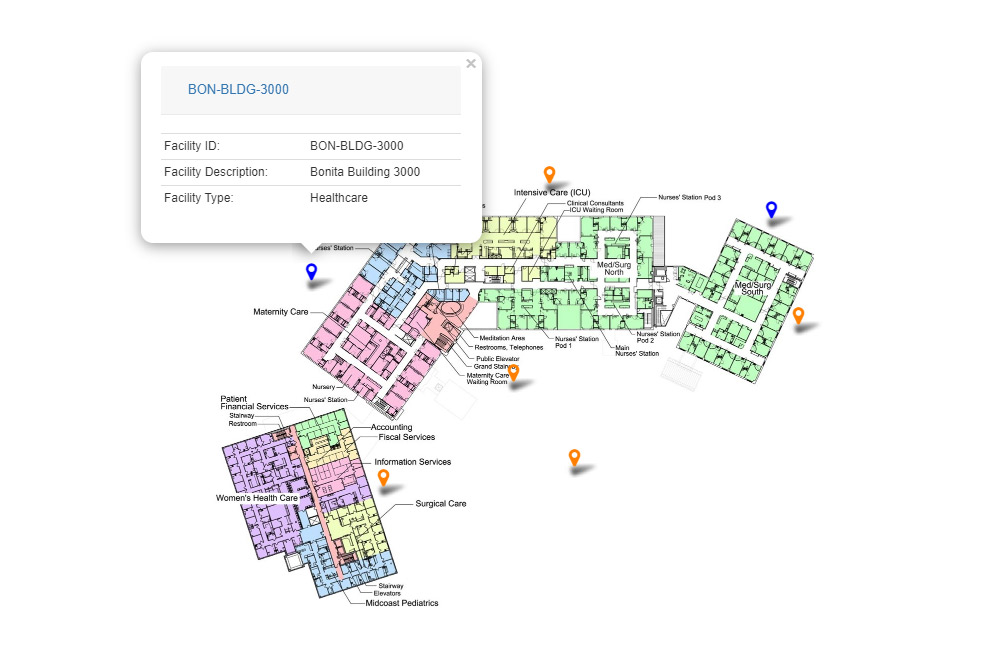
That emphasis suits internal operations. Schools and industrial facilities appear in the company’s materials. Healthcare trade coverage also identifies clinics and small- to medium-size hospitals with in-house cleaning staff as a fit. The buyer is organizing a crew’s work inside a facility, with all the handoffs that entails.
- 01Request
- 02Assign
- 03Complete
- 04Record
03 / The cupboard belongs in the system
A schedule quietly assumes the necessary materials will be there. CleanMaint makes supplies and personal protective equipment part of the same management problem. Its documented inventory capabilities include product manufacturer, concentration, lot code, and expiration date, along with alerts when stock runs low.
That changes the manager’s questions. Which area needs attention? Who is responsible? Which supplies does the procedure require? Are they available? The useful idea is to resolve those questions together, before a worker arrives with an assignment and an empty cupboard.
The Irisys relationship takes the idea further. CleanMaint’s website promotes SafeCount, which counts people entering and leaving washrooms and provides occupancy information on electronic signage. The site says SafeCount data can feed eMaint to trigger cleaning service orders. It suggests a practical connection between how a space is used and when work gets requested.
04 / Read the price in people
CleanMaint sells subscriptions by user. Its published plans list Base at $33 per user monthly with at least three users, Premium at $85 with at least three, and Enterprise at $120 with at least five. Multiply those numbers and the minimum monthly subscriptions become $99, $255, and $600.
Base covers the core scheduling, crew, service, and supply functions. The higher tiers list reporting, document storage, workflows, a customer portal, and an offline-capable mobile app. A buyer should test a complete working day against the chosen tier. A cheap login is less interesting than a crew that can finish its actual tasks.
The FAQ describes cancellation at contract renewal. Implementation also receives explicit attention: configuration assistance, an implementation team, training, and customer success support. Those services acknowledge an everyday truth about operational software. A browser login does not decide who owns an overdue request.
Browser access supports desktops, tablets, and phones, while the FAQ offers a limited-time trial by arrangement. That trial is a useful place to rehearse the awkward cases: an urgent request, a missing supply, or a job handed to the next shift. A manager can then judge the fit against the work people actually do. The demonstration becomes more revealing when the crew brings its own questions.
05 / Give the record an owner
CleanMaint’s immediate competition is familiar: the clipboard, the spreadsheet, and the telephone call. Beyond them sit general maintenance platforms and specialist cleaning systems. Its particular position is the application of maintenance management tools to custodial work, with scheduling and supplies attached to the work history.
The approach depends on behavior. If staff do not update jobs, the dashboard loses its connection to the building. If procedures are unclear, putting them online preserves the confusion. A team with only a few simple recurring tasks may find the minimum subscriptions and setup effort difficult to justify. These are operating judgments, rather than measured results from a customer study.
The part a reader can copy is simple: follow one cleaning job from request to completion. Give its location, procedure, supplies, assignee, and record an explicit home. Then check where the handoff gets lost. That exercise makes CleanMaint’s proposition concrete: yesterday’s invisible work should leave something useful behind.