A first-aid cabinet makes a rather convincing promise. There it hangs, reassuringly white, ready for the day someone needs it. Yet the cabinet cannot tell you whether a dressing has expired, whether yesterday’s supplies were replaced, or who is supposed to check. Owning the box is easy. Keeping the promise requires somebody to come back.
- Monthly first-aid service, plus fire protection, AEDs, eyewash, PPE, and training.
- Published first-aid plans split the work: onsite service or customer restocking.
- Acquisitions add local technicians; a shared portal keeps the records together.
That recurring obligation is the business Thompson Safety has chosen. Founded in Houston in 2018 by a team led by Tommy Thompson, it serves the facility managers and environmental health and safety professionals responsible for keeping workplaces prepared. Its proposition lives in the space between buying equipment and remembering everything that equipment needs afterward.
01 / The invoice tells the story
The revealing detail appears in a customer testimonial. John Rivera of AmSpec Group praises reduced spending, then mentions something more mundane: the time he used to spend deciphering bills. He also likes having one representative handle AEDs, eyewash, and first aid. For someone managing a facility, that is a recognizable form of relief.
“no longer have to spend time parsing through every invoice!”
John Rivera · AmSpec Group
Company-published customer testimonial
Read that as a clue about what customers are buying. A bandage has a price. So does the manager’s attention, although it rarely appears beside the bandage on the invoice. Thompson’s service model bundles supplies with repeat visits and documentation. The appeal is a shorter list of loose ends.
02 / Twenty dollars, and a different job
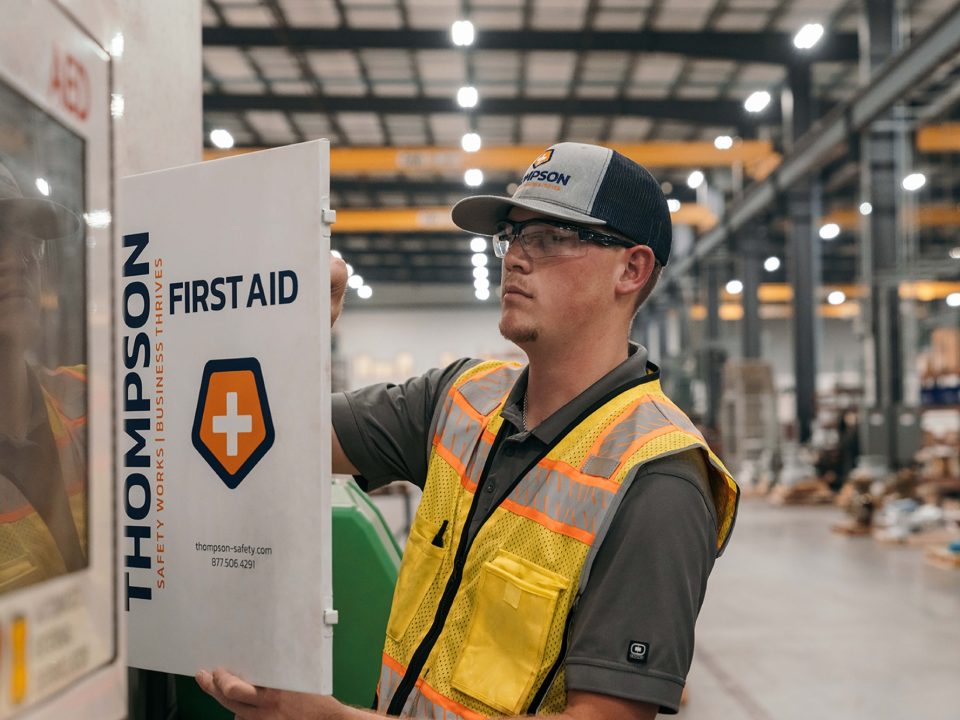
Thompson advertises its Safety Works onsite first-aid program at $129.99 a month. Its published process begins with assessing a workplace and choosing cabinet locations and contents. Monthly visits cover inspection, cleaning, and replenishment, with records supplied for tracking. The cabinet becomes part of an ongoing service relationship.
There is also a $109.99 monthly Click-to-Order program. Customers scan a QR code on the cabinet, select supplies, and receive a shipment. They handle the restocking themselves. Thompson positions this option for small offices and remote sites. The difference is a practical question about who performs the work.
Thompson visits and restocks
Supplies ship; your team restocks
Published prices checked October 2026. Confirm cabinet scope and service terms for your site. These are first-aid programs.
For a buyer, the useful comparison includes staff time, consumption, cabinet scope, and local coverage. Those first-aid prices do not establish the cost of a building’s fire protection program. A sprinkler system and a box of dressings create different service requirements. The sensible next step is a quote tied to the actual facility.
03 / The building has more than one problem
Thompson’s wider offering follows the safety manager around the building. There are extinguishers and emergency lights, alarms and sprinklers, kitchen suppression systems and backflow assemblies. On the first-aid side sit eyewash stations, protective equipment, and AED programs. Training covers subjects including CPR, AED use, and fire extinguishers.
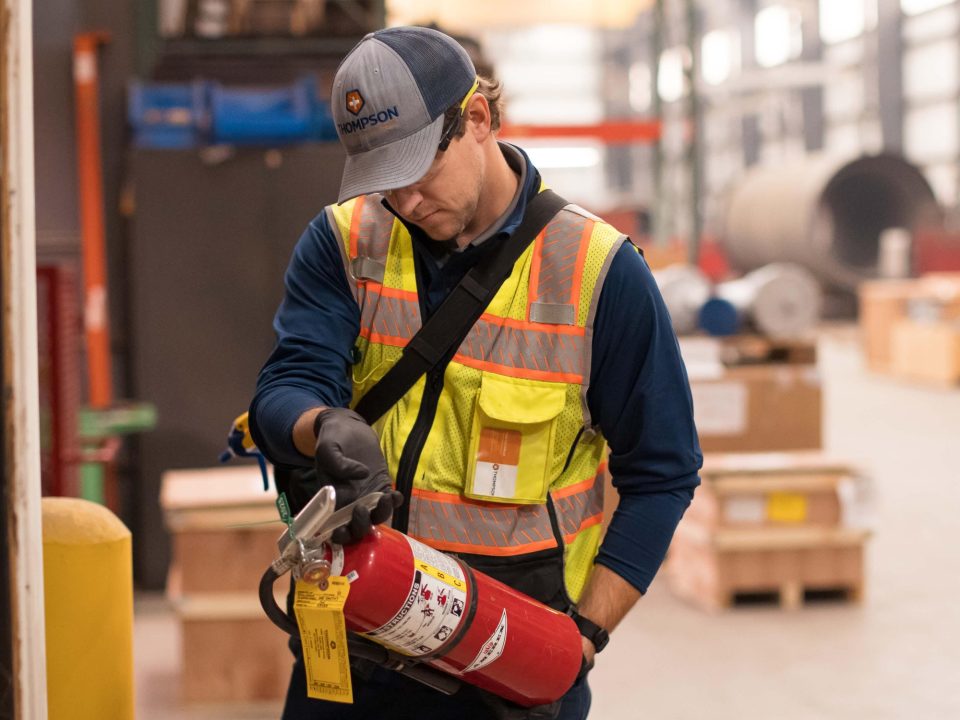
An AED illustrates why the relationship continues after delivery. Thompson’s published program includes checking functionality, pads, and batteries, maintaining records, and offering staff training. Through a partnership announced with Examinetics in February 2023, customers can also access occupational health testing, including hearing tests and respirator fit testing.
This places Thompson among national safety-service providers, specialist fire contractors, and local inspection businesses. Its competitive pitch emphasizes breadth, transparent programs, and a continuing contact. The distinction matters most to buyers juggling several categories of equipment. It still has to be earned through the quality of each local visit.
04 / A map for the things that need fixing
Then comes the paperwork. Thompson Customer Portal, powered by Uptick, provides maintenance scheduling, asset records, automated reports, and a deficiency registry. Interactive floor plans show equipment and test results. Technicians capture information onsite so it can be reviewed and used for quotations.
- 01Capture
the condition - 02Locate
the deficiency - 03Review
the next action
Illustration of the portal’s published workflow.
The useful idea is that finding a defect and dealing with it belong in the same chain of work. A map helps a manager locate a problem; an accessible record helps the next person understand it. The software supports a physical service business whose promises must eventually be fulfilled inside real buildings.
05 / Buy the team, widen the route
In April 2023, Berkshire Partners made a growth investment in Thompson. The announcement identified new markets, acquisitions, technology, and central support as priorities. Financial terms were undisclosed. It also described plans to move further into complex fire services, including suppression, sprinklers, and alarms.
The subsequent deals make that ambition concrete. Kartman Fire brought a Philadelphia operation with roots going back to 1983 in September 2025. Metropolitan Fire Protection followed in January 2026, adding sprinkler and standpipe expertise in Pennsylvania. In February, Fulshear Fire Protection added experienced technicians and service capacity in Greater Houston.

Thompson’s pitch to owners includes shared help with finance, human resources, marketing, and technology. Its careers material stresses employee judgment and quick communication. The operating challenge is clear: centralize the administrative work while preserving the local knowledge that makes a technician useful to a customer.
06 / The part another business can copy
There is a transferable lesson here. List every task your customer inherits after buying your product. Decide which ones you can perform reliably, price clearly, and document. Thompson’s cabinet service makes that exercise unusually tangible: someone must assess, replenish, record, and return.
The arrangement depends on fit. A remote office using Click-to-Order still needs someone to put supplies away. A complex facility needs the appropriate technical coverage and a scope that reflects its equipment. The buyer’s test is wonderfully ordinary: who will show up, what will they do, and how will I know it happened?