A car can be washed, polished, photographed, and still spend days waiting to become something a dealership can sell. The strange part is that everyone involved may have finished their assignment. Service has done its work. Detail has done its work. Somewhere between departments, however, the car has acquired a new identity: somebody else’s problem.
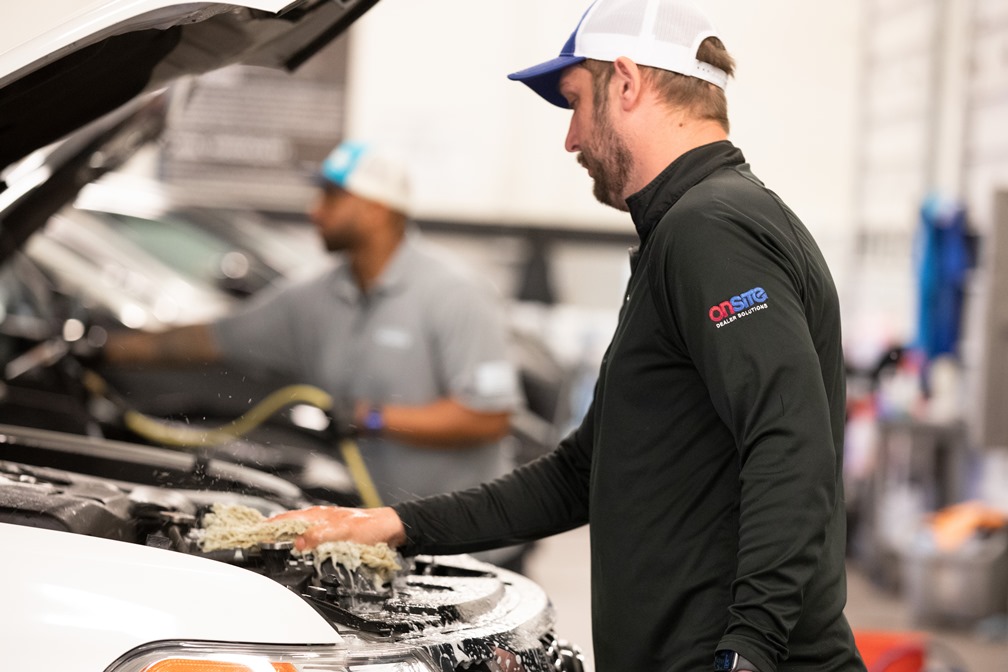
- OnSite puts its own employees inside dealerships to handle detail, make-ready, and support work.
- Its SERV software connects inventory, vendors, work orders, and billing.
- Its useful proposition: manage the journey between jobs, alongside the jobs themselves.
This is the territory occupied by OnSite Dealer Solutions. The company sells dealerships an organized route from incoming inventory to sale-ready vehicles. Its tools include wash attendants, department managers, reconditioning specialists, and software. That combination makes sense once you stop looking at a dealership as a showroom and start looking at it as a series of handoffs.
01 Seven days hiding in plain sight
Consider Corwin Automotive. In an April 2024 interview published by ODS, corporate fixed-operations director Trent Hauschild described a relationship covering seven Corwin dealerships. The work included detailing, reconditioning, vehicle delivery, photography, and, at some stores, window tinting. Corwin also used part of OnSite’s SERV software.
Hauschild reported that average recon time had fallen from seven to ten days to three to five. He also described relief from recruiting and training for those roles. These are a customer’s reported results in a supplier-published interview, rather than a controlled experiment. Still, the pairing is revealing: faster cars and fewer staffing distractions appeared in the same account.
OnSite’s model moves responsibility beyond filling a vacancy. Its employees work at the dealership, supported by local management, training, and company oversight. The buyer is purchasing someone to manage the operation as well as people to perform it. For a service manager whose morning disappears into schedules and call-offs, that distinction has practical value.
02 The software came through the bay
Heath Mayor’s earlier ventures began in 2008. A relationship with a family-owned automotive group in Peoria, Illinois, helped shape the operating model. ODS formally started in 2011, initially serving Oklahoma, Kansas, and Missouri. Its history describes an expansion from detail and make-ready into broader labor services, reconditioning, and technology.
SERV is the software expression of that experience. It connects vehicle inventory with digital work orders, vendors, approvals, invoices, and reporting. VIN scanning ties activity to a particular car. Integration with dealership management systems helps departments share information without repeatedly entering it. Mobile and desktop access bring the workflow to different people doing different parts of the job.
“We become an extension of the dealership team.”OnSite Dealer Solutions
The distinction from buying a standalone workflow tool is straightforward: OnSite can also supply the crew whose work appears on the screen. Yet SERV is offered for dealerships using in-house recon teams or multiple vendors, too. Its usefulness does not depend entirely on handing over the detail department.
- 01 Vehicle arrives
- 02 Work is assigned
- 03 Recon + detail
- 04 Photos + listing
The physical service menu reaches beyond cleaning: paintless dent repair, wheel restoration, tint, ceramic coating, and paint protection film. For a dealership, combining those tasks can mean fewer separate vendor relationships to coordinate. OnSite occupies the space where a staffing decision, an appearance repair, and an inventory decision overlap.
03 Count the towels, too
The financial argument starts with a deceptively simple question: what does the department actually cost? OnSite’s free labor analysis and Fact$heet compare current operations with an outsourced proposal. Inputs include labor, supplies, turnaround times, efficiency, and monthly sales volume. Benefits, overtime, and turnover belong in the comparison alongside hourly wages.
A company-published Reno case offers one concrete arrangement. ODS described a negotiated per-vehicle charge that included chemicals, supplies, towels, and rag service. It also described production-based pay and changing how tinting and photography were supplied. The initial problem, in OnSite’s account, was staffing that did not match throughput, accompanied by expensive supplies and slow recon.
For a dealer evaluating the model, the copyable move is the accounting exercise. Trace one vehicle through the department. Count supplies and management time. Then compare the proposed bill with the full existing cost. A low hourly wage says surprisingly little about the cost of a finished, correctly prepared car.
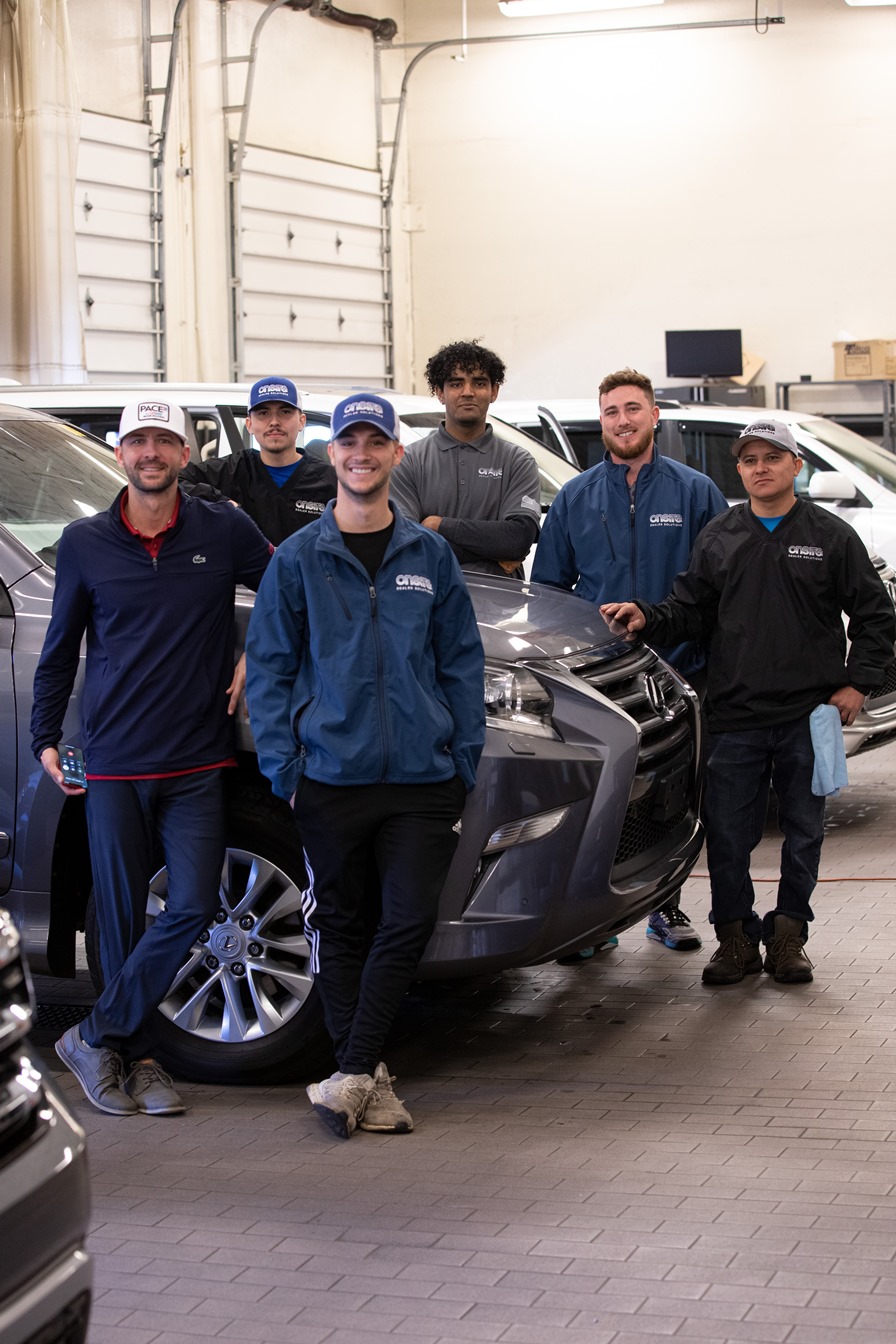
Training supplies some of that operating consistency. In a July 2026 profile, Texas State Trainer Christian Bautista described a progression from detail technician through assistant and site management. ODS credited him with training more than 100 employees. The expertise moves through the organization with someone who has performed the work.
04 A helicopter enters the story
In April 2025, OnSite announced its acquisition of Automotive Detailing Solutions. Founder Mike Spal wanted to pursue helicopter flight training. ODS gained a 26-person team serving predominantly luxury-brand dealerships. The announcement also described bringing SERV to clients previously managed through spreadsheets, manual tracking, and sometimes inconsistent billing.
The transaction illustrates OnSite’s appeal to another operator: a home for employees and customer relationships, with management systems attached. The business has since joined the wider Paceline Companies group. Rotunda Capital lists Paceline as a 2025 investment, and Paceline lists ODS alongside other automotive service brands.
05 The last queue is online
In April 2026, OnSite detailed its photography partnership with VUMO. The combination adds capture guidance, image consistency, and analytics identifying vehicles missing photos. ODS presents a target of 24 hours from completed recon to online listing. That starting point matters: the photography clock begins after recon finishes.
The model depends on conditions as ordinary as its subject: enough local staffing, dependable managers, and departments willing to use a shared process. OnSite itself says expansion requires judging whether it can staff a location effectively. Software can reveal a delay; somebody must still resolve it. For anyone managing inventory, that is the useful lesson here: follow the item all the way through, including the pauses nobody owns.