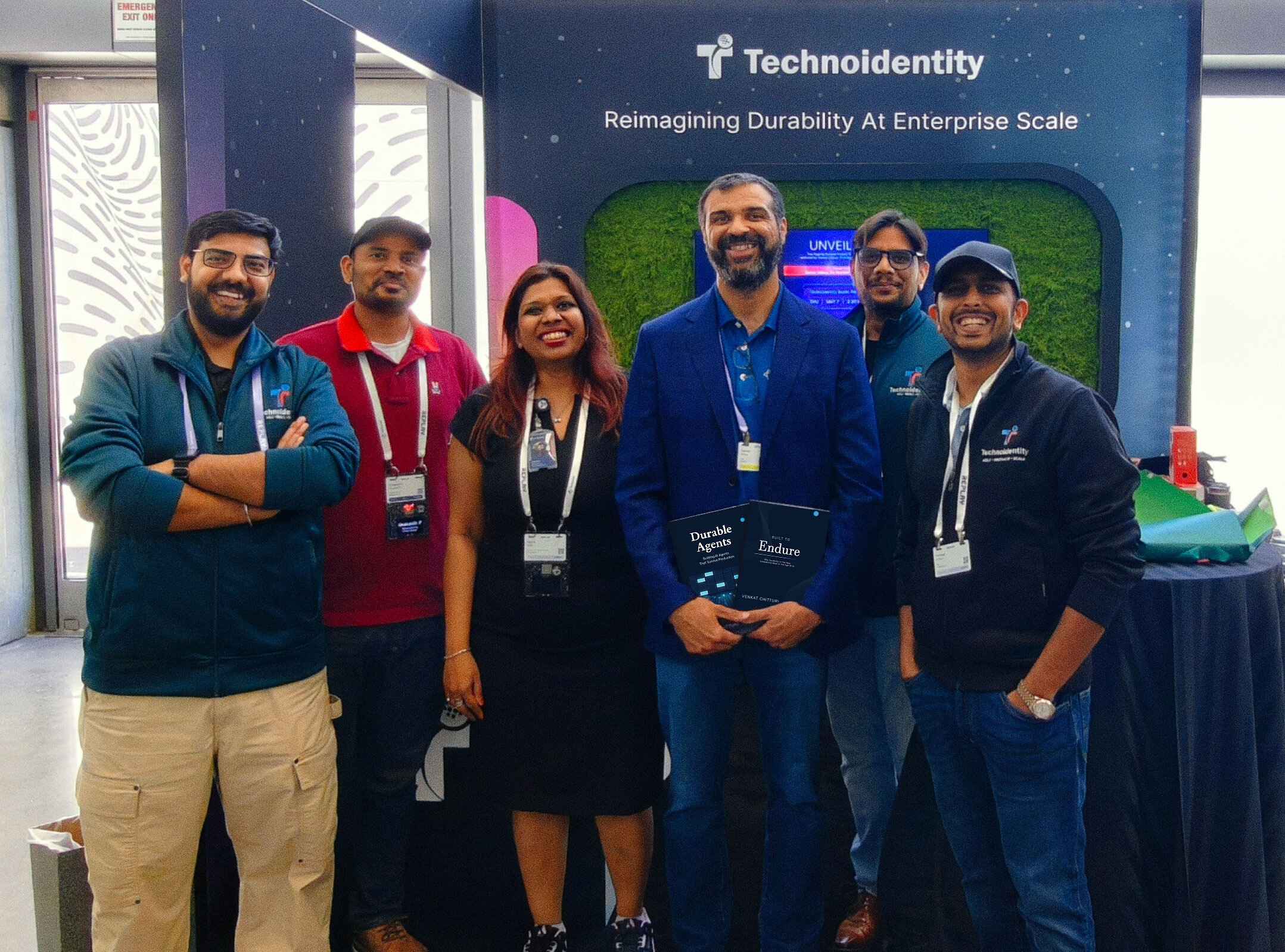
A book launch is a handsome place to make a case against judging things by their launch. At Replay 2026, Venkat Chitturi introduced Built to Endure and Durable Agents, with Temporal Technologies CEO Samar Abbas joining the occasion. There were books to hold and a photograph to take. The subject of both books, however, begins when everyone puts the camera away.
Chitturi is the founder and CEO of Technoidentity, based in Houston. His professional concern is the software on which organizations depend: the workflows that must finish, the transactions that must be accounted for, the automated decisions somebody may later need to explain. He has made durability the organizing idea of his company’s engineering work. It is a sober word, although its appeal is quite human. People would rather build something useful than spend tomorrow apologizing for yesterday’s release.
A developer’s route to the corner office
His route into that argument began in Hyderabad, where he worked as a software developer and gained experience with Microsoft’s partner platform team. He has described that period as a stimulus to founding his own business. Technoidentity was established in 2011. The enterprise he leads today works across software engineering, data and AI, and digital twins, with operations connecting India and the United States.
That background gives his current writing a particular vantage point. He approaches a company through the machinery it relies on. The interesting part of a business can be the process that moves work between departments, preserves a record, or allows another person to finish a task. None of these duties acquires glamour merely by becoming digital. Each becomes rather conspicuous when it stops being done.
The progression from developer to founder has also left learning on his professional agenda. He describes himself as committed to continuing education and growth. Leadership, in that account, includes keeping the organization capable of learning as its tools change. It is a useful ambition for anyone employing engineers: expertise has a habit of acquiring an expiry date while its owner is still feeling pleased with it.
The bill nobody names
One of Chitturi’s recurring subjects is the expense of software that stays upright with assistance. He calls this the fragility tax. In his examples, an engineer checks a system because experience has taught them to be suspicious; colleagues reconcile information by hand; additional people absorb the work that unreliable integrations create. These are illustrations of an operating burden, rather than accounts of a single named customer.
The phrase puts an ordinary office frustration into financial language. A recurring meeting consumes salaries. Manual verification consumes attention. A release that makes every subsequent release more difficult leaves an obligation behind. Chitturi’s argument asks an organization to count that obligation even when the incident report looks reassuring. The software may be available while its keepers are permanently occupied.
He gives the more desirable condition another name: operational trust. In his usage, it describes confidence that a system can operate correctly without constant supervision and can recover when conditions change. It shifts attention from the reassuring report about yesterday to the design decisions that will matter tomorrow. A quiet service earns its quietness through engineering; silence alone supplies very little evidence.
“Intelligence is becoming abundant.”
Venkat Chitturi, on the release of his two books
There is an appealing restraint in choosing this subject. A successful repair makes its engineer visible. A system that needs no routine rescue leaves fewer occasions for applause. Chitturi’s concern makes room for work whose success is the freedom it gives other people. An employee who can turn to a new problem has received something more valuable than another alert.
An agent needs somewhere to stand
His two books put that concern into complementary forms. Built to Endure examines mission-critical systems through failure, change, and scale. Durable Agents brings the argument to AI systems operating in production. Both were published by BlueRose Publishers in 2026. Together they place a familiar engineering responsibility beside a newly fashionable kind of software.
The second book separates intelligence, execution, and decision into an architectural frame. In plain language, producing an answer is only part of the job. The work around the answer must be coordinated. Interrupted tasks need a way forward. Actions need records that can be examined afterward. Chitturi’s interest lies in giving an agent the surrounding arrangements that make its behavior operable.
An editorial guide to the book’s intelligence, execution, and decision architecture.
He has extended the same concern in his writing about intelligence debt: decisions that cannot be explained, interrupted workflows that cannot recover cleanly, and models so entangled with their surroundings that replacing them becomes a reconstruction project. These are his categories for discussing obligations that accumulate during deployment. They move the conversation toward the consequences of owning an automated process.
That is where his engineering background meets his executive role. Someone choosing a technology must also consider the organization that will operate it. Who can establish what happened? How will the process continue? What will changing a component disturb? The questions are practical enough to survive the disappearance of the fashionable vocabulary surrounding them.
A philosophy with a name attached
Chitturi has written explicitly about why he chose to trademark an engineering philosophy. Durable Product Engineering gives Technoidentity a named standard around which to describe its work. In a services market filled with similar descriptions of capability, he wants the company’s approach to be identifiable. The name has to carry a recognizable expectation.
His explanation connects that expectation with hiring and architectural reviews. He favors engineers who consider failure early, and systems whose records and recovery behavior are part of their design. It is a demanding position to put in public because a named standard invites a customer to ask whether the delivered work meets it. A philosophy becomes more interesting when someone can use it to question the invoice.
His essay on production extends the argument beyond branding. Software will face changing requirements, unexpected inputs, and failures among the services it depends on. He treats the ability to observe, recover, adapt, and operate with limited supervision as part of the engineering assignment. Deployment leaves that assignment open. The customer begins relying on the product precisely when the launch celebration might suggest the work is over.
Forty-eight hours to try something
The company’s internal HackTIvate event offers a concrete glimpse of how learning enters its working calendar. On November 22 and 23, 2025, teams at Technoidentity’s Hyderabad campus spent 48 hours prototyping around Temporal workflow orchestration. The participants came from different engineering disciplines. Their task was to turn ideas into running demonstrations.
Entries were evaluated on business value, creativity, execution, feasibility, and communication. The winning team used the name Workflow Wizards; the runners-up were Temporal Trailblazers. Engineers, happily, remain capable of naming a team with considerably more levity than they would name a production database.
For Chitturi, the event was a way for people to test ideas together and carry what they learned into customer work. That gives the short exercise a place inside the longer durability argument. A prototype allows a team to examine a possibility. Operating the eventual system asks for further discipline. The event creates an opportunity to begin that process with colleagues who bring different kinds of expertise.
- 2011Technoidentity established
- 2023B Corp certification in October
- 2026Two books on durable systems
A principle with paperwork
Chitturi’s ambitions for technology also include education and social justice. Those interests appear in his account of why he built the company and the kinds of academic, civic, and commercial collaborators he hopes to meet. They give his career a broader purpose than the successful completion of an engineering contract.
There is a company milestone to place beside that stated purpose. Technoidentity became a Certified B Corporation in October 2023. Its listed overall B Impact score is 88.9. The assessment covers categories including governance, workers, community, environment, and customers. The credential belongs to the business; it gives a concrete reference point within the founder’s account of responsibility.
His leadership language also connects inclusion with people being able to contribute and develop. Taken together, the certification, the internal learning event, and his engineering writing show the subjects he chooses to put on the organization’s agenda. They provide different ways of asking whether an intention has been given a working form.
What remains on Monday
Another of his terms, continuity of value, follows software beyond the delivery date. The question is how long a feature continues doing useful work without deteriorating into repeated intervention or replacement. It gives an executive a reason to return to earlier investments, rather than judge the engineering organization solely by the next thing it ships.
This is where the various parts of Chitturi’s argument meet. A workflow should recover. A decision should leave enough evidence to be understood. A useful feature should retain its usefulness. Teams should have opportunities to learn. The company should be willing to describe the standard against which its conduct and its engineering can be judged.
The books at Replay gave those ideas a cover and a date. Chitturi’s preferred examination takes longer. It happens on an ordinary working day, when customers expect the process to finish and colleagues would like to devote their attention to something new. A launch can be enjoyed in an afternoon. Software has the rather less sociable duty of turning up again on Monday.