Forty-plus technology leaders, one room, and an evening devoted to a problem that refuses to fit neatly into a product demonstration. At the East Bay CXO gathering on April 30, 2026, the subject was context: everything a business knows that its new AI system does not. Andy Singh, founder and CEO of Teqfocus, had helped bring the room together. For someone whose business involves connecting software, he spends a noticeable amount of time connecting people.
There is a pleasingly human complication in that choice. An executive can buy another platform. Getting colleagues to explain how work actually happens takes conversation. The exceptions, the handoffs, the customer who needs a different answer: those details rarely volunteer themselves during a sales presentation. Singh's recent work keeps returning to that gap. His career offers a way to understand why.
A business that needed its own passport
Teqfocus began in 2012. Singh's account of its early years starts with a small team serving smaller and midsize businesses in North America and India. By 2015, the leadership team was moving to North America, with offices established in London, Toronto, and New York. Cloud migration gave the company work across borders. Expansion also meant obtaining visas for six countries. The international founder's romance, it turns out, comes with a considerable stationery requirement.
Looking back in 2023, Singh described five to seven hectic early years and said the business had grown without external investors. He compared the company to a first child, while acknowledging two children at home. That comparison has an uncomfortable precision: customers, like children, do not necessarily schedule their demands during office hours. Hiring more people eventually brought greater balance. The personal story here includes the gradual work of allowing a company to depend on more than its founder.
His education connects engineering and management: a Bachelor of Engineering from Nagpur University and an MBA from Christ Institute of Management. His professional home is now Danville, California. Those are useful coordinates for a career spent between technical systems and commercial expectations. A customer rarely experiences that boundary as two separate departments. The software either helps the business do its work, or somebody has another awkward meeting to arrange.
Keeping a hand on the machinery
Singh's public credentials include Salesforce administrator certification, issued in April 2016, and Sales Cloud consultant certification, issued in January 2017. They add a practical detail to the founder title. During the years when Teqfocus was establishing an international presence, he was also acquiring formal qualifications in the platform around which much of its work developed. The sequence puts technical familiarity alongside sales and company building, rather than treating them as unrelated chapters.
In May 2022, Teqfocus announced a Salesforce reseller arrangement in India. Singh described the expansion in terms of helping smaller businesses grow. The offering joined license sales with consulting and implementation. That combination matters in understanding his business: buying access to software begins a relationship that still needs configuration, integration, and people who can use it. A license can arrive quickly. A working business process tends to ask more questions.
The emphasis has remained visible as the company has broadened its work. Teqfocus now brings data transformation, analytics, AI, applications, and support into its service offering. Its leadership includes people responsible for operations, revenue, people and strategy, and platform delivery. Singh's own message on the company site ends with three compact verbs: “We listen, adapt, and deliver.” The order puts listening ahead of the more easily photographed parts of the job.
“We listen, adapt, and deliver.”
Andy Singh · On Teqfocus's approach
The founder learns to share the room
At the end of 2024, Singh reflected on his team's participation in the Agentforce World Tour in Toronto. His examples were surprisingly specific: a lunch with Salesforce's financial services team and a dinner with customers and industry leaders. He used those occasions to discuss shared leadership, giving colleagues room to contribute and holding people accountable through their actions. The founder was describing progress through what other members of the team could do.
That is a revealing measure for a business that once required so much of his own time. A company can add offices while leaving every important decision attached to one person. Singh's stated preference is for leadership distributed through the organization. It asks the founder to accept a smaller share of the conversation. There is a practical elegance to that ambition: more people can build a relationship when only one of them needs to be Andy.
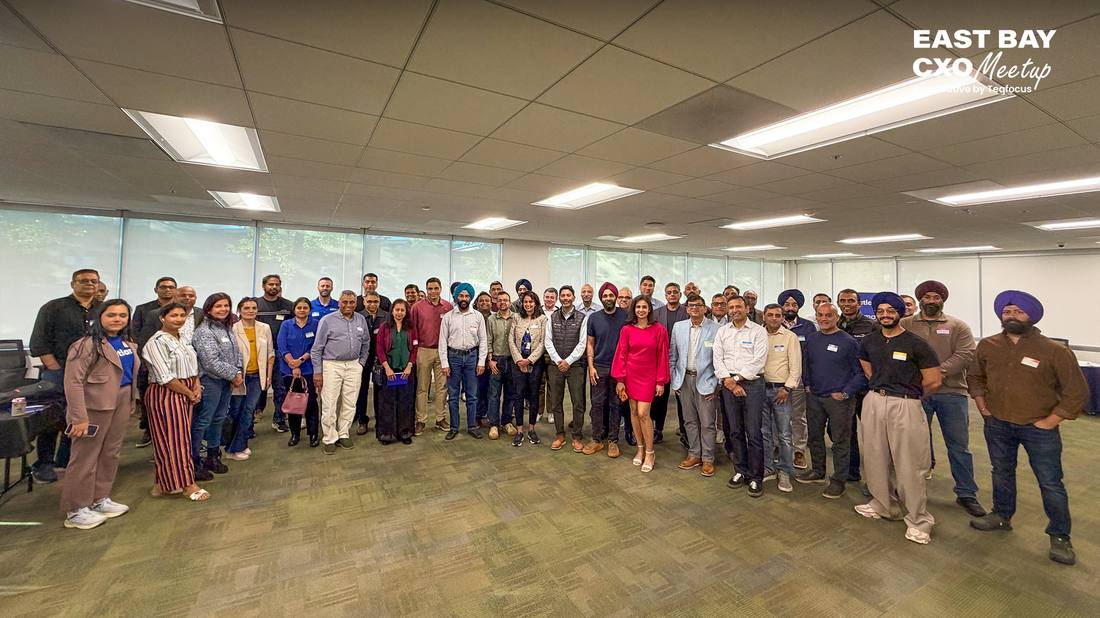
The gathering has become a recurring part of his professional life. East Bay CXO events bring senior technology leaders together for discussion and networking, with an emphasis on exchanging experience. An event listing places Singh in the moderator's chair for a conversation about Salesforce, Snowflake, and enterprise data. Moderating is a different kind of leadership exercise: the useful result is what other people manage to explain.
A tennis evening, a storage bet, a bigger stage
His approach to bringing people together has included an evening at Toronto's National Bank Open. Teqfocus and AWS invited customers to Sobeys Stadium for a keynote and discussion of data, generative AI, and analytics before the tennis. Singh was listed as a keynote speaker, alongside technology executives from Alexa Translations and interVal and an AWS solutions architect. The agenda allowed the conversation to continue over food and the match. Enterprise technology had, for once, acquired a decent spectator sport.
His interest in the machinery extends beyond consulting engagements. In a January 2024 post, Singh described Teqfocus's participation in QiStor's seed round and its collaboration with founder Andy Tomlin. QiStor's work concerned accelerated key-value storage technology for cloud applications. Singh presented the investment as a way to give customers earlier access to developments in data infrastructure. It is a concrete example of the investment interest mentioned in his professional biography: a bet on the systems underneath the applications.
A different public platform arrived at Dreamforce 2025. Singh announced a Salesforce+ Studio session with Phoenix M. about Workday, Teqfocus, and Tableau. The proposed discussion covered the connection of Tableau, Salesforce Data Cloud, and Slack, and the move from dashboards toward analytics that can inform action. Here again, the subject crossed organizational and software boundaries. The founder's job included explaining why those connections matter to the people expected to make decisions with them.
After the applause, the implementation
In 2025, Teqfocus announced Salesforce Summit partnership status. Singh used the occasion to emphasize execution. The announcement described work connecting Agentforce and Data Cloud with technologies including AWS, Snowflake, and Databricks. These names can turn a sentence into a crowded business-card holder. Their practical significance is simpler: a business keeps its information in several places, and an AI agent needs the right information before it can take a useful action.
The distinction gives Singh's current ambitions some continuity with the cloud migration years. Tools change; customers still need their systems to cooperate. A partnership designation marks a development in the business, while the daily work remains specific to an implementation. The announcement also included CTO Jas Kaur's emphasis on whether AI is working in practice. Singh's public position and his colleague's message meet at the same test: the customer must be able to use what gets built.
THE QUESTIONS BENEATH THE DEMO
- 01 / ContextWhat does the business know?
- 02 / ConnectionsWhich systems hold it?
- 03 / AuthorityWhat may an agent do?
- 04 / EvidenceCan people inspect the result?
An editorial reading of his stated priorities, not a performance measurement.
The knowledge that never made it into the manual
In January 2026, Singh published five predictions for CIOs. He described a move toward autonomous agents, greater commercial responsibility for technology leaders, more attention to business-specific context, better visibility across systems, and the challenge of leading teams that work with AI. These were his forecasts. They also reveal what he wanted to discuss next: the organizational consequences of software that can execute work, as well as provide information.
He wrote that he had spoken with more than 100 CIOs at East Bay gatherings during the previous year. The value of that detail is the listening it represents. A founder selling technical work needs to hear where the work becomes difficult. His predictions give human judgment a continuing place in the picture. As automation takes on more tasks, somebody still has to understand the business and accept responsibility for what it does.
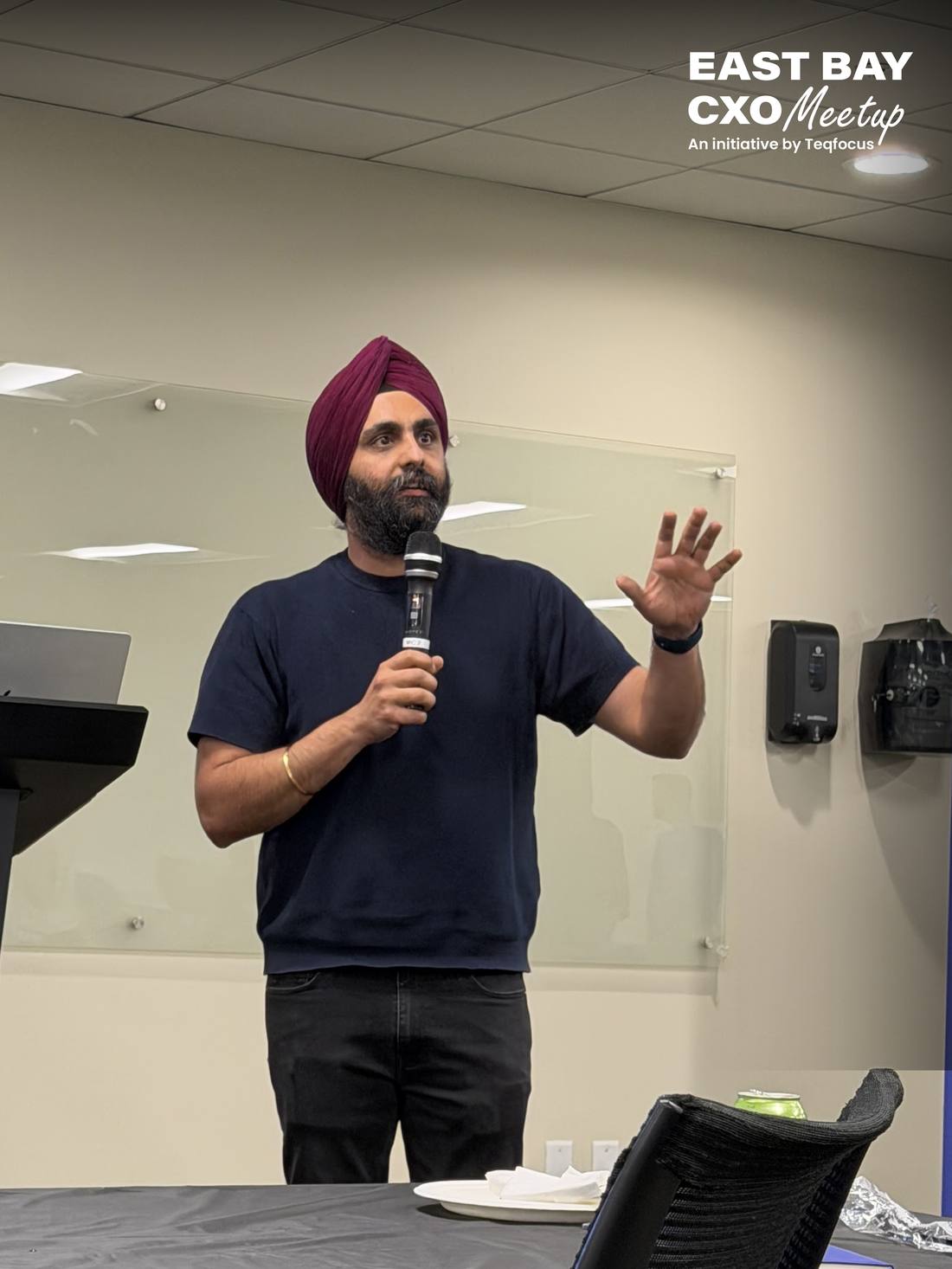
By the April gathering, that discussion had sharpened around institutional knowledge: the accumulated understanding of deals, customer behavior, and exceptions that an organization possesses. Singh argued that businesses need to make that knowledge available to the AI they deploy. The room's conversation joined that problem to trust and the ability to examine an agent's decisions. Better technology alone would leave some necessary work unfinished.
That brings the story back to the smaller room. Singh has built a company across borders, worked within large technology ecosystems, and put money behind data infrastructure. He also keeps assembling people who can explain the awkward particulars. There is a thread connecting those activities: staying close enough to the work to hear what the presentation left out. An enterprise may have an ambitious AI strategy. Someone still needs to ask the next question.