The offer was free. The obstacle was everything around it. In a diabetes-device campaign described by Sumeru, only 5% of eligible patients completed the process of redeeming a trial voucher. Somewhere between being offered a glucose-monitoring device and actually trying it, people disappeared. For a technology consultancy, this is an unusually revealing place to begin. The interesting question is what happens between the advertisement, the database, the message, and the person expected to act.
- Sumeru combines technology delivery, marketing, security, and staffing.
- Its Salesforce work reaches beyond installation into integration and ongoing operations.
- Its case studies reward attention to handoffs, ownership, and measurement.
01 / Free still has friction
Sumeru’s account describes an unnamed medical-device manufacturer with a patient journey that needed repair. The response connected web, email, SMS, and mobile touchpoints, supported by Salesforce tools, Power BI, and Adobe AEM. Measurement and data governance were part of the work. The team was assembling a way to see the journey and adjust it.
The company reports an 18% increase in customer acquisition, a 42% improvement in email deliverability, and a 25% increase in open rates within a few months. These are company-reported marketing results. They describe acquisition and communication, rather than clinical benefits. The distinction matters: getting a message delivered and getting a patient healthier are different jobs.
The useful lesson is to inspect the route to the offer. A persuasive promise can lose its force when each step requires the customer to begin again.
02 / The business between departments
Sumeru occupies a busy intersection. It sells consulting and software delivery, digital customer experience, cybersecurity, analytics, and talent services. A buyer might need a Salesforce implementation, a marketing workflow, a security assessment, or specialists to join an existing team. The breadth makes more sense when you consider how frequently those requests depend on one another.
Its Salesforce partnership dates to 2018. The company reports more than 250 engagements and describes work across sales, service, marketing, and other Salesforce products. Its offer includes custom development, data migration, third-party integration, and ongoing management. That last part is consequential. A CRM keeps changing as the business changes; somebody has to maintain the connection between the configuration and the work.
The commercial model follows those needs: consulting and implementation projects, continuing managed services, and staffing arrangements. Talent services include staff augmentation, recruitment process outsourcing, payroll, employer-of-record support, and scoped statements of work. Buyers can add people to their own operation or commission a defined outcome. Those choices put responsibility in different places, so the contract deserves as much attention as the presentation.
The interesting question is what happens between the advertisement, the database, the message, and the person expected to act.Our reading of the Sumeru approach
03 / Put the security check earlier
Onemoney, the Indian financial-data business, supplies a second view of Sumeru’s work. Here the challenge concerned sensitive information and secure development. Sumeru describes reviewing assets and priorities, assessing gaps, testing applications and networks, reviewing code, and helping developers adopt secure development practices.
That sequence gives the engagement a practical shape. Find the exposure. Prioritize it. Work with the people who write the software. Check earlier in development, when the same weakness can be prevented from returning. The company reports 20% savings in achieving compliance, 33% less effort to patch production vulnerabilities, and an 80% reduction in recurring vulnerabilities for this case.
Those figures belong to this engagement. The broader point is operational: a security report becomes more useful when developers can act on it and carry the lesson into the next release. Sumeru’s security portfolio also includes penetration testing, application security, compliance support, and monitoring of external exposure.
04 / AI gets a control room
The current website puts enterprise AI near the front of the shop. Orchestra AI packages that direction into four modules: Copilot for business workspaces, Console for development, Compute for isolated agent execution, and Cockpit for governance. The names are theatrical; the division of work is quite concrete.
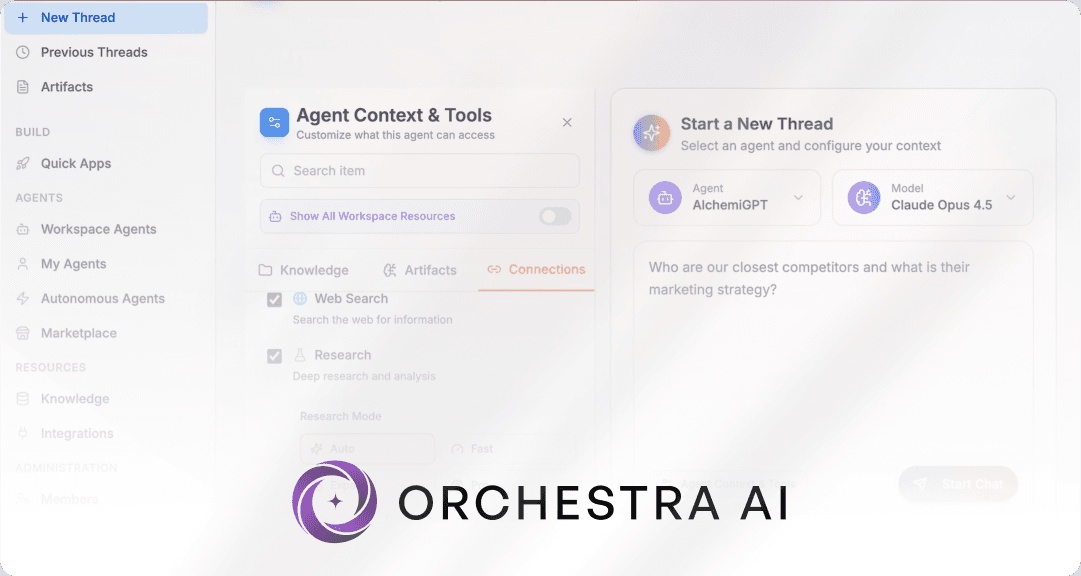
Sumeru markets controls for permissions, budgets, model access, audit trails, and runtime limits alongside tools for building agents. The proposition is that business adoption, engineering, and oversight should share an operating system. For buyers, the revealing demonstration would show who can authorize a tool, inspect an action, and stop a runaway task.
This is also where Sumeru’s older integration work meets its newer product ambitions. Enterprise AI has to interact with business applications and enterprise knowledge. A useful evaluation would test that interaction with the buyer’s own permissions and workflows, rather than judging the product from a polished conversation alone.
05 / A wider purpose, a narrower brief
Sumeru traces its beginnings to a group formed in Bangalore in 2002 and identifies Los Angeles as its headquarters. Its stated purpose extends to society: the company says profits after investment support programs of the Art of Living Foundation and the International Association of Human Values. It also identifies itself as a sponsor of the 2023 World Culture Festival.
For a prospective customer, the strongest reason to consider Sumeru is its ability to cover connected pieces of a business problem. Its market alternatives range from broad consultancies to specialist Salesforce partners, security firms, marketing agencies, and staffing providers. A single provider can reduce coordination work. A specialist may fit a tightly bounded requirement better. That is a scope decision.
A sensible brief would specify which systems are in scope, who supplies access, what the delivery team must hand over, and how the customer will accept the work. For managed services, it should also describe who owns changes after launch. For staffing, it should identify who directs the work day to day. Breadth becomes useful when those obligations become specific.
The copyable practice is simple enough to put on a whiteboard: draw every step from customer intent to completed action, name the owner of each handoff, and agree on the measure of completion. Then decide whether the missing ingredient is software, expertise, or coordination. The method depends on usable data, access to the relevant systems, and people willing to change the workflow. Start there. The free voucher can wait.
Sumeru website ↗ Company case studies ↗ Orchestra AI ↗ LinkedIn ↗ X ↗ Facebook ↗