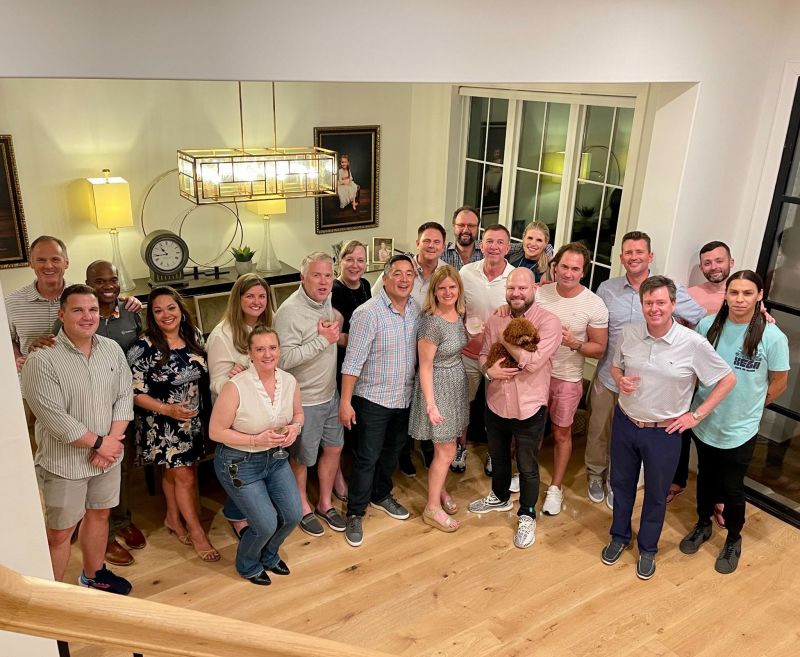
Richard Wolfe invited the sales, marketing and client experience teams to his home. In the photograph, colleagues bunch together beneath a rectangular light fitting, looking up toward the camera. Someone is holding a small dog. There is no lectern. The room is doing perfectly well without one.
Wolfe shared the gathering on LinkedIn in May 2022, describing an evening his family had hosted for conversation. It is a modest scene in a career that includes a $41 million financing round and the sale of the company he helped start. Yet it offers a useful place to begin. Across Wolfe’s working life, the recurring concern is what happens between people when an organization gets bigger, its systems get more complicated, and another handoff seems inevitable.
He co-founded Empyrean in 2006 and became chief executive in 2011, after serving as chief operating officer. His business is employee benefits administration, a field whose vocabulary can make even a short explanation sound like the minutes of a committee meeting. His underlying proposition is easier to grasp: build technology that accommodates an employer’s actual needs, and keep knowledgeable people close enough to make it work.
The education before the startup
Wolfe’s route into entrepreneurship ran through the machinery he would eventually try to improve. He studied at the University of Pittsburgh from 1990 to 1994, earning a bachelor’s degree in accounting, finance and economics. His subsequent work took him through Hewitt, Synhrgy HR Technologies and Mercer. These were jobs in implementation, operations, product development and the practical architecture of outsourced services.
At Hewitt, he worked as a senior implementation manager for large clients. At Synhrgy, he was a senior director responsible for business operations and product development. When Mercer acquired Synhrgy, Wolfe became a senior operations director and principal, working on solution architecture and service delivery for large outsourcing customers.
Consider the perspective those assignments provide. A sales presentation ends; an implementation begins. A system has to accommodate rules, exceptions and the habits of the organization paying for it. Someone has to understand why a seemingly awkward requirement exists. Wolfe’s early roles placed him inside that work. His later company would make the relationship between configuration and service central to its offer.
There is a particular kind of founder who discovers an industry by arriving from elsewhere. Wolfe belongs to the other tradition: the operator who spends time inside an established business, sees room for a different approach, and starts building an alternative.
A business built around remembering
The opportunity Wolfe identified was the gap between complex customer programs and systems that could adapt to them. By 2015, Empyrean’s approach included a service model called Hi-Touch Benefits Administration. Wolfe and his team had studied other service organizations, looking for the ingredients of dependable support. Their answer emphasized consistency and continuity, with dedicated specialists involved in planning, implementation and ongoing service.
That history matters because it makes the founding idea unusually concrete. A commitment to customer service can fit comfortably on almost any company’s wall. Arranging the work so people retain knowledge of an account requires choices about staffing, training and responsibility. The useful question is who stays after the launch.
Empyrean’s current answer is its Day One Team. The company describes a group assembled around each customer before the sale, remaining involved through implementation and ongoing support. Multiple people know the account, allowing continuity when a colleague is absent or changes roles. Institutional memory gets a place in the operating model.
- 01PlanLearn the employer’s requirements
- 02ImplementBuild with that knowledge
- 03StayCarry context into daily support
One relationship through three stages. A diagram of the company’s stated service model.
Anyone who has retold a problem to successive departments will recognize the appeal. The original explanation should have a longer shelf life than the call that contained it. In Wolfe’s business, remembering is part of the service being sold.
What $41 million was meant to buy
On March 12, 2013, Empyrean announced a $41 million capital raise led by FTV Capital, with participation from existing investors and management. It was a substantial financing milestone for the Houston business. Wolfe described plans to put additional resources into products, service and support operations, and sales expansion.
The allocation is revealing. Software and the organization supporting it were both in the picture. A configurable platform needs engineering; a service promise needs people who understand what has been configured. Growing those together presents a more involved management problem than adding another feature to a release list.
The financing also brought relationships. FTV’s Chris Winship and Christopher Tan joined the board. In a later account of the partnership, Wolfe credited the investor with help recruiting a chief revenue officer, guidance during an acquisition, follow-on financing, and work on banker selection and the eventual sale process. Capital arrived with introductions and transaction experience attached.
“They collaborated with us as we enhanced our team, including helping to recruit a new CRO.”
Richard Wolfe, reflecting on FTV Capital’s involvement
This is a less theatrical account of entrepreneurship than the solitary-founder version. The founder hires, borrows judgment, builds relationships and lets other people improve the organization. Wolfe’s own description gives those people room in the story.
The office that had to move
Houston supplied a much less orderly test in 2017. Hurricane Harvey made Empyrean’s existing building unusable after flooding affected essential infrastructure. The company had already been considering a headquarters move as it grew. The storm accelerated the timetable, with open enrollment adding pressure to the business calendar.
Facilities leader RJ Kosadnar worked on finding a new location in Westchase. The move involved lease negotiations, a redesign around furniture already in the new space, and collaboration among Wolfe, Kosadnar, creative director Anthony Shumate, technology executive Rick Miller and the architecture firm Inventure Design.
The surviving furniture is a pleasing detail. Corporate change is often narrated through grand intentions; here, the work included making sensible use of someone else’s desks. It also gives a more accurate picture of leadership in an operational business. The chief executive appears among a group of people solving a problem with leases, layouts, infrastructure and a deadline.
For a company selling dependable service, an unusable building is a rather direct examination of the premise. Continuity has to survive something more demanding than a diagram. The Westchase move belongs in Wolfe’s story because it put the organization’s practical coordination on display.
A sale, followed by more work
Recognition accumulated along the way. Wolfe was named an Employee Benefit Adviser IT Power Player in 2016 and an Employee Benefit News Technology Innovator in 2017. By 2019, he had been an EY Entrepreneur Of The Year finalist for five consecutive years. The distinction is finalist, a word worth preserving even when the trophy cabinet would prefer a shorter caption.
In November 2019, Securian Financial announced an agreement to acquire Empyrean. At that point, the business reported more than 400 employers, 3.6 million participants and over 600 employees. Those are figures from the transaction announcement, a snapshot of the company Wolfe had helped build by that stage.
Wolfe framed the deal around shared values and a culture focused on customer service. The agreement called for Empyrean to remain independently operated. The acquisition was completed in December 2019, and Wolfe continued as CEO. A change of ownership became another chapter in running the business.
The distinction gives the career its shape. He had moved from operations to the chief executive’s job, taken the company through outside investment and a sale, and remained responsible for what happened afterward. The service promise still needed delivering on the next working day.
The front door gets wider
In 2021, Empyrean appointed Kelly Clark as chief information and technology officer. Wolfe connected the hire to future customer needs and the tools used by the service organization. Clark’s responsibilities included software engineering, AI, infrastructure, analytics and research. The operational background remained visible in the way Wolfe explained a technology appointment.
Then, in February 2023, Empyrean acquired Enspire, the employee communication and engagement platform founded by Amanda Wiles. The combined offering, introduced as +YOU, put employer-branded communications and resources alongside administration. The problem had expanded from running a program to helping employees find their way into the resources an organization already provided.
“We bring it all together, all in one place.”
Richard Wolfe, announcing the Enspire acquisition, February 2023
The ambition was practical: fewer disconnected destinations, with an employer’s own identity carried through the experience. Wiles’s platform added a communications layer to the business Wolfe had spent years building. Here again, the growth involved another founder and another team.
By August 2026, Empyrean was describing Halo, an AI layer connecting guidance, service and administration. One detail fits the longer story especially well: when an interaction moves to a human representative, the relevant context is meant to travel with it. The technology has changed. The old irritation of explaining yourself again remains recognizable.
The photograph belongs here
Return to the gathering at Wolfe’s home. It would be excessive to ask a single photograph to prove a management philosophy. What it does show is a founder choosing to bring colleagues into his family’s space and publicly recognizing their connection with clients and one another.
His public posts also acknowledge employee recognition and the company’s volunteer program. These are small gestures beside financing and acquisitions, but scale is precisely why the small gestures deserve attention. Organizations can grow more elaborate while the relationships inside them become harder to see.
Wolfe’s career offers a consistent question for a business that combines software with human support: how much useful knowledge survives the journey from one stage to the next? From dedicated account teams to a digital conversation that carries its context forward, he has kept working in that territory. The photograph supplies a warmer version of the same concern. Put people together. Give them time to talk. Remember who was in the room.