At Greenacres Fire Rescue in Florida, the scheduling system had a peculiar limitation: you had to be there. Overtime information circulated through an Outlook calendar and a spreadsheet passed between shifts. Assistant Fire Chief Phillip Konz described the consequence plainly: “If you weren’t here, you were out of luck.” A staffing process had become a test of proximity.
- Vector sells training alongside software for staffing, inspections and safety.
- Its advantage lies in the details of regulated work: credentials, callbacks, equipment and records.
- The practical lesson: connect the next action to the information that should trigger it.
The department, with 61 firefighters in Vector’s account, reported spending roughly 40 administrative hours every two weeks on scheduling. A workforce increase of about 25% threatened to push that estimate to 60. It adopted the product now called Vector Scheduling in 2018, automating callbacks and shift trades. Konz reported fewer fairness disputes and easier mobile access. The first thing to fail had been the handoff between people.
A course is only the beginning
This is a useful way into Vector Solutions, a company usually filed under e-learning. That description captures the classroom and misses much of the building. Vector sells software and industry-specific courses to organizations where training intersects with regulated work: fire departments, schools, universities, manufacturers, engineering firms and government agencies.
A learning management system assigns courses and records completion. Vector’s broader portfolio reaches into who works the next shift, whether equipment has been inspected, and what happens after someone reports an injury. These are related questions for the buyer, even when different departments own the answers.
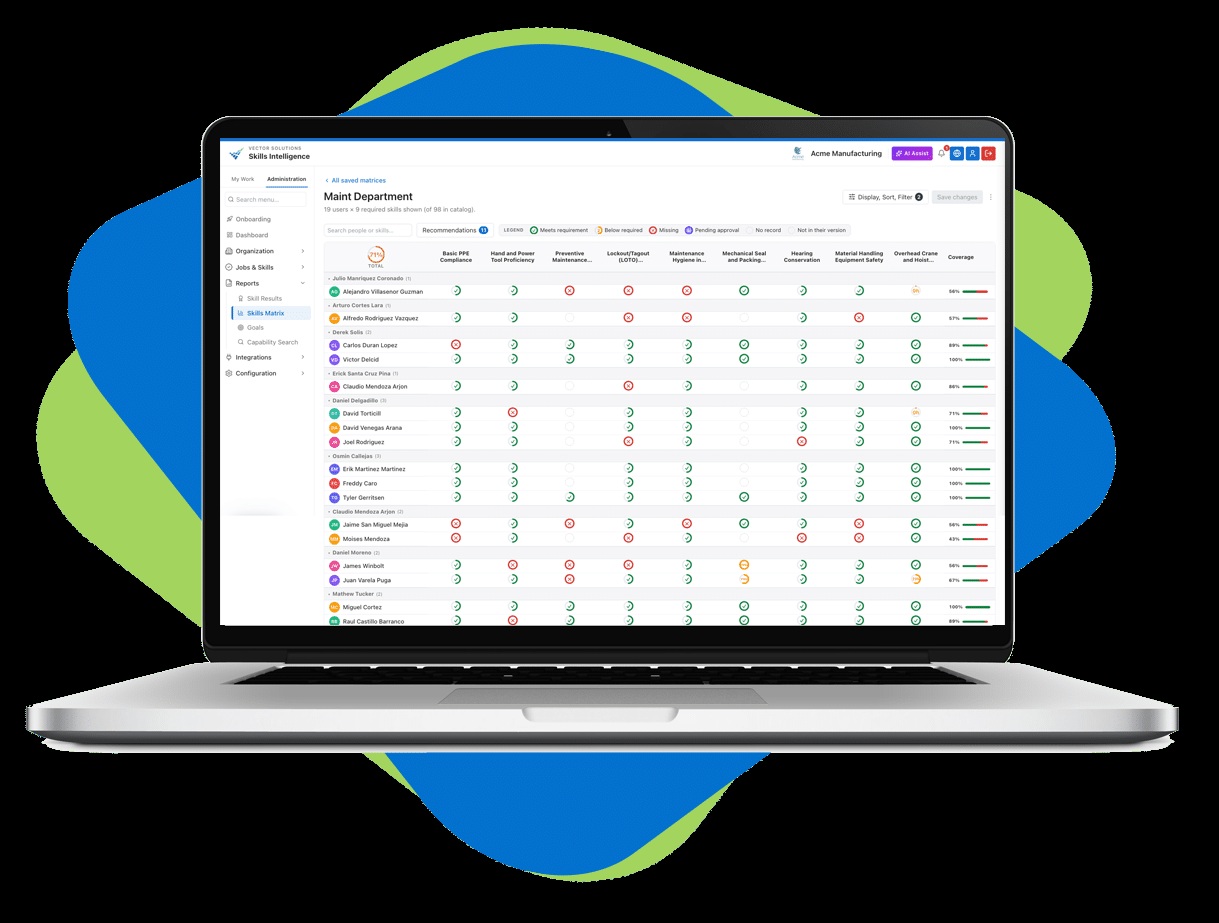
TargetSolutions handles fire and EMS training records. Vector Check It supports equipment inspections and controlled substance tracking. Acadis manages public safety training and certification workflows. In education, the range includes staff compliance, student prevention courses, professional development and work-based learning. The common customer is an institution that needs an answer it can document.
Two courses become a collection of specialties
The business began with RedVector in late 1999, offering continuing education for architects, engineers and contractors. Its first two courses arrived in early 2000. Acquisitions then widened the perimeter: TargetSolutions in 2013 brought fire and EMS; Scenario Learning in 2017 brought school and campus safety programs.
That history helps explain the product names. Vector is a portfolio built around specialized customers, with brands that already meant something in their markets. In 2025 it added Frontline Public Safety Solutions, expanding agency operational software, and ArdentSky, extending gaming licensing and compliance capabilities. A casino licensing desk and a fire station have different checklists. Both need defensible records.
Private equity supplied part of the ownership story. Golden Gate Capital announced its acquisition agreement in 2018. In July 2021, Genstar Capital and Insight Partners completed a majority investment, with Golden Gate remaining a significant shareholder. The transaction terms were undisclosed. The company now reports more than 24,000 clients worldwide.

The email that missed its destination
Woodgrain, the building-products manufacturer, illustrates a different failure. Its incident alerts relied on email. Distribution lists struggled to keep pace with changing roles, so notifications could be delayed or inconsistent. Temporary-worker hours were also tracked inaccurately, complicating safety-rate calculations. The organization had information; its route through the organization was unreliable.
In Vector’s customer account, Woodgrain moved toward standardized incident reporting, assigned corrective actions and clearer training records. That is the unglamorous attraction of this category. An incident report becomes more useful when it reaches an accountable person and leaves a trace of what happened afterward. Better paperwork can change the conditions for better decisions.
Vector formalized that connection with EHS Prevent in September 2026. The product links an incident investigation to corrective action, recommended courses and verified training completion. Its AI recommendations use incident details to suggest relevant learning. Safety teams can follow the record from the original event through the response.
- 01Record
the incident - 02Assign
the action - 03Deliver
the training - 04Verify
completion
The price of connecting the dots
Vector sells subscriptions and licensed content, with scope and user count shaping the quote. A public August 2024 proposal to the Independent Cities Risk Management Authority offers a concrete example: nine city members, 3,511 users, and an annual bulk subscription of $101,819. Annual maintenance added $3,915; one-time implementation added $10,200.
Bulk subscription rate for 3,511 users.
Maintenance and implementation were additional.
Those figures describe one proposed deployment. They are useful because they show the buying unit: an organization, its workforce and the work of getting a system running. A buyer should compare the full deployment with the administrative process it replaces, including the hours consumed by apparently inexpensive tools.
Vector faces alternatives. HSI also combines learning management, safety courses and EHS software. An institution can assemble separate systems, too. Vector’s distinction is the breadth of its industry-specific portfolio. The decision turns on whether those specialized workflows fit the buyer’s actual requirements.
Practice before the pressure arrives
The newer products confront another gap: a standard course may teach the principle while missing the local situation. Learning Studio, introduced for education in June 2026, lets administrators adapt training to institutional policies and audiences. AI-generated changes arrive as drafts requiring review and approval before publication.
In October, Vector announced Scenario Simulator. Learners answer in their own words, navigate changing situations and receive feedback grounded in expert-authored content. Initial applications include harassment prevention, hazard communication and student safety. Existing licensees of participating courses receive corresponding enhanced variants at no additional cost at announcement.
“Knowing the right answer and being prepared to act on it are two different things.”Rob Buelow / Vector’s October 2026 announcement
That distinction deserves to survive the sales pitch. A completion record cannot establish judgment under pressure. Software also needs usable incident data, maintained credentials and people who follow through. The lesson readers can copy is specific: find the handoff that fails, give the next action an owner, and make its completion visible. Greenacres’ spreadsheet offered a surprisingly good place to start.