A refrigerator is an unromantic place to put a philosophy. There are shelves to wipe, temperatures to check and labels that insist on an expiration date. Yet the branded refrigerator inside a grocery store is a useful place to begin the story of Urban Remedy. Here, a company founded around the conviction that food can improve people’s lives has to answer a less elevated question: will someone buy this bowl before it goes bad?
- Organic meals, refrigerated snacks and drinks, ready when lunch is.
- Grocery partners supply the shopping trip; Urban Remedy supplies the food.
- Freshness makes distance, forecasting and waste unusually consequential.
- The current range is plant-forward, with vegan options alongside chicken and collagen.
That little cold cabinet connects two worlds. One is the world of founder Neka Pasquale, a licensed acupuncturist whose approach to food grew out of traditional Chinese medicine and her Northern California surroundings. The other is the world of retail operations, where a lovely salad that nobody buys becomes a very small financial disaster. Urban Remedy’s story is interesting because both worlds have to fit through the same refrigerator door.
A practitioner discovers the limits of advice
Pasquale’s starting point was a private practice, not a supermarket buying office. In the company’s origin story, she describes more than a decade working with patients and leading wellness retreats before founding Urban Remedy in 2009. Food belonged to the way she thought about everyday health. A packaged-food business gave that philosophy something practical to inhabit.
There is an ordinary obstacle hidden inside a nutrition conversation: knowing what you would like to eat does not put it in your lunch bag. Someone still has to shop, chop, cook and clean. Urban Remedy sells the completion of that job. Its customer can choose a prepared bowl or chilled drink instead of assembling the ingredients and finding an hour that the calendar has already spent.
The phrase “Food is Healing” is the company’s organizing belief. It helps explain its ingredients and its educational voice. It should be read as a brand philosophy, rather than a clinical finding about a particular bottle. What shoppers can examine directly are the ingredients, certification, nutrition panel and convenience.
The shop that fits inside another shop
Urban Remedy dates its first store to San Rafael in 2011 and its Whole Foods Market relationship to one Berkeley store in 2016. By January 2018, trade reporting counted 13 standalone locations and 30 refrigerated kiosks. Stores were then the largest channel; kiosks were the fastest growing. A $17 million Series B led by General Mills’ venture arm, 301 INC, supported the next expansion.
Consider the difference between opening a shop and putting products in a shop that people already visit. A standalone location has to become a destination. Inside a grocery store, lunch can be discovered during an existing errand. The refrigerator has a wonderfully modest sales pitch: you are already here, and you will be hungry later.
Operational diagram, not a claim about profit margins.
In 2021, then-CEO Paul Coletta described a consignment arrangement: the retailer took a share of register sales while Urban Remedy stocked the refrigerator. It reduced the need for a staffed storefront and a long lease. The lesson is attractive, but conditional. Borrowed traffic is valuable only when the shoppers want the product, the retailer wants the relationship and replenishment arrives on time.
The clock gets a vote
The pandemic exposed the awkwardness of perishability. BevNET’s 2021 account describes customers shopping less often and stocking their pantries. Products with generally fewer than ten days of shelf life were a poor match. Sales fell. Direct online sales grew, but overnight chilled freight and customer acquisition made that channel less attractive than kiosks.
The response included eight co-manufacturing partners, packaging that extended some meals’ shelf life by 50%, and better demand planning. Those are historical figures, not a description of every product today. They show the nature of the repair: shorten the journey, gain usable time and improve the guess about what shoppers will buy.
“The simpler you keep it when you’re doing something complex, the better.”
Neka Pasquale, Beyond a Million interview
A separate 2021 FoodNavigator interview put the factory map in plain terms. Richmond and a Bronx facility could serve substantial parts of the coasts, but distance constrained access to other regions. Coletta also described investment in an enterprise planning system and plans for warmer, more substantial dinner bowls. The company was adjusting both how food travelled and which meal occasion it served.
The $18 million Series D announced in July 2021, led by Manna Tree with Builders Fund and Obvious Ventures, supplied capital for expansion. It was financing, not an itemized price for fixing the business. The useful distinction is between money raised and money made: a larger footprint can create opportunity while demanding more working capital and more operational discipline.
Lunch, with the label doing some work
For a shopper, the operation becomes visible as choices: salads, quinoa bowls, juices, wellness shots, shakes and refrigerated snacks. The Macro Bowl and Vegan Caesar offer familiar meal formats built around plants. In September 2026 the company reported 17 grams of protein and 11 grams of fiber for the Macro Bowl. Seed cheese and chickpea croutons give the Caesar another route to texture and substance.
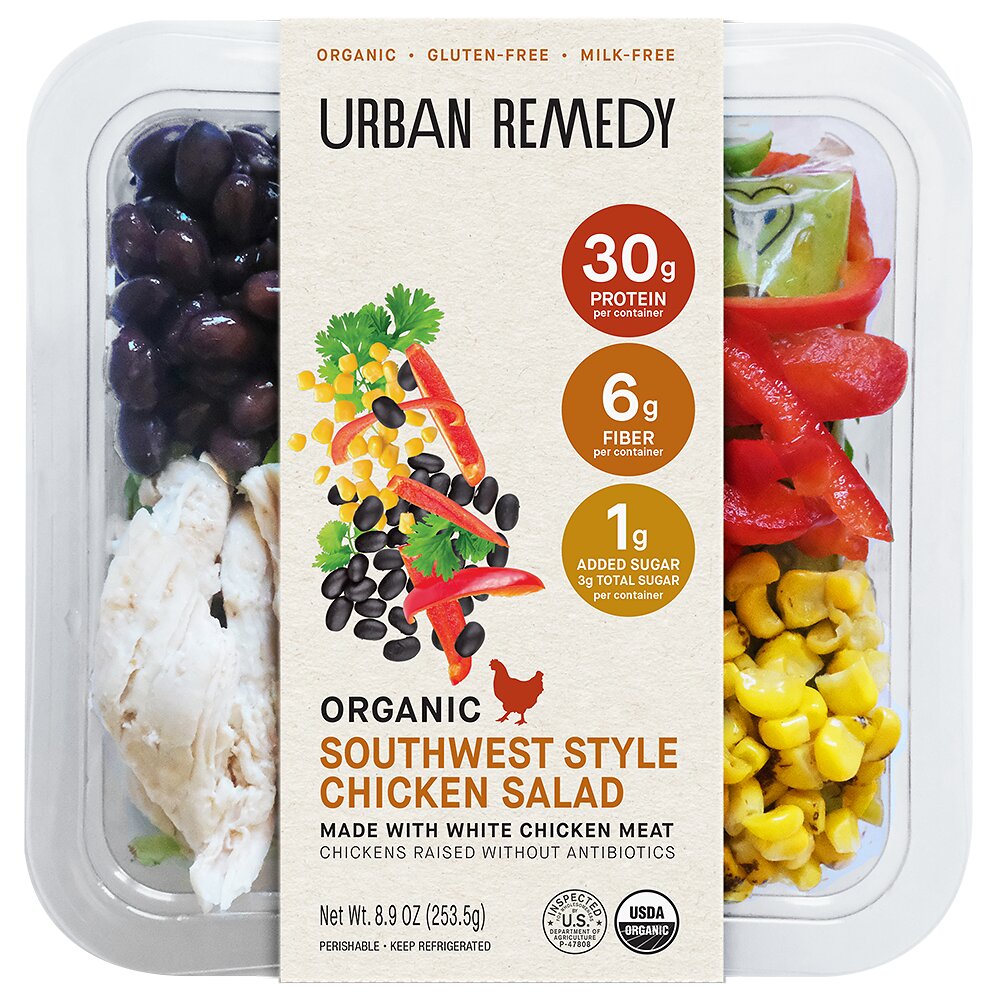
The chicken is worth noticing. Older descriptions cast Urban Remedy as wholly plant-based. Its present range includes chicken salads and bovine-collagen shakes. Dairy-free does not mean vegan. The September 2026 shake announcement lists 28 to 30 grams of protein per bottle, depending on flavor, and explicitly identifies the collagen’s animal origin.
Urban Remedy competes for several decisions at once: the quick lunch otherwise bought from a prepared-food counter, the drink otherwise selected from a juice case, and the breakfast otherwise improvised on the way to work. Its distinction is the combination of ingredient standards, recognizable meals and grocery convenience. Whether that earns the purchase depends on taste, price and the alternative sitting on the next shelf.
A national footprint, a narrower shipping promise
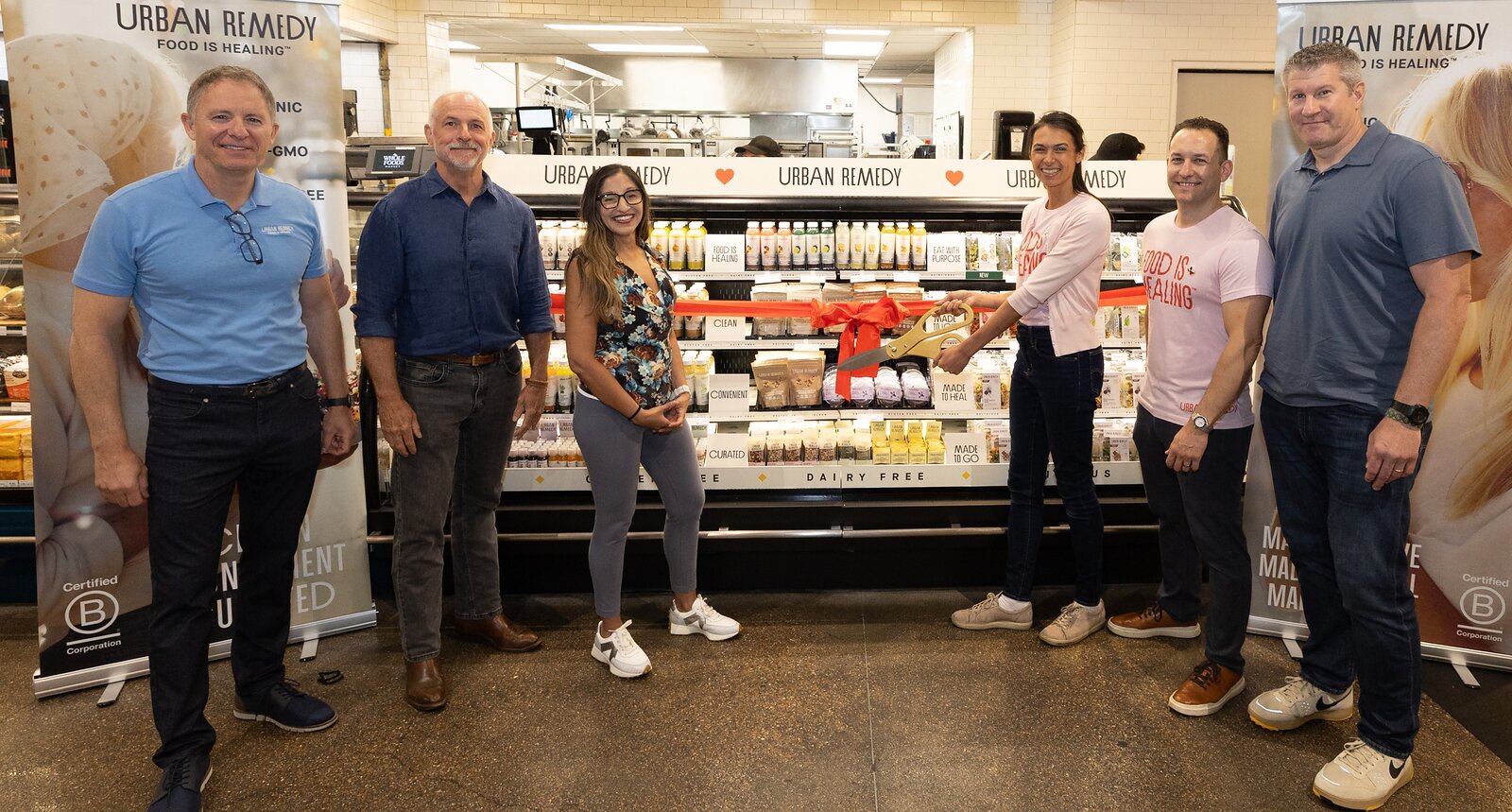
In June 2025, Urban Remedy announced national Whole Foods Market distribution, adding 27 Texas locations. CEO Steven Naccarato said the company had sold more than a million Macro Bowls. By September 2026, the company reported more than 450 Whole Foods Market stores and over 800 retail locations overall. These are distribution counts, not customer totals.
A national footprint built around refrigerated food.
The current FAQ also records a retreat: Urban Remedy has stopped direct website shipping, citing perishable freight costs and packaging concerns. Customers can use grocery locations and retailer delivery options. It lists four exceptions to full organic certification, including Mint Cacao Meal Shake and UR Calmer Shot, because particular functional ingredients are unavailable in certified organic form. A useful brand promise can tolerate fine print when that fine print is legible.
B Lab independently lists Urban Remedy as certified since February 2018, with an 82.0 impact score. The company describes paid volunteer hours, employee feedback and redistribution of food nearing expiration. Those commitments sit beside another obligation: food safety. A 2022 voluntary recall covered a specific strawberry tea-tonic lot over possible hepatitis A contamination; the announcement reported no illnesses from the Urban Remedy product at that time.
Copy the shopping trip
The transferable idea is to start with an existing customer habit. Urban Remedy found a way to put a prepared meal inside the grocery errand. For another business, the equivalent might be a place where the intended buyer already spends time. The hard part is making the product fit that setting without asking the customer to learn a new routine.
Perishable food adds conditions that enthusiasm cannot negotiate. Sparse demand, unreliable refrigeration or a long replenishment journey can consume the advantage. For shoppers, the practical test is equally concrete: find a nearby stockist, choose a product whose ingredients suit you, check the date and keep it cold. A refrigerator can carry a philosophy across the country. It still has to deliver lunch.
Open the refrigerator door
Explore the products · Find a stockist · Read the product FAQ · Company news · Journal
Instagram · LinkedIn · X · Facebook
Watch Pasquale’s Beyond a Million interview ↗
Listen to her 2026 Kara Goldin interview ↗