The first useful thing in Kite Hill’s story was a mouthful of someone else’s cheese. Tal Ronnen was helping develop vegan menus for Steve Wynn’s Las Vegas properties when a chef tasted a dairy-free cheese and spat it out. For a cook, this is an admirably unambiguous review. Ronnen came away determined that being vegan would no longer be sufficient grounds for putting something on a plate.
- The idea: give almond milk the cultures, enzymes and attention ordinarily reserved for dairy cheese.
- The audience: vegans, dairy-avoiding households and people who simply want a familiar meal made with plants.
- The route: start at Whole Foods, then move into everyday spreads, yogurt, pasta and professional kitchens.
- The new pitch: an April 2026 protein cream cheese launch, made with almond milk and soy.
The cheese that left the room
There is a particular trap in replacement foods. The maker compares a product with the alternatives available to someone on a restricted diet. The eater compares it with the food they remember. Those are different examinations. A cheese that seems respectable in a vegan tasting can look rather less accomplished beside the cheese already in the fridge.
Ronnen’s ambition required a team with an unusual division of labor. He brought the culinary demand. Monte Casino, a former cheesemaking instructor at Le Cordon Bleu in Boston, brought craft. Pat Brown, a Stanford biochemist, brought the search for a workable transformation. Kite Hill’s own history dates their alliance to 2010 and its first Whole Foods cheeses to 2013.
Early reporting describes Brown sending freshly processed almond milk to Casino in Boston. Later, the team brought in Jean Prevot, whose experience included goat cheesemaker Laura Chenel, to oversee the Hayward facility. That is the amusing inversion at the heart of this company: to make food without dairy, it recruited people who understood dairy rather well.
Teach the almond a dairy trick
A conventional cheese factory receives milk. Kite Hill first had to make its own. A 2014 factory visit found the business in a former Shutterfly printing space, with equipment for turning nuts into milk before cheesemaking could begin. The finished cheese was the visible product. Behind it sat an extra manufacturing operation.
The earliest experiments did not all cooperate. Associated Press reporting described cashew trials that failed to form the curd the team wanted, and conventional dairy coagulation ingredients that did not work for its process. Almond-and-macadamia blends featured in the early range. These were specific formulation problems, rather than proof that a particular nut could never make a good vegan cheese.
“You couldn’t open up a book, there were no rules, no guidelines.”Monte Casino, speaking in 2015
Kite Hill says it tested more than 20 almond varieties to find the balance of protein, sugars and fats it wanted. It sources almonds from California’s San Joaquin Valley and custom-blends batches to accommodate seasonal variation. Brown isolated the cultures and enzymes used in its cheese process; the cultures are grown on a vegetable-based medium.
- 01Make milkSelected almonds
- 02Add cultureEnzymes + cultures
- 03Rest overnightCurds + whey
- 04Work the curdPress + mix
The company’s description of its cultured cheese process. Individual products have different formulations.
Its account of the process sounds familiar to a cheesemaker: inoculate the milk, let it rest, form curds and whey, then press and mix. The difference is the starting material. That was the original competitive proposition - a cultured food with its own structure and flavor, fit to eat without a recipe doing all the camouflage.
The counter was part of the product
The early soft cheeses reached Whole Foods’ cheese department alongside dairy. For a small brand, this mattered beyond the honor of sharing a refrigerator with Parmesan. The location invited shoppers to judge the product as cheese, with the same crackers, accompaniments and expectations.
Think of that placement as an argument made with shelving. A shopper did not have to search a separate dietary corner to encounter the product. Kite Hill accepted a demanding comparison and gained a chance to reach people who had not arrived looking for vegan food. For another maker, the useful question is equally concrete: where will the intended customer understand what this product can do?
The market around it is crowded. Miyoko’s Creamery offers another route into plant-based cheese; Daiya competes across cheese alternatives, while Forager Project is an option in cultured dairy alternatives. Conventional dairy remains the everyday reference point. Kite Hill’s almond-milk process gives it a specific story, but the shopper still has to prefer the flavor, find the product and accept the price.
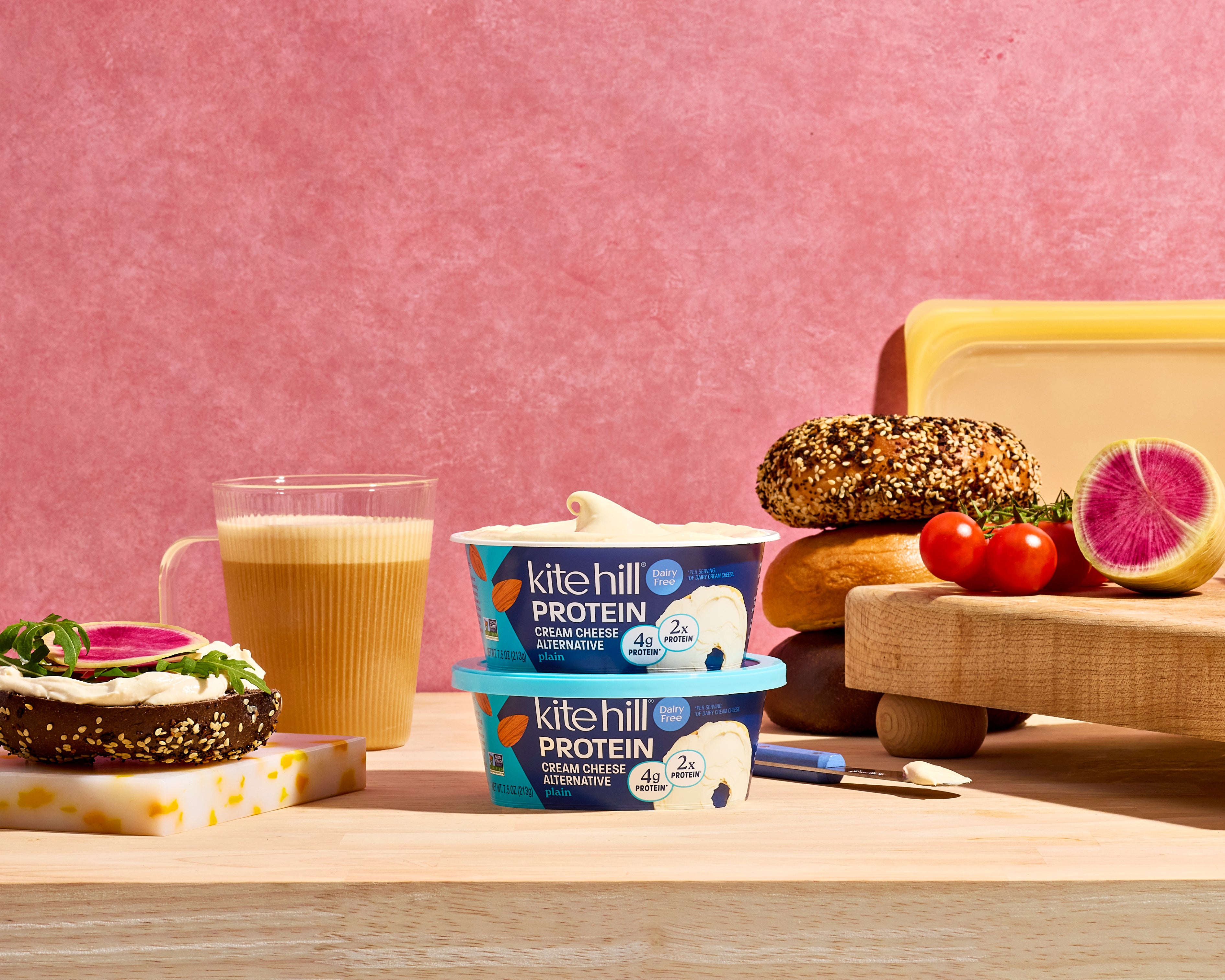
A bagel is a bigger market than a cheese board
In 2015, Kite Hill added almond milk yogurt and cream cheese-style spread. Today, its catalog includes Greek-style yogurt, ricotta, sour cream alternatives, dips, ravioli, tortellini and a dairy-free vodka sauce. A company introduced through specialty cheese now has products for breakfasts, lunchboxes, snacks and dinner.
The practical attraction is familiarity. Ricotta can go into lasagna. Plain cream cheese can go on a bagel. Yogurt can serve as breakfast or a cooking ingredient. Kite Hill recommends starting substitutions with plain or unsweetened varieties, using a one-to-one ratio for its yogurt, cream cheese and ricotta alternatives. That is a starting point for the kitchen, rather than a promise that every recipe will behave identically.
The filled pastas carry the ingredient into a prepared meal. Mushroom and spinach ravioli, butternut squash ravioli and tortellini give shoppers ways to use the ricotta without making pasta dough. Its vodka sauce combines tomatoes, almond milk and vodka. The dinner occasion supplies a clear answer to a question specialty ingredients often leave hanging: what shall I actually cook?
The commercial model follows the refrigerator. Kite Hill manufactures branded foods for grocery retailers, including Whole Foods, Target, Sprouts and Publix. It also supplies professional kitchens through Sysco Marketplace. Sysco handles billing and Dot Foods fulfills those orders. Restaurants get a distribution route; customers get another chance to encounter the products outside their own kitchens.
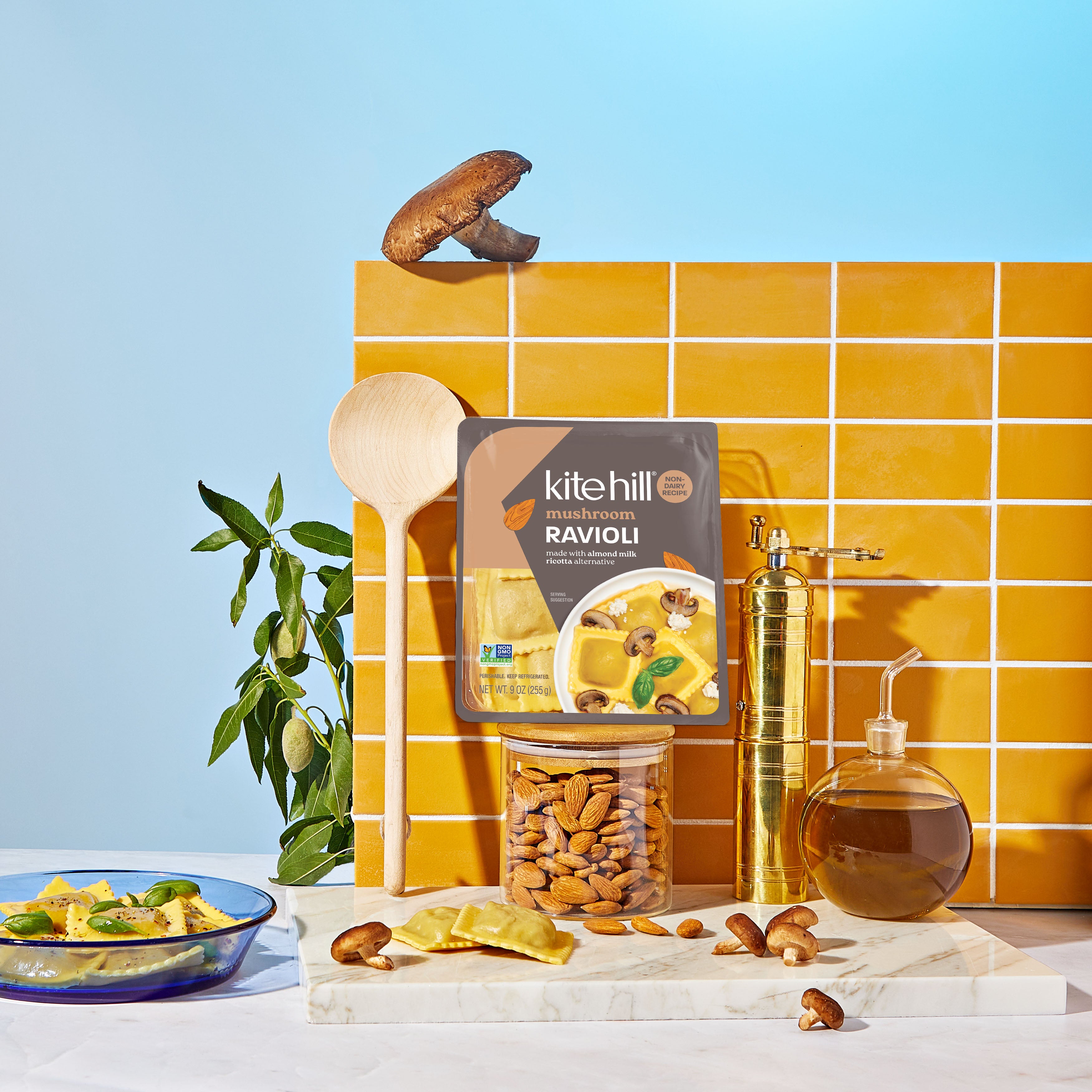
The expensive part was making enough
The original ambition was artisan. The next problem was industrial. Kite Hill’s expansion needed money for production and distribution, as well as new recipes. An $18 million round in 2016 was led by General Mills’ venture arm, 301 INC, and CAVU, with Khosla Ventures also participating.
In October 2018, another $40 million investment arrived, led by 301 INC. Reporting at the time described plans to expand factory capacity and get more core products into thousands of stores. Management expected capacity to grow two to three times in the near term. That was an intention stated at the time, rather than a measurement of what eventually happened.
Individual reported financing rounds. These bars show investment, not sales or a complete funding history.
Another $10 million was reported in 2019. CEO Rob Leibowitz described intended spending on innovation, infrastructure, people and marketing. For anyone copying the strategy, those nouns deserve attention. Grocery expansion brings an obligation to make, move and support the product repeatedly. Getting a listing is the beginning of that obligation.
Now the almond has a gym membership
Kite Hill’s recent work changes the comparison again. Its plain unsweetened Greek-style yogurt lists 15 grams of protein in a 5.3-ounce cup. The ingredient list includes soy protein isolate alongside almond milk. In its FAQ, the company says customers asked for more plant protein and that soy delivered the taste and thick texture it wanted.
On April 27, 2026, Kite Hill announced Protein Cream Cheese Alternative at Whole Foods nationwide. The almond-and-soy spread launched with a claim of four grams of protein per two tablespoons, compared with two grams in the leading dairy cream cheese brand. The serving size is part of the claim. This is a protein benefit attached to an ordinary spread, rather than an invitation to eat an entire tub.
There is a useful discipline in that change. The brand did not insist that the almond solve every nutritional problem unaided. It brought in another ingredient to meet a stated customer request. The familiar format remained the sales pitch: breakfast, with another reason to choose the dairy-free version.
Borrow the test, then check the label
The part of Kite Hill’s approach that another business can copy is the test. Choose a real use, recruit people who understand the original food and let a demanding eater judge the result. A cracker exposes a cheese. A bagel exposes a spread. The brand story cannot supply the missing pleasure after the first bite.
For shoppers, the limits are equally practical. Almond allergies rule out these almond-milk products. Greek yogurt and the protein cream cheese contain soy. Filled pasta contains wheat, and the Everything cream cheese contains sesame. A dairy-free label answers one ingredient question; it does not answer them all.
Nor should artisan language be mistaken for a nutritional guarantee. Check the particular product’s ingredients and serving size, keep it refrigerated and buy an amount you will use. Kite Hill recommends consuming opened products within seven days or before their best-by date, whichever comes first. A pleasing substitute still has to fit the household, the recipe and the grocery budget.
Ronnen’s early experience supplied a blunt standard. The current company has more formats, more distribution and a new protein proposition, but each purchase brings it back to the same small encounter: a person tastes something and decides whether another mouthful sounds good.