Company Profile / Plant-Based Beverages
The Curvy Bottle That Convinced America to Pour Almonds in Its Coffee
Founded by the man who once sold Odwalla to Coca-Cola, Califia Farms turned a citrus packinghouse and a strangely shaped bottle into a plant-milk empire pouring in about 30 countries.
Walk into almost any American grocery store, stand in front of the refrigerated dairy case, and you will spot it before you read a single word on the label: a tall, curved, hourglass bottle that looks less like a milk carton and more like a piece of glassware. That bottle belongs to Califia Farms, and it has done more to sell plant-based milk than most marketing budgets ever could.
Califia Farms is a Los Angeles company that makes plant-based drinks - almond, oat, coconut, cashew and now soy milks, dairy-free coffee creamers, cold brew, barista blends and ready-to-drink lattes. It was founded in 2010 and today sells across roughly 30 countries, backed by a $225 million round led by one of the world's largest sovereign wealth funds. But the more interesting story is how a juice company ended up here at all.
01The juice guy who did it twice
To understand Califia, start with its founder. Greg Steltenpohl was not new to beverages when he launched the company. In 1980 he co-founded Odwalla, the fresh-juice brand that helped kick off the natural-foods movement, and he built it into a business large enough for Coca-Cola to buy in 2001. Most founders never build one category-defining beverage company. Steltenpohl set out to build a second.
The origin was almost accidental. Califia began not with milk but with juice, produced in a California citrus operation tied to the growers behind those small, easy-peel clementines you find in mesh bags. The name came from Queen Califia, a mythical warrior queen from a 1510 Spanish novel - the same legend that gave the state of California its name. The pivot to plant-based milks came shortly after, and with it, the bottle that would become the brand's signature.
Plant-based milks aren't alternatives anymore.— The Califia Farms positioning, in its own words
That single line captures the company's core bet. For years, plant milk was sold as a substitute - the thing you drank if you couldn't drink the "real" thing. Califia's argument is that almond milk in a latte, or oat milk on cereal, is not a compromise but a choice. Reframing a category from "alternative" to "first choice" is a marketing move as much as a product one, and it is central to how the company thinks.
02What is actually in the bottle
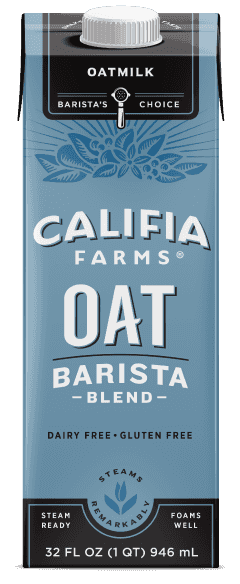
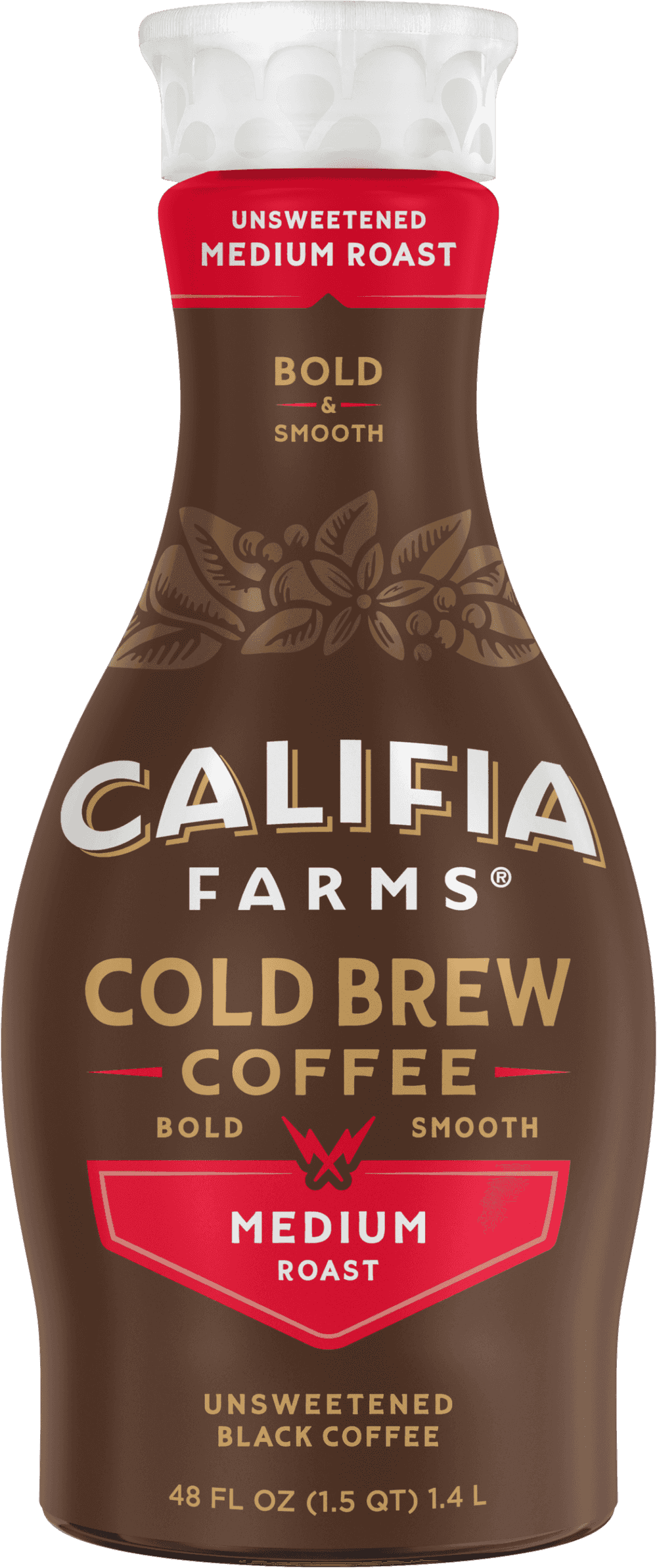
Califia's catalog reads like a tour of the plant-based aisle. There is the flagship almondmilk that helped make almond milk a coffee-shop default. There is oat milk and an oat barista blend built to steam and foam. There are dairy-free creamers in flavors like French Vanilla, Caramel and Toasted Hazelnut, plus a cleaner "Simple & Organic" line that has become one of the company's fastest movers. And there is coffee itself - ready-to-drink cold brew, lattes and, more recently, a matcha almond tea latte.
In 2024 the company pushed into new territory with Califia Complete, a plant milk built from a blend of pea, chickpea and fava bean protein. The pitch is direct: it matches dairy milk nutrient-for-nutrient, but with less fat, less sugar and fewer calories. It is a signal of where the category is heading - away from "dairy-free" as the selling point and toward "nutritionally at least as good."
Then, in 2026, Califia did something it had never done in 16 years: it launched a soymilk. The Simple & Organic Soymilk, in 48oz and 32oz bottles, joined almond, oat, coconut, cashew and vanilla-almond in the organic platform, alongside a fresh run of coffee and tea blends including vanilla and brown sugar cold brew and unsweetened matcha.
03Who buys it, and how the money works
Califia is a consumer packaged goods business. It makes the drinks and sells them wholesale into grocery, mass, natural and club retailers, direct to shoppers online, and through third-party e-commerce. It also runs an away-from-home channel, putting its products into cafes and offices. Revenue comes mostly from branded product sales on shelves across those roughly 30 countries.
The customer is broader than the vegan stereotype suggests. The core buyer is the "plant-curious" or flexitarian shopper - someone reducing dairy rather than swearing it off entirely - plus coffee drinkers reaching for a creamer and baristas working with barista blends. That mainstream framing is deliberate. Califia has never positioned itself as a niche health brand; it wants to be in the door of the average supermarket, next to the cow's milk.
We are committed to bringing the irresistible goodness of plants to people.— Califia Farms mission statement
04The $225 million question
In January 2020, Califia closed a Series D that generated $225 million, led by the Qatar Investment Authority and joined by Singapore's Temasek, the Canadian firm Claridge, Green Monday Ventures and a Latin American family with interests in coffee. Reports at the time put the company's valuation around $800 million. Earlier backers included California citrus grower Sun Pacific - whose packinghouse helped launch the company - along with Stripes and Ambrosia.
When sovereign wealth funds from Qatar and Singapore write nine-figure checks for an almond-milk company, it says something about how seriously the plant-based category is now taken. The money was earmarked for expanding the oat platform, increasing production capacity and funding research and development.
05A founder's exit, and a handoff
Later in 2020, Califia named Dave Ritterbush as chief executive. He arrived as a packaged-goods veteran, most recently having led Quest Nutrition to a roughly $1 billion acquisition. The timing mattered more than anyone knew: in March 2021, Greg Steltenpohl passed away at 67. The company he had built twice-over lost its founder, and the task of carrying a mission brand forward without its visionary fell to an operator.
By Ritterbush's telling, the years since have been among the most active for innovation - Complete, the soymilk launch, the new coffee blends. The through-line is a company that keeps finding open lanes in a shelf that looks, from the outside, completely full.
06The competition, and the moat
The plant-milk aisle is a crowded, price-competitive place. Califia competes with Oatly, Danone's Silk and So Delicious, Chobani's oat line, Blue Diamond's Almond Breeze, Planet Oat, Elmhurst and a rising tide of store brands - and, of course, with regular dairy milk itself. In a category where products can taste similar and undercut each other on price, differentiation is hard to hold.
Califia's edge is partly taste and formulation and partly something more old-fashioned: design. The vase-shaped bottle is so distinctive it functions as the logo, letting the brand be recognized at a glance from across the store. Distinctive packaging is an underrated moat in consumer goods, and Califia has leaned on it as hard as any brand in the aisle.
07Where it fits in the market
Zoom out and Califia sits among the largest independent plant-based beverage brands in the world - big enough to matter globally, still private, still mission-led. Its sustainability strategy runs on a four-pillar framework it calls Califia Impact: resilient agriculture, the circular economy, climate solutions, and being a positive force for people and communities. In CPG, that kind of language often lives on a website; for a plant-based company, it also describes the supply chain.
The bet underneath all of it is simple. Plant-based drinks are no longer a fringe experiment; they are a permanent fixture of the modern grocery store. Califia's wager is that the brand which keeps expanding the menu - and keeps being recognizable on the shelf - gets to lead the category rather than defend it.
08The timeline at a glance
09Questions people ask
What does Califia Farms make?
Plant-based beverages: almond, oat, coconut, cashew and soy milks, dairy-free creamers, cold brew coffee, barista blends, refreshers and ready-to-drink lattes.
Who founded it?
Greg Steltenpohl, who also co-founded Odwalla, founded Califia Farms in 2010. He served as CEO until 2020 and passed away in 2021.
Who runs it now?
It is a private company led by CEO Dave Ritterbush since 2020, with investors including the Qatar Investment Authority, Temasek, Claridge and Sun Pacific.
Where does the name come from?
From Queen Califia, a mythical warrior queen in a 1510 Spanish novel - the same legend that inspired the name California.