A hummus company that acts like a fresh food company.
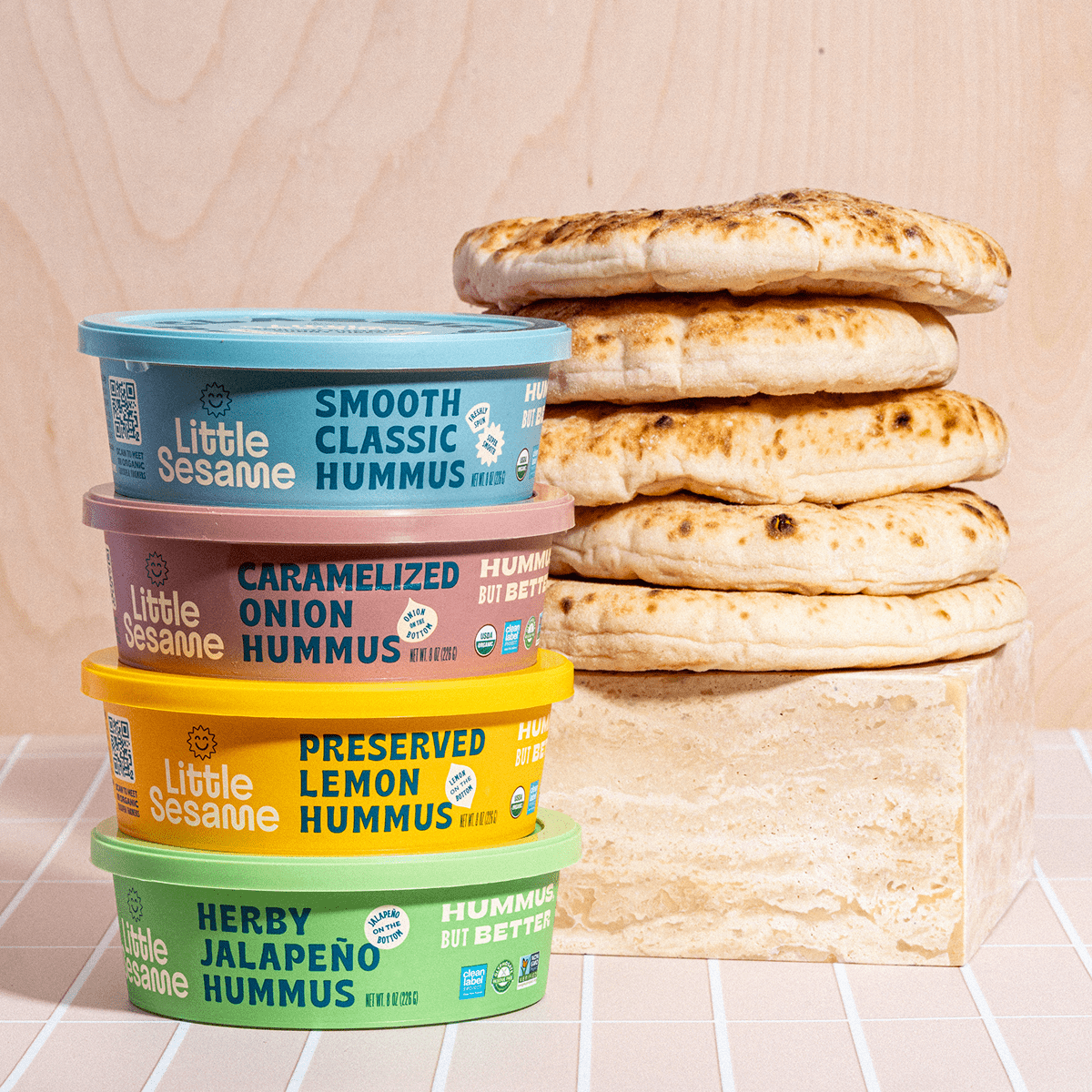
Walk into a Whole Foods refrigerator aisle in 2026 and you will find Little Sesame sitting where shelf-stable dips used to win by default. Freshly spun, small-batch, organic. Flavors with names like Herby Jalapeno and Preserved Lemon. It looks like something a chef made this morning, because the people behind it once did exactly that, in a 500-square-foot basement under their old deli. Today that basement habit is a two-part business: a fast-casual restaurant in D.C. and a packaged-goods brand in more than 1,000 stores nationwide.
The trick is that none of it feels mass-produced. Most hummus on a shelf has been engineered to survive shipping and sit untouched for months. Little Sesame went the other direction and decided the survival of the hummus was the wrong thing to optimize for.
It looks like something a chef made this morning, because the people behind it once did exactly that.— The Little Sesame pitch, abbreviated
Most hummus is great at one thing: sitting still.
The grocery hummus category had quietly agreed on a compromise. Make it shelf-stable, make it cheap, make it last. The flavor flattens, the ingredient list lengthens, and the chickpea, the entire point of the thing, becomes an afterthought sourced from wherever is cheapest that quarter. Nobody asks where it came from because nobody can answer.
Little Sesame looked at that arrangement and saw two problems wearing one coat. First, the food was forgettable. Second, and harder to fix, the supply chain behind it was invisible. A commodity chickpea is a commodity chickpea. The farmer growing it has no security, the soil gets no thanks, and the climate footprint disappears into an averaged-out blur. The founders decided you could not fix the flavor without fixing the farm.
You cannot fix the flavor without fixing the farm.— The central bet
Three cousins, one chef, and a stubborn idea about soil.
Nick Wiseman is a third-generation D.C. native who started cooking at fifteen. He worked his way through kitchens in Washington and New York, and in 2010 met chef Ronen Tenne at New York's Altamarea Group. Add cousin David Wiseman, and you have the founding table. They opened Little Sesame in 2015 in that famous basement beneath their deli, DGS, and a restaurant followed in downtown D.C.
Their bet was unfashionable for a food startup: instead of chasing the cheapest input, build a direct line to the farm. Every chickpea Little Sesame buys is sourced from Casey Bailey, a fourth-generation regenerative organic farmer working 5,000 acres in Fort Benton, Montana. Bailey spent years converting that ground to organic, soil-first management. By buying directly, Little Sesame gives the farmer security beyond the whims of commodity pricing, and gives itself a chickpea worth bragging about.
Good agriculture is one of the best tools we have in the fight against climate change.— Little Sesame's operating thesis
From Basement to Shelf: The Short Version
The basement. Little Sesame is born in a 500-sq-ft space under the founders' deli, spinning fresh hummus by hand.
The restaurant. A fast-casual flagship opens in downtown Washington, D.C., with hummus as the star.
The land grab. Expansion into 1,000+ new retail doors; first-to-market Kids Hummus Cups launch; USDA awards a $2.2M organic farming grant.
The raise. $8.5M Series A closes in July, led by InvestEco Capital, to scale manufacturing and grocery distribution.
The factory. A ~23,600-sq-ft facility with in-house High-Pressure Processing comes online, targeting a 400% jump in output.
Hummus, taken seriously. Plus snacks for the lunchbox set.
The core is organic hummus in chef-driven flavors, freshly spun and sold cold. Around it, the company built a snacking line: grab-and-go packs, build-your-own bundles shipped direct-to-consumer, and a first-to-market run of Kids Hummus Cups aimed squarely at the lunchbox. It is plant-based, dairy-free, gluten-free and clean-label, which in this category is less a marketing flourish than a side effect of using real ingredients.
You can eat it three ways: pick it up at the D.C. restaurant, grab a tub at the grocery store, or have a bundle mailed to your door. The point each time is the same. Open it, and it tastes like it has a recipe, not a formula.
Open it, and it tastes like it has a recipe, not a formula.— What freshly spun actually means
The numbers caught up with the conviction.
Conviction is cheap until a retailer buys in. By 2024, Little Sesame had landed in over 1,000 new doors, including Whole Foods, Sprouts, Wegmans, Giant Food, plus online grocers Misfits Market and Imperfect Foods. Then the capital followed: an $8.5M Series A in July 2025, led by InvestEco Capital with Watchfire Ventures, Santatera Capital and Beliade Consumer Partners. Earlier, the USDA chipped in $2.2M to back the organic chickpea supply chain itself, a rare federal vote for a single brand's farming model.
The 400% Jump
The new D.C.-area plant adds in-house High-Pressure Processing and a test kitchen. Translation: four times the hummus, same recipe, and a freezer that finally keeps up. (Old figure approximate; the 400% growth target is the company's own.)
Sell the dip. Fund the soil.
Here is where the hummus stops being just hummus. Little Sesame treats its product as the funding mechanism for something slower: regenerative farmland. The company has set a goal to transition 10,000 acres to regenerative management by 2027. Every tub sold is, in their telling, a small subsidy for healthier soil and a farmer who is not at the mercy of commodity markets.
It is an unusually patient story to tell on a grocery shelf, where most brands compete on price and shelf life. Little Sesame is competing on provenance, and asking shoppers to care where a chickpea grew up. So far, enough of them do.
Every tub is a small subsidy for healthier soil.— The mission, in one sentence
Five Things You Did Not Know About a Tub of Hummus
- It started in a 500-square-foot basement under a deli called DGS.
- Co-founder Nick Wiseman is a third-generation D.C. native who started cooking at 15.
- Nick met chef and co-founder Ronen Tenne at NYC's Altamarea Group in 2010.
- Every chickpea traces to Casey Bailey, a fourth-generation Montana farmer.
- The brand wants 10,000 acres under regenerative management by 2027.
The aisle is changing. So is who gets to win in it.
Go back to that refrigerated aisle. For decades it rewarded whoever could make food last longest for the least money. Little Sesame is a small test of a different rule: that shoppers will pick the product that can tell you its farmer's name, and that a brand can grow nationally without burying its supply chain. The Series A and the new factory are bets that this is not a niche.
If they are right, the hummus is almost beside the point. The real product is a working example of a food company that scaled without losing the thread back to the soil. The tub on the shelf used to be anonymous. Now it has an address in Fort Benton, Montana, and a basement origin story in Washington, D.C. That is the whole idea, and it fits in your hand.