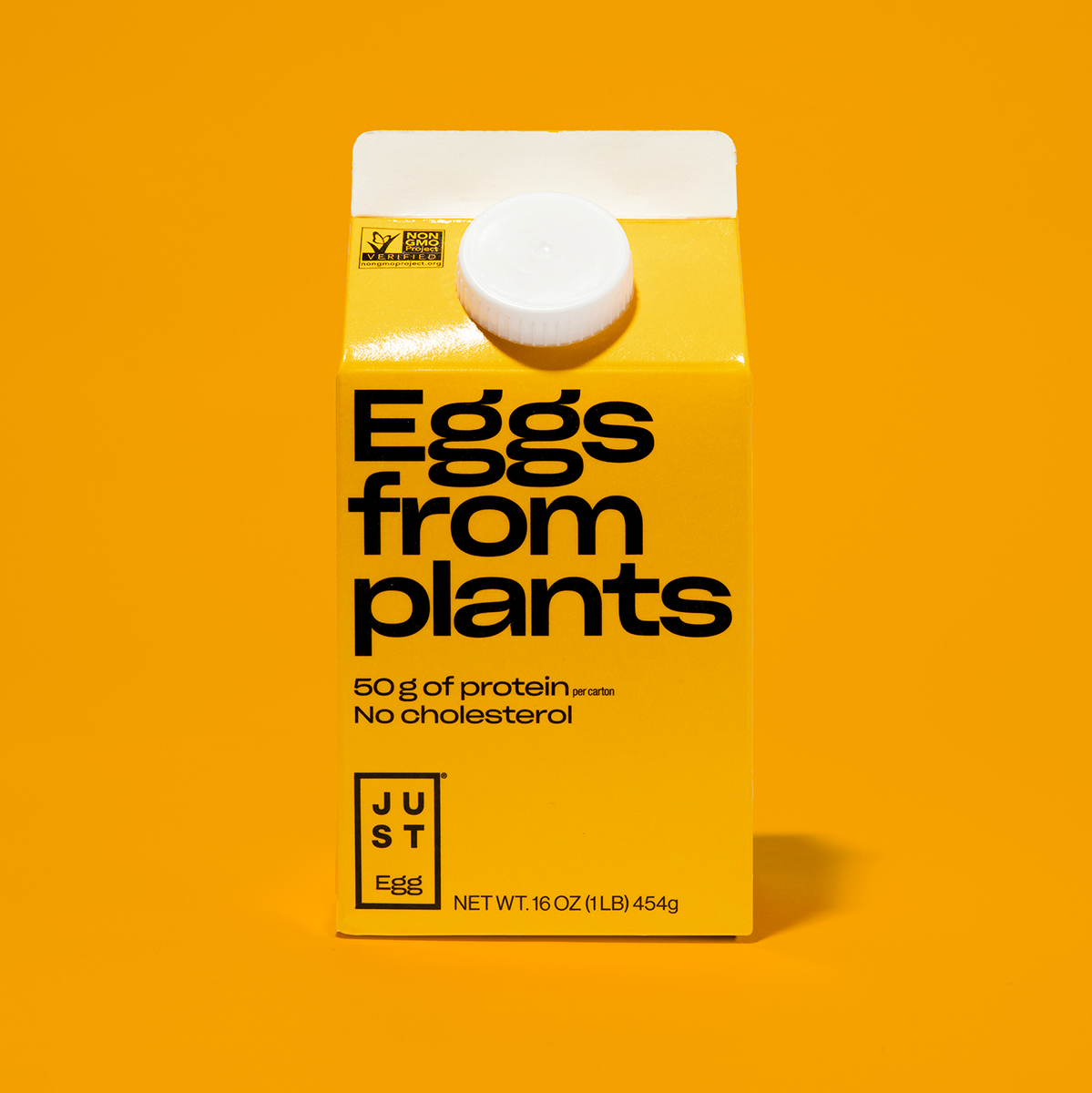
It is 6:47 a.m. somewhere in suburban Houston. A father pulls a pourable yellow carton from the refrigerator and tilts a viscous, faintly turmeric-colored liquid into a hot pan. It scrambles. His daughter, six years old, eats it. A chicken, somewhere, does not need to be involved. The carton says JUST. It does not say "egg substitute." That distinction, more than any single piece of intellectual property, is what Eat Just has spent fourteen years and roughly $850 million trying to earn.
Who they are nowA food company, mostly. A bio company, sometimes.
Eat Just, Inc. operates out of a former naval base in Alameda, California, where about 260 people pursue a deceptively simple thesis: that protein doesn't have to come from animals to taste like it does. The company has two arms. One squeezes proteins out of plants - specifically a mung bean isolate that scrambles, folds, and lies convincingly in a breakfast sandwich. The other grows actual meat from animal cells in stainless-steel vessels that, depending on your worldview, are either the future of agriculture or an expensive science experiment.
Both arms answer to the same person: Josh Tetrick, a former college football player and World Bank intern who has been called - in the same magazine, in the same year - both "remarkable" and "polarizing." He is fine with both.
The problem they sawEggs are cheap. The system that makes them isn't.
In 2011, when Tetrick and his childhood friend Josh Balk founded what was then called Hampton Creek, the egg industry was already a marvel of optimization. American hens laid roughly 75 billion eggs a year, in cages, on feed grown for the purpose. The eggs were cheap. The hidden costs - water, land, antibiotics, periodic outbreaks of avian flu, the moral arithmetic of caged animals - were borne elsewhere.
Tetrick's bet was that someone could replicate the function of an egg - the scramble, the bind, the protein - using plants. Not as a hippie alternative, but as a default. The idea wasn't novel. Soy products had existed for decades. The novel part was the ambition: make it taste like the real thing, sell it at Walmart, and don't ask the customer to feel virtuous about it.
The founders' betOne bean. A lot of grinding.
After screening more than 4,000 plants, the company settled on the mung bean - a small green legume cultivated in Asia for millennia, mostly for sprouts and dal. The proteins inside it, when isolated and rehydrated with canola oil, turmeric, and a careful ratio of gums, behave alarmingly like an egg in a hot pan. JUST Egg launched in 2017. It was not an overnight hit. It was, more accurately, a slow ten-year hit. JUST Egg has now sold the equivalent of more than 500 million eggs.
The cultivated meat arm - now branded GOOD Meat - took a different route. Rather than start with a bean, it started with a biopsy. In December 2020, after years of regulatory negotiation, the Singapore Food Agency approved GOOD Meat for sale, making it the first cultivated meat product cleared by any regulator anywhere. A restaurant called 1880 in Singapore served the first commercial dish. The bill was steep. The headline was free.
The productWhat's actually in the carton.
A 16-ounce paper carton of JUST Egg contains the rough equivalent of ten chicken eggs, 50 grams of plant protein, and zero cholesterol. The base ingredient is mung bean protein isolate. The rest is water, canola oil, dehydrated onion, gellan gum, natural carrot extract for color, and a pinch of nutritional yeast. There are no artificial preservatives. The packaging - newly redesigned and shipping in 2024 - is fully recyclable, which the company is keen to point out, since previous iterations were plastic.
The cultivated meat product, where it is permitted, is chicken cells grown in nutrient broth inside bioreactors that look more like microbreweries than abattoirs. It is, biologically speaking, real chicken. It is also, in 2026, still expensive to produce at scale. Eat Just admits this openly, which is unusual for the category.
A short list of things JUST Egg is not
- It is not made from soy.
- It is not a powder you reconstitute.
- It is not a tofu scramble.
- It is not particularly cheap, but it is closing the gap.
A fourteen-year scrambled timelineMile markers, with detours.
Hampton Creek is founded in San Francisco by Josh Tetrick and Josh Balk.
Just Mayo, a plant-based mayonnaise, hits Whole Foods shelves.
JUST Egg launches commercially - made from mung bean protein.
Hampton Creek formally rebrands as Eat Just, Inc.
Singapore becomes the first country in the world to approve a cultivated meat product. The product is GOOD Meat chicken.
The USDA and FDA jointly clear GOOD Meat for sale in the United States.
JUST Egg switches to a recyclable paper carton; reports tracking toward profitability.
Just Meat - a plant-based chicken line - launches with H-E-B across Texas.
The proofWhere the receipts live.
A company can sell a story for a few years. It can't sell one for fourteen. JUST Egg is now stocked at Whole Foods, Walmart, Kroger, Target, and as of last fall, H-E-B. The company reported an 80-percentage-point improvement in JUST Egg's gross margin between full-year 2022 and the first half of 2023 - the sort of curve that turns a category-creating product into a profitable one. The 2022-2023 avian flu outbreak helped too. When chicken egg prices spiked, JUST Egg suddenly looked less like a premium alternative and more like a hedge against the next epidemic.
JUST Egg in numbers
The missionMake the better choice the boring one.
The food-tech industry has produced more manifestos than products. Eat Just, to its credit, has produced both - but its mission has always been narrower and stranger than the usual save-the-planet pitch. The goal is not to convert anyone. The goal is to make the plant-based option indistinguishable enough, cheap enough, and available enough that nobody notices the conversion has occurred. The cultivated meat program is the same idea, scaled up: produce real animal protein without the animal, and let the market - not the moral argument - do the work.
It is, in a way, an unusually patient mission for Silicon Valley. The company is venture-backed, but its product cycle is measured in regulatory approvals and shelf space wins, not user growth curves. That has, at various points, frustrated investors and management consultants alike.
Curiosities, for the dinner party
- The website ju.st uses the country-code TLD of Sao Tome and Principe.
- The old Twitter handle still reads @hamptoncreek. Brand archaeology is real.
- Eat Just's first commercial cultivated chicken dish was served by a chef who had previously worked at Noma.
- The company screened more than 4,000 plants before settling on the mung bean.
Why it matters tomorrowThe mung bean as climate technology.
There is a version of the next two decades in which Eat Just remains a clever specialty brand - a carton you reach for when the chicken eggs run out. There is another version in which the gap between plant-egg cost and chicken-egg cost closes, the cultivated meat unit economics improve, and large slabs of the global protein supply quietly migrate to bioreactors and bean fields. The latter version requires policy, capital, and palate to align. None of those things move quickly.
What Eat Just has already done, however, cannot be undone. Cultivated meat is now a legal product category in two countries. Plant-based eggs are now a real shelf section in American grocery. Those are small facts. They are also irreversible ones. Companies don't usually move first in food. Eat Just did - twice.
Back to the kitchenThat same Houston morning, ten years later.
The father in suburban Houston is now ten years older. His daughter is sixteen and orders breakfast tacos that contain something the menu calls "egg" - she has stopped reading the asterisk. The grocery store still stocks chicken eggs. It also stocks two SKUs of JUST Egg and, since last September, three flavors of Just Meat in the meat case next to the chicken thighs. The yellow carton is no longer the curious one in the door. It's just the one she pours.
Whether that scene becomes the norm is the open question of the next decade. Eat Just has bet the company on the answer being yes. For now, the carton sits in the door. It scrambles. It tastes like breakfast. The chicken, somewhere, does not need to be involved.