The salmon burger came first. At UC Berkeley’s Alt: Meat Lab, Kimberlie Le and Joshua Nixon worked on a fish substitute made with koji, the fungus familiar to cooks through miso and sake. It was a plausible beginning for a food company: an unusual ingredient, a recognizable dish, a problem worth solving. Then they asked prospective customers what they wanted to buy. The answer was bacon.
- Prime Roots grows fungi protein into animal-free cold cuts.
- Customer demand pushed it from salmon and meals toward standalone meats.
- Its deli strategy works with the counter, the clerk and the slicer.
- Canadian distribution arrived through Dot Foods in March 2026.
That answer deserves more attention than the usual startup origin story gives it. A founder can be right about an ingredient and wrong about dinner. Prime Roots’ useful discovery was that people could welcome a different source of protein while remaining quite particular about how it entered their lives. The sandwich, it turns out, is a demanding little institution.
The customer who edited the recipe
Founded in 2017, Prime Roots began with a combination of scientific curiosity and kitchen experience. Le had grown up around her mother’s restaurant. The company describes early experiments in an apartment Instant Pot before the work moved into a larger test kitchen. The equipment changed; the question remained culinary. What would people actually enjoy eating?
The February 2020 bacon launch sold out in four hours, according to Prime Roots. It went on to test prepared meals. By January 2022, the founders were explaining a change of direction: bacon on its own had outsold those meals, and customers wanted convenient ingredients for regular use. Their survey also found that 64% of customers did not identify as vegan or vegetarian. That is an early company survey, rather than a description of every customer today.
The prepared meal had solved too much of the problem. It supplied the protein, but it also made decisions about the rest of the plate. Selling an ingredient leaves the eater in charge. A strip of bacon can enter someone’s existing breakfast; an entire new dinner asks for a larger surrender.
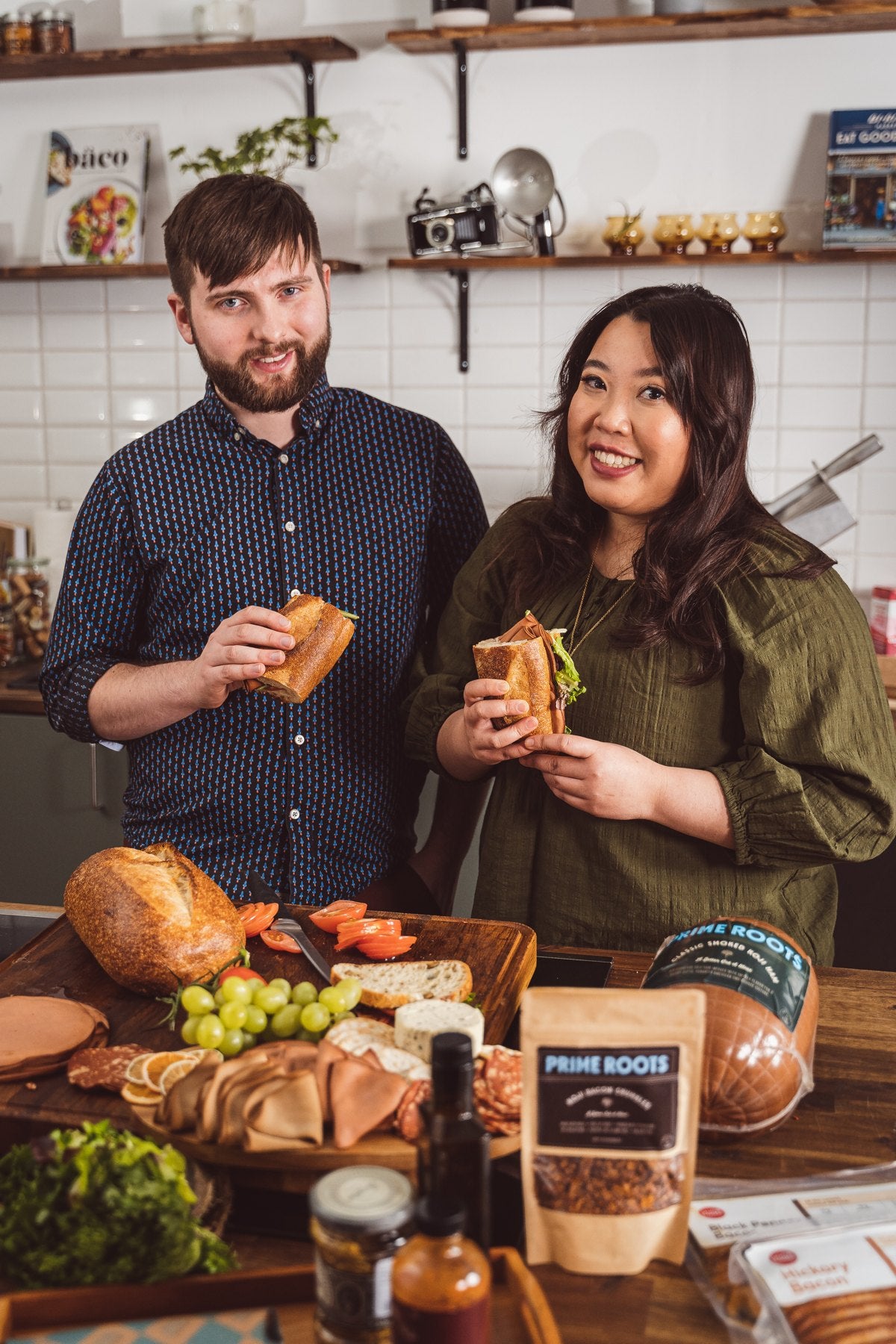
The change reached the packaging too. Prime Roots worked with Saint Urbain on a nostalgic, meat-centered identity and explained that its founders were flexitarians who still enjoyed meat. A customer did not need to join a dietary club to buy a slice. That positioning lets the product compete for an occasion - lunch - without demanding a declaration about every other meal.
An old fungus meets an old machine
Prime Roots’ central expertise is making fungi protein behave like food people already recognize. Koji contributes savory flavor and a fibrous structure. Fermentation grows the material; formulation turns it into a deli product. The important distinction is that the company uses fungal biomass as food. It is not raising an animal, and its deli meats are not cultivated animal cells.
The current range speaks the language of the sandwich shop: Black Forest Ham, Salami, Cracked Pepper Turkey, Smoked Turkey, Bacon, Pepperoni and Roast Beef. These are animal-free interpretations, with product names doing the work of describing the intended experience. Historically, Prime Roots also developed charcuterie such as pâté and foie-gras-style products.
There is a temptation to let an elegant ingredient story replace the ingredient list. Resist it. The current Black Forest Ham label includes a blend of mycoprotein, yeast and koji, plus water, pea fiber, rice bran oil, konjac flour, flavors and seasonings, among other ingredients. The finished product is a recipe. The company’s emphasis on transparency is most useful when the shopper can inspect that recipe.
The product is marketed as free of the top nine US food allergens, including soy and wheat. For operators, that is a formulation characteristic worth checking against the actual label and their own handling practices. A sandwich assembled in a busy kitchen brings its bread, sauces and shared surfaces into the equation too.
The counter is part of the product
In 2022, early partners included Bi-Rite Market, Berkeley Bowl and Rhea’s Deli. These were places where the company could meet people through foods they already wanted. Its launch post described tastings and training at Bi-Rite. The deli clerk became someone who could explain the product while putting it into a meal.
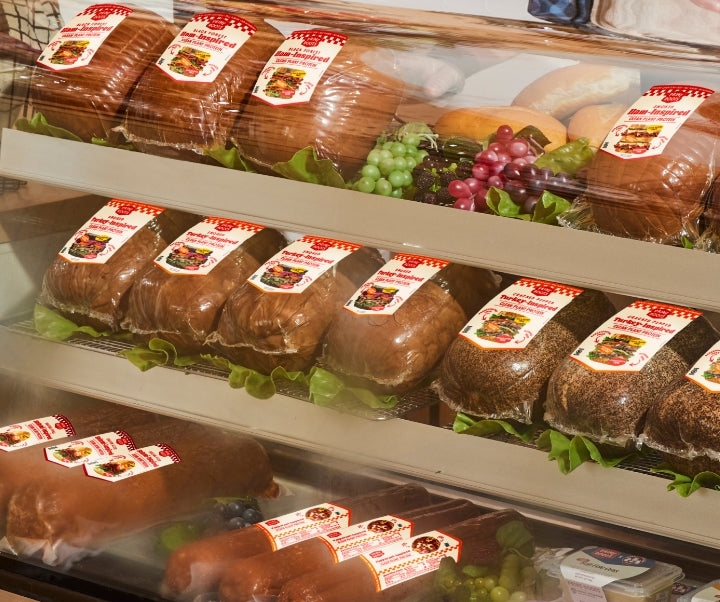
Consider the difference between choosing a sandwich and choosing a new food technology. The first decision has a price, a taste expectation and a place in the day. The second can arrive with homework. Putting a new ingredient inside an established buying ritual makes the invitation smaller and more concrete.
Le told Food Business News in April 2025 that operators could use Prime Roots without additional equipment. At that point, the publication reported availability in 18 states. The company sells to grocery delis and foodservice businesses, and offers culinary help with menu development. Its commercial proposition includes fitting into a working kitchen.
That gives Prime Roots a specific place in the market. Conventional cold cuts are the immediate alternative at lunch. Other vegan deli slices compete for the same filling. Burger substitutes compete for a different occasion. The fungi platform may be versatile, but the counter narrows the task to something measurable: can the operator make a sandwich customers order again?
A sandwich still has to pay its way
In May 2023, Prime Roots announced a $30 million Series B, bringing announced funding to approximately $50 million. The purpose was to expand production and reach deli counters and restaurants more widely. That is capital raised, not a receipt for the pivot or a measure of how much money the business had spent.
Series B funding for scaling and distribution.
Approximately $50m in total funding at the announcement.
Quorn became both an investor and a collaborator in 2023, with its investment included in the Series B. The agreement covered expansion opportunities and new offerings. An established fungi-protein business brought experience that a younger manufacturer could use. In food, a potential competitor can also be a useful guide through the supply chain.
By August 2025, Le told AgFunderNews, “We are unit profitable.” She also described measured expansion, occasional shortages and the difficulty of serving retail and foodservice together. Positive economics for individual units matter. They do not, by themselves, establish that the whole company earns a profit after its other expenses.
“We are unit profitable.”Kimberlie Le · AgFunderNews · August 2025
The online store offers a small, concrete illustration of the economics. The Black Forest Ham page currently displays $9.99 for a 125g sliced pack, with a $50 minimum order and $25 refrigerated shipping below the stated free-shipping threshold. Prices and terms can change. For someone curious about a few slices, a nearby deli is an easier first experiment than assembling a cold-shipped order.
The route north
In March 2026, Prime Roots announced Canadian-made deli products and nationwide distributor access through Dot Foods Canada. Retailers and foodservice operators could source them through their existing distribution partners. Access through a national distribution network does not mean every local shop has put the products on its shelves.
The distinction matters. A retailer’s interest is one decision; getting refrigerated stock to its counter reliably is another. The Canadian announcement addresses that second decision. Prime Roots’ next chapter depends on the quiet work between a fermentation facility and a lunch order: inventory, deliveries, storage and replenishment.
The company has also been a certified B Corporation since January 2023, with an 86.5 score in B Lab’s published profile. That assessment covers business practices across governance, workers, community, environment and customers. It adds a separate measure of how the business operates; it does not tell you how its salami tastes.
Borrow the habit, earn the repeat order
Le has described a culture built partly around shared food and team lunches. It is an apt ritual for this particular business. A product can look convincing in a presentation and still disappoint in the meal for which it was designed. Keeping lunch close to the work keeps the question pleasantly literal.
The lesson another founder can copy is to test the smallest useful change in a customer’s routine. Watch purchases as well as praise. Make the product compatible with the equipment and suppliers the buyer already uses. Let familiar formats introduce unfamiliar materials. None of those choices requires inventing a new fungus.
They do require a product that earns repeat orders. If taste disappoints, if refrigerated logistics consume the margin, or if the local counter cannot sell enough before stock expires, familiarity will not rescue the economics. An early sell-out tells you people were curious relative to the stock available. The harder test comes when they have already tried it.
Prime Roots has chosen a wonderfully unglamorous place to take that test. Between bread, beside mustard, under the scrutiny of someone who knows precisely what lunch ought to taste like.