Trying to out-engineer the dairy cow - one molecule of ice cream at a time.
Here is a thing about the dairy business that sounds like a joke but is actually a business model: the product people love - the creamy, cold, rich thing - is not, strictly speaking, a cow. It is a specific arrangement of fats, proteins and water that your mouth reads as "ice cream." Cows are simply the incumbent supplier of that arrangement. They have been the supplier for roughly ten thousand years, which is a very long moat but not a law of physics.
Eclipse Foods, founded in 2019 and headquartered in Alameda, California, is a bet that you can build the same arrangement from plants and that customers will not care about the switch as long as you do not ask them to. This is a subtle but important framing. Most plant-based dairy sells you a substitute and asks you to feel good about the tradeoff. Eclipse's premise is that the tradeoff is the whole problem, so it engineered a product designed to remove it. The company describes what it makes as non-dairy products "indistinguishable" from conventional dairy - which is a bold claim, and also a testable one, which is refreshing.
The two people making the claim are worth introducing. Thomas Bowman, the co-founder and CTO, is an award-winning chef who staged or cooked in sixteen Michelin-starred kitchens, was twice nominated for the James Beard Rising Star Chef award, and then did something chefs are not supposed to do: he left the restaurant world to lead product development at JUST, the plant-based food company, where he built and scaled some of the category's best-sellers. Aylon Steinhart, the co-founder and CEO, came at the same problem from the finance-and-strategy side, having incubated alternative-protein startups at the Good Food Institute and advised investors on a market that, at the time, mostly did not exist yet.
The engineering choice that defines Eclipse is what it refuses to use. The easy way to make plant-based ice cream is to freeze a plant milk - almond, oat, coconut, soy - and accept the flavor and texture that comes with it. Eclipse went the other way. Its proprietary blend leans on non-GMO staples like cassava, corn, potato and fava, assembled to mimic the molecular structure of milk fat and protein rather than to taste like the plant it came from. No almonds, no oats, no coconut, no soy. The point is not virtue; it is that those ingredients carry flavors and textures that give the game away. If your goal is a product nobody can distinguish from dairy, the ingredient list is a constraint, not a marketing opportunity.
This is, more or less, the Beyond Meat playbook, and Eclipse has said so out loud. Beyond Meat won by making a product good enough that restaurants would serve it and customers would not flinch, then rode that credibility onto grocery shelves. Eclipse ran the same sequence in the dairy aisle: start in foodservice, where a scoop shop or a diner will put your ice cream in a cone and let the customer be the judge, then use that proof to earn retail distribution. It is a slower path than launching pints straight into a freezer case, but it front-loads the hardest test - does it actually taste right - and gets it answered by strangers rather than by a marketing deck.
James Beard-nominated chef from Chicago with sixteen Michelin-starred kitchens behind him. Left fine dining to run product development at JUST, then co-founded Eclipse to bring restaurant-grade craft to food science. He is the reason the flavors are chef-crafted rather than lab-approximated.
A Berkeley-based food-systems entrepreneur who incubated alt-protein startups at the Good Food Institute and advised investors on the category before it was a category. He handles the strategy, the fundraising, and the argument that changing the food system does not require anyone to eat worse.
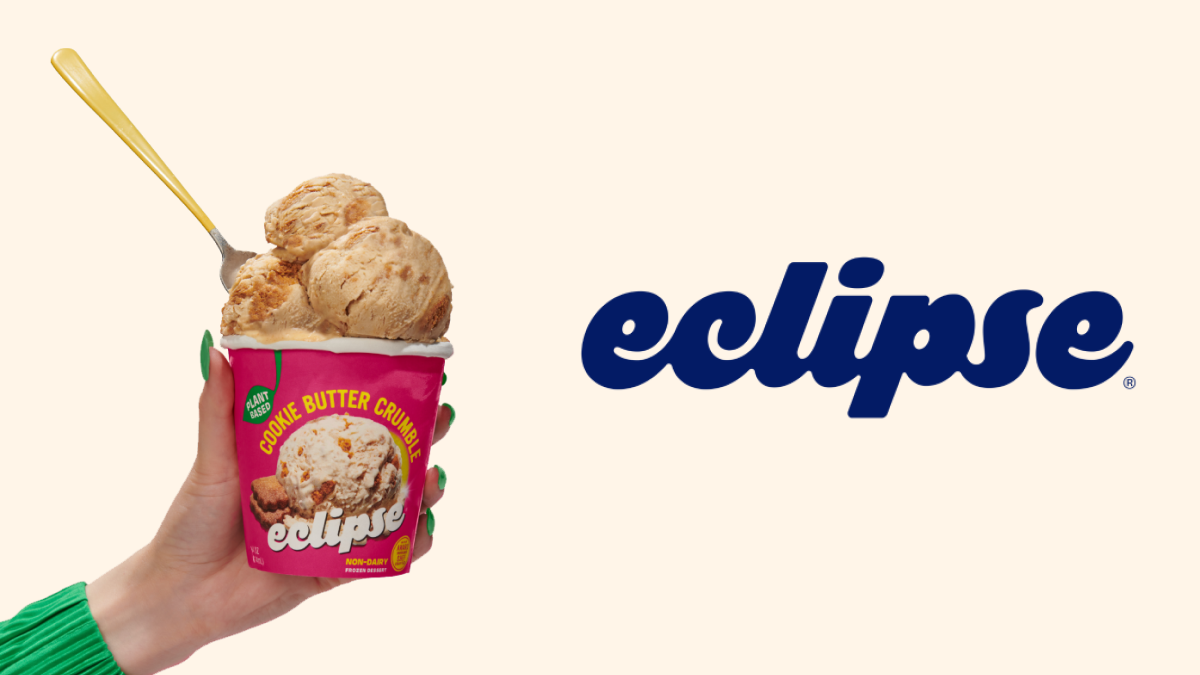
Chef-crafted flavors in pints, sold nationally on Amazon and at grocers including Whole Foods Market. No dairy, nuts, soy, coconut, oats or GMOs - just a plant blend built to read as ice cream.
Soft-serve mix, scoop-shop mix, three-gallon tubs and single-serve cups for diners, burger joints and scoop shops - the channel where strangers vote with their taste buds.
Shelf-stable whole milk in 32 oz Tetra Pak cartons, engineered to steam, froth and pour like dairy. Pitched as a barista's secret weapon; went nationwide on Amazon in 2026.
Oat milk changed coffee. It won the barista wars by being good enough to steam, and in doing so it made "plant milk in your latte" ordinary. Eclipse looked at that and made a deliberately harder bet: not another oat milk, but a non-dairy whole milk - the rich, full-fat version that dairy defenders consider unbeatable.
The strategy here is to attack the incumbent where it is strongest rather than where it is weakest. If your milk can hold its own against dairy whole milk in a cappuccino, in a bakery, in a smoothie, then the "you have to compromise" objection loses its last foothold. Eclipse launched the milk to foodservice partners in April 2025 - coffee shops, cafes, smoothie bars, bakeries - and brought it to Amazon nationwide by early 2026.
It is the same molecular-mimicry logic as the ice cream, applied to a different form factor. Get the fat, protein and water into the arrangement a barista's steam wand expects, and the drink comes out the way the customer expects. The cow, once again, turns out to be optional.
Eclipse has raised roughly $96 million to date. The 2022 Series B was led by Sozo Ventures with Forerunner Ventures, Initialized Capital and Gaingels - plus KBW Ventures, the firm of Saudi Prince Khaled bin Alwaleed. Earlier backers include Reddit co-founder Alexis Ohanian and Seth Goldman, chairman of Beyond Meat and founder of Honest Tea. It is an unusually legible cap table: nearly every name signals a bet that the dairy category is about to shift.
Bowman and Steinhart launch Eclipse to make non-dairy products indistinguishable from dairy, starting with foodservice ice cream.
A $12M Series A funds a move into retail during the pandemic - "following the Beyond Meat playbook."
Plant-based ice cream reaches Whole Foods Market shelves.
Sozo Ventures leads a $40M round with Forerunner, Initialized, Gaingels and KBW Ventures.
Debuts a non-dairy whole milk for foodservice partners, engineered to perform like dairy.
Eclipse Non-Dairy Whole Milk becomes available nationwide on Amazon.
Cassava, corn, potato and fava are in. Almonds, oats, soy and coconut are deliberately out - because they give the plant away.
Co-founder Thomas Bowman staged or cooked at sixteen Michelin-starred restaurants before pivoting to food science.
Saudi Prince Khaled bin Alwaleed backs Eclipse through his firm KBW Ventures - the "vegan prince" of the headlines.
The 2025 milk had to steam and froth like dairy to earn its "secret weapon" pitch to coffee shops.
Plant-based dairy products - non-dairy ice cream (retail and foodservice) and, since 2025, a non-dairy whole milk - designed to be indistinguishable from conventional dairy.
A proprietary blend of non-GMO plants such as cassava, corn, potato and fava - notably without dairy, nuts, soy, coconut or oats.
Chef Thomas Bowman (CTO) and food-systems entrepreneur Aylon Steinhart (CEO) co-founded the company in 2019.
Roughly $96M total, including a $40M Series B led by Sozo Ventures in 2022, with backers such as Prince Khaled's KBW Ventures, Alexis Ohanian and Seth Goldman.
Nationally via Amazon and at grocers including Whole Foods Market and regional retailers; foodservice partners include scoop shops, diners and burger chains.