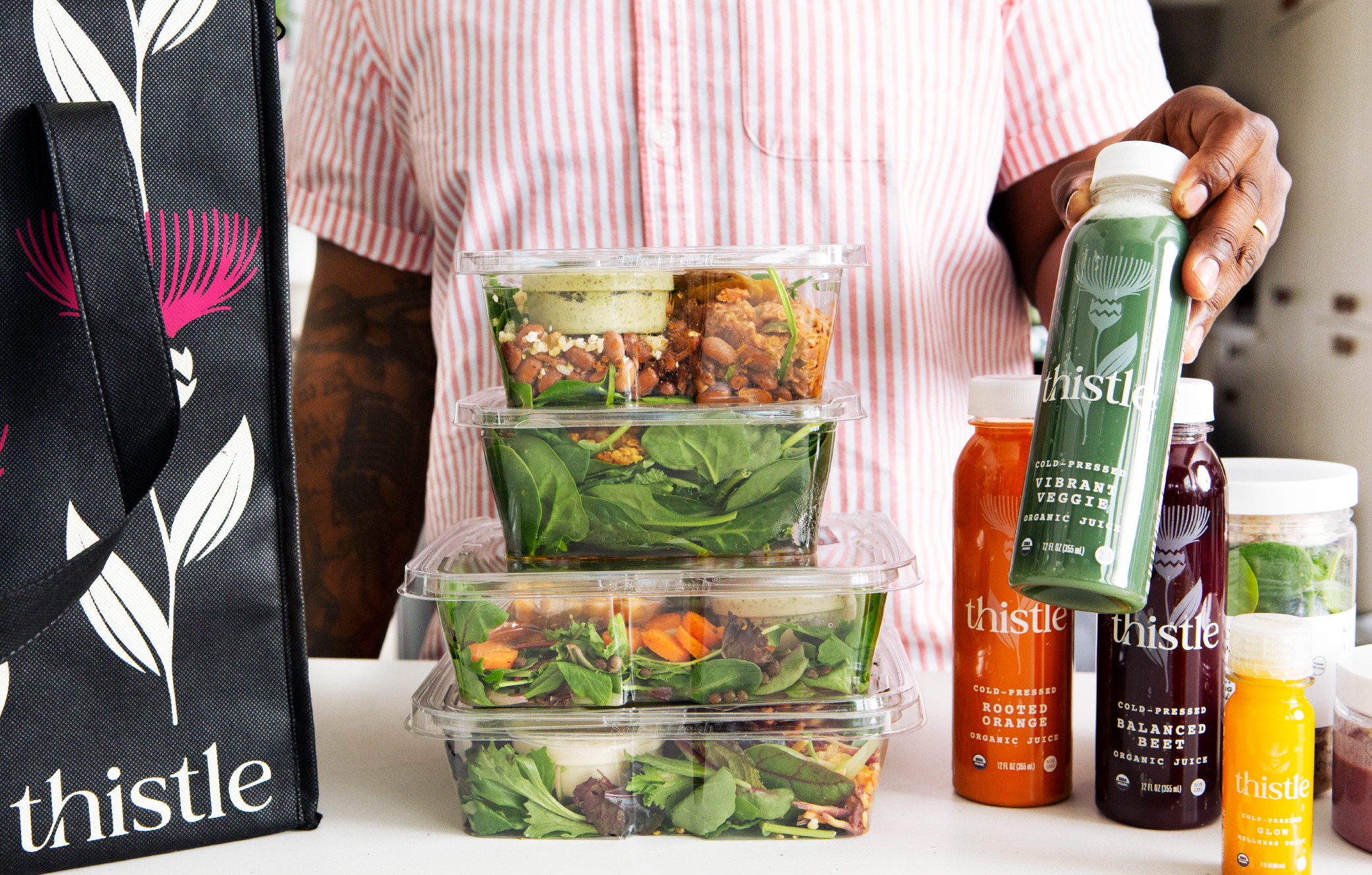
Thistle is what happens when a climate scientist and a guy who really likes lunch decide the freezer aisle has had its run.
01 // WHERE THEY ARE NOWThe kitchen at 4:17 a.m.
At four-something in the morning in Vacaville, California, a crew is plating something most Americans still treat as a side dish - vegetables - and packing it into insulated boxes bound for several thousand front porches. A thousand miles east, in Burlington, New Jersey, another crew is doing the same thing, in reverse time zone, for the other coast. By Friday night, somewhere over a hundred thousand ready-to-eat meals will have left those two buildings. None will contain beef. Almost all will contain something a nutritionist actually approves of.
This is Thistle in 2026. It is not a startup anymore - or at least, it has stopped having to apologize for being a food company. It is a thirteen-year-old operation with roughly 390 people, two coastal kitchens, an iOS app, a Series B from PowerPlant Ventures, and a customer base that has, against most odds, kept ordering the kale.
02 // THE PROBLEMTwo graphs, one answer
The pitch deck that built this company had, more or less, two charts. The first was about people: rising rates of diet-related disease in the United States, a generation of adults who eat fewer vegetables than their grandparents did, and a healthcare system buckling under the bill. The second was about the planet: agriculture's stubborn share of global emissions, water, and land use, most of it tied to animal protein.
Read separately, those graphs feel like distinct catastrophes - the kind a sensible person delegates to a sensible nonprofit. Read together, they suggest something more interesting: that the diet that's better for the patient is also, almost embarrassingly, the diet that's better for the soil. The cure for one problem is the cure for the other. The trouble is that nobody has time to cook it.
Thistle's founders saw the overlap and treated it as a logistics challenge. The science said eat more plants. The grocery store said good luck. The freezer aisle said try our new microwavable burrito. Thistle, very politely, said: we'll just bring it to you.
03 // THE BETA juice cup, a pop-up, a thesis
In 2013, Ashwin Cheriyan opened a small spot in Bernal Heights, San Francisco, selling cold-pressed juices. It was the kind of business that, in another timeline, would have stayed a beloved corner shop and never bothered anyone with a Series B. But Cheriyan's co-founder happened to be Shiri Avnery, who happened to hold a PhD in Environmental Science and Policy with an emphasis on the intersection of climate, air pollution, and food. She brought a thesis. He brought a kitchen.
Together they ran a slightly suspicious experiment: take a product people associate with self-punishment - the healthy meal - and make it not punishing. Make it convenient. Make it taste like something a chef would willingly serve. And make it default to plants, not because plants are trendy, but because the math on climate and chronic disease pointed there and refused to leave.
That's a tidy origin story. The messier truth is that healthy food delivery has been a graveyard of well-funded startups. Several of Thistle's contemporaries do not exist. Surviving a decade in this category is, in itself, a result.
04 // THE PRODUCTWhat's actually in the box
The unit of value at Thistle is a meal you don't have to assemble. The menu rotates weekly. Chefs design it. Nutritionists vet it. The recipes lean plant-forward by default - bowls, salads, grain dishes, soups - with optional chicken or pork add-ons for omnivores. Beef is conspicuously absent. That isn't an oversight; it's a climate decision baked into the SKU list.
Everything is dairy-free and gluten-free, with no refined sugars, artificial sweeteners, preservatives, or the polysyllabic additives that haunt most ready-to-eat food. Cold-pressed juices, the original product, are still on the menu. Snacks round out the order. The whole thing arrives in a box, on a schedule, and waits in your fridge until you decide you're hungry.
It's a subscription business, which means Thistle lives or dies by retention. Convenience gets the first order. Taste gets the second. The third is where the thesis has to land: customers stay because they feel better, and because not cooking dinner is, it turns out, an underrated luxury.
Plant-based meals out the door, every week.
Across seed, Series A and Series B funding rounds.
Vacaville, CA and Burlington, NJ. Bi-coastal by design.
Climate math, not a marketing claim.
05 // THE PROOFReceipts, in chart form
Investors, of course, want more than vibes. The Series B in January 2021 - $10.3 million led by PowerPlant Ventures, with Siddhi Capital, Alumni Ventures Group, and Rich Products' venture arm along for the ride - landed eleven months after the Series A. That is not a normal cadence for a food business. It signaled conviction. PowerPlant, whose entire investment thesis is plant-centric consumer brands, doubled down because the unit economics had stopped looking like a science project.
The Thistle timeline
Thistle funding, by round
Series A figure is implied from reported cumulative totals. All other figures from company and investor releases.
06 // THE MISSIONPlants as the default, not the diet
It's tempting, in 2026, to talk about plant-based food the way the rest of the food industry does - as a category, a shelf, a marketing label. Thistle has resisted that framing for thirteen years. Internally, the bet has always been that plant-based is not a niche; it's the path of least resistance once you remove the inconvenience tax.
Their mission statement, restated by the founders many times, is short: make it easy to get and stay healthy while improving the sustainability of the food system. The first half explains the meals. The second half explains the supply chain. Thistle sources from local farms where it can, leans into seasonal produce, and has built its menu around ingredients that are, by accident or by design, less brutal on land and water than the standard American plate.
You will not find a press release boasting about this. The company has the unusual habit, for a venture-backed brand, of saying less than it could.
07 // WHY IT MATTERS TOMORROWThe boring revolution
The most important things food companies do are usually boring. They build kitchens. They negotiate cold-chain logistics. They figure out how to ship arugula across a continent without it turning into a sad green smear. None of this trends on social media. All of it determines whether a generational behavior change is possible.
If Americans are going to eat meaningfully more plants in the next decade - and the public health and climate data both say they should - someone has to make it stupidly easy. Restaurants are not built for it at scale. Grocery stores are working on it slowly. Meal delivery, with subscription discipline and operational rigor, is one of the few formats that can actually move the needle. Thistle's continued existence, at scale, in a category that has buried more famous brands, is the quiet evidence that the format works when the company is patient enough to let it.
The team is roughly 390 people now. The two kitchens are humming. The juices that started it all are still on the menu. The thesis - eat more plants, and let someone else do the dishes - has not aged badly.
08 // BACK TO THE KITCHEN4:17 a.m., one decade later
It's still four-something in the morning in Vacaville. The crew is still plating vegetables. The boxes are still going to several thousand front porches. The thing that has changed is everything around the kitchen: a second facility on the opposite coast, an app on the customer's phone, a brand identity refreshed for its second decade, and a number on the dashboard that says, in the most undramatic way possible, that the experiment worked. People kept ordering. The thesis kept holding.
What Thistle does is unglamorous and, in the long arc, important. Two people opened a juice shop. They had a quiet argument with the entire freezer aisle. So far, the freezer aisle is losing.
Find Thistle
Official channels, press, and a couple of YouTube reviews if you want to see the unboxing before you commit.