The interesting thing about Petit Pot’s little glass jar is that you can buy its dessert without one. At Publix and Target, the company moved into paper-based cups. Its explanation is refreshingly concrete: shoppers save $1 per serving. For a brand whose name means “little pot,” this is rather like a hatmaker deciding the hat is optional.
The decision exposes the question underneath the beret-wearing mascot. How much of a French dessert experience lives in the container, and how much lives on the spoon? Petit Pot has spent years making that question into a grocery business. Its answer now comes in several sizes.
The spoon-sized version
- The product: chilled French-style custards and rice puddings, with dairy, plant-based and protein options.
- The advantage: Petit Pot manufactures its own desserts in California, keeping recipes and production under one roof.
- The useful lesson: a recognizable brand can change its packaging to make the pleasure easier to afford.
- The next move: a seven-figure Series A announced in September 2026 will support innovation and distribution.
01 / A MISSING ENDINGThe chef who went looking for dessert
Maxime Pouvreau grew up in southwest France and trained as a pastry chef. In America, he noticed an absence. French supermarkets offered the creamy desserts he knew; the American grocery shelves he encountered did not. He founded Petit Pot in 2014 around pot de crème, a rich custard whose name translates to “pot of cream.”
His insight was modest enough to be useful. A person could enjoy a proper dessert at home without making custard, booking a restaurant or committing to an entire cake. The occasion already existed. The particular product was missing.

The business began with the familiar French form: a small glass vessel, something creamy inside, a foil lid above. The company’s early fundraising profile describes a progression from catering to retail. That is a sensible direction of travel for a chef: first make something people want to eat, then work out how many other people might want it.
The name and the orange beret do some translating of their own. An unfamiliar French noun can seem expensive or intimidating. A smiling pot in a striped shirt asks considerably less of the shopper. You can take dessert seriously without requiring the customer to sit an examination.
02 / WHAT IS ON THE SPOON?Custard with a California address
Petit Pot’s dark chocolate pot de crème contains milk, chocolate, egg yolks, sugar and cream, alongside ingredients including rice starch and pectin. It is sold chilled and carries organic and kosher certification. Vanilla bean and pistachio sit alongside it in the classic collection; rice pudding offers a different texture within the same small-dessert habit.
The preparation is recognizably culinary. Ingredients are weighed, milk and cream are heated, eggs and flavorings are added, and the cooked mixture is filled into jars and cooled. Turning that sequence into repeatable production is the work hidden behind a very short eating experience.
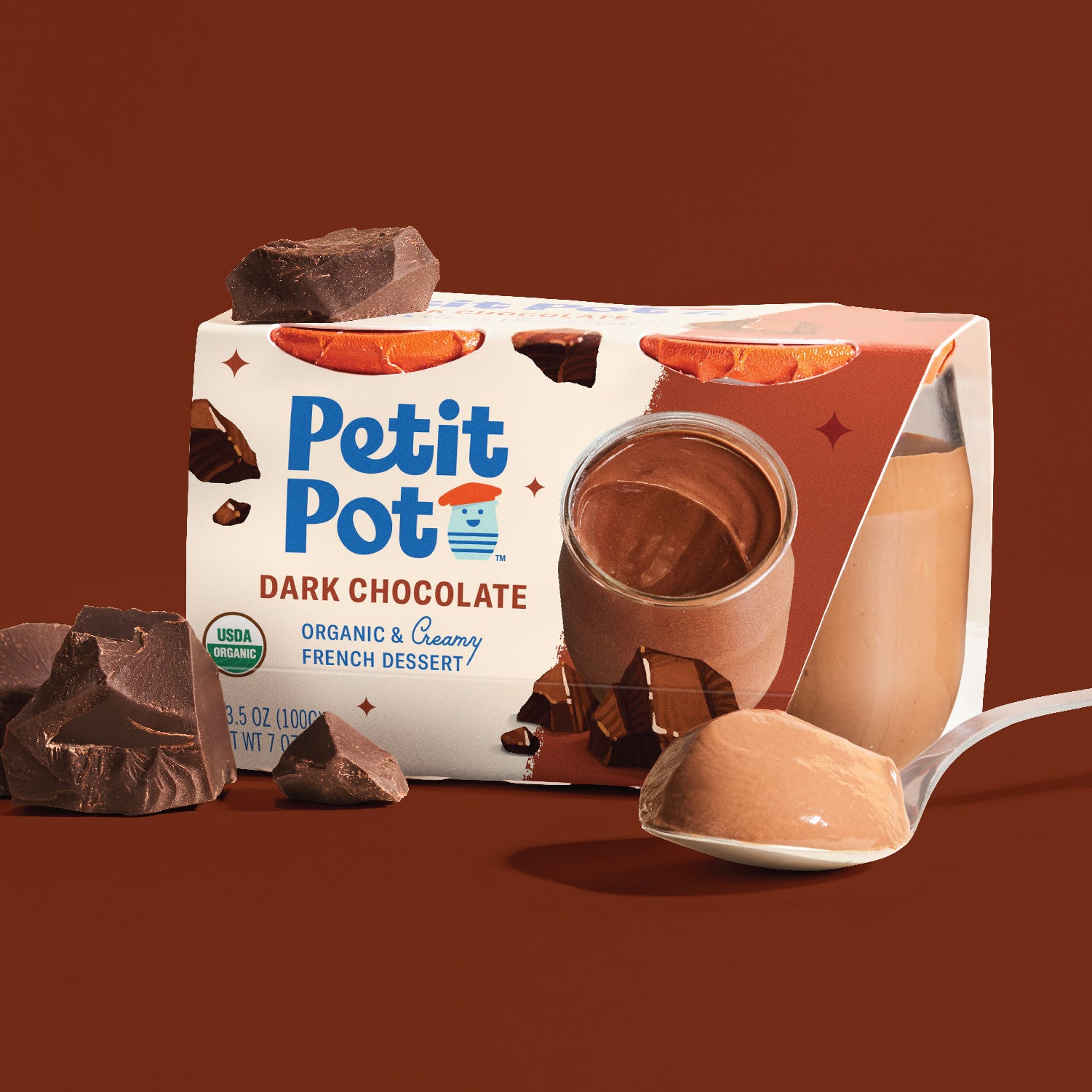
For people avoiding animal ingredients, the oatmilk chocolate version uses oat milk and coconut milk with dark chocolate and agar. The plant-based collection also includes vanilla rice pudding. These are choices within a dessert brand, rather than a demand that every customer eat the same way.
The practical instructions are uncomplicated: keep it refrigerated, follow the date and read the ingredient label for your particular recipe. Availability varies by retailer and location, so the store locator is more useful than assuming every flavor lives in every dairy case.
03 / THE PART YOU CANNOT TASTEThe factory behind the beret
Petit Pot self-manufactures in Emeryville. For a young food company, that is a substantial commitment. A production facility brings equipment, staffing, scheduling and quality control into the business. It also lets the people selling the product speak directly to the people making it.
In a 2022 Taste Radio interview, Pouvreau described cautious spending, planning and the arrival of an experienced operations executive as important to scaling production and reaching profitability. The account puts an unglamorous skill near the center of a charming brand: knowing what each additional batch asks of the business.
For another founder, the transferable idea is to make operational expertise an early concern. A recipe can win affection before a company knows how to deliver it consistently. More orders then multiply the production problem. Owning a factory is useful only when the team can operate it and the demand can justify it; renting capacity may suit a different business better.
Two jobs in the same dessert
At the shelf
Make it easy to want.Flavor, a recognizable package and a portion that fits an ordinary day.
Behind the shelf
Make it possible to repeat.Recipe control, production planning and dependable refrigerated supply.
Petit Pot describes a team drawn from more than ten countries, with daily product tasting built into its food philosophy. The pleasures are small; the work of making them involves a much wider company than the chef on the label.

04 / THE JAR MEETS THE RECEIPTA dollar changes the occasion
The paper cup is the most revealing extension of the idea. Petit Pot’s own FAQ puts the switch at Publix and Target in terms of customer value. Its rice-pudding cup page also describes a container suited to lunchboxes and snacking. A formal little dessert has acquired a more portable social life.
Less per serving, according to Petit Pot’s explanation of its paper-cup switch at Publix and Target.A COMPANY-REPORTED SAVING, NOT A PRICE PROMISE FOR EVERY STORE.
This is a useful distinction for anyone building a consumer product. Shoppers may care about the experience while caring less about a particular material. Changing that material can let a brand serve another occasion or price expectation. The test is whether customers still recognize the pleasure they came for.
Glass remains part of Petit Pot’s range. A redesign documented in 2023 reduced jar weight by 35% and used 55% post-consumer recycled glass. The company also sells reusable lids. An emptied pot can become a storage container; dessert has unusually accommodating leftovers.
Same little pot, less glass weight
A reusable vessel needs someone to reuse it. Petit Pot says it has no formal jar recycling program, leaving reuse and local recycling to the customer. The pleasing little object is an opportunity, not a guarantee of what happens after dinner.
05 / A DEADLINE, MISSEDThe packaging that nearly stayed on paper
During its brand refresh, Petit Pot’s existing paperboard supplier and printer could not meet the launch deadline. The company turned to JP Graphics and Monadnock Paper Mills. Together, they supplied the printed packaging within a week.
That is a better business anecdote than an immaculate launch. Packaging sits between the factory and the sale: if it does not arrive, a finished dessert still has somewhere it cannot go. A supplier’s timetable can become the brand’s timetable with alarming speed.
The copyable move is to treat alternative suppliers as part of launch preparation. Substitutions have to work with the actual pack and production process. The little flourish on the redesigned package - a barcode shaped like a jar and spoon - is delightful. The ability to obtain the package is rather more consequential.
06 / MORE THAN AN AFTER-DINNER POTProtein joins the dessert trolley
Petit Pot now has another answer to the question of when to eat pudding. Its protein range, launched in summer 2026, extends the brand toward snacking. The company’s protein site lists chocolate and strawberry four-packs with 8g of protein per cup, and a Costco chocolate 12-pack with 10g per cup.
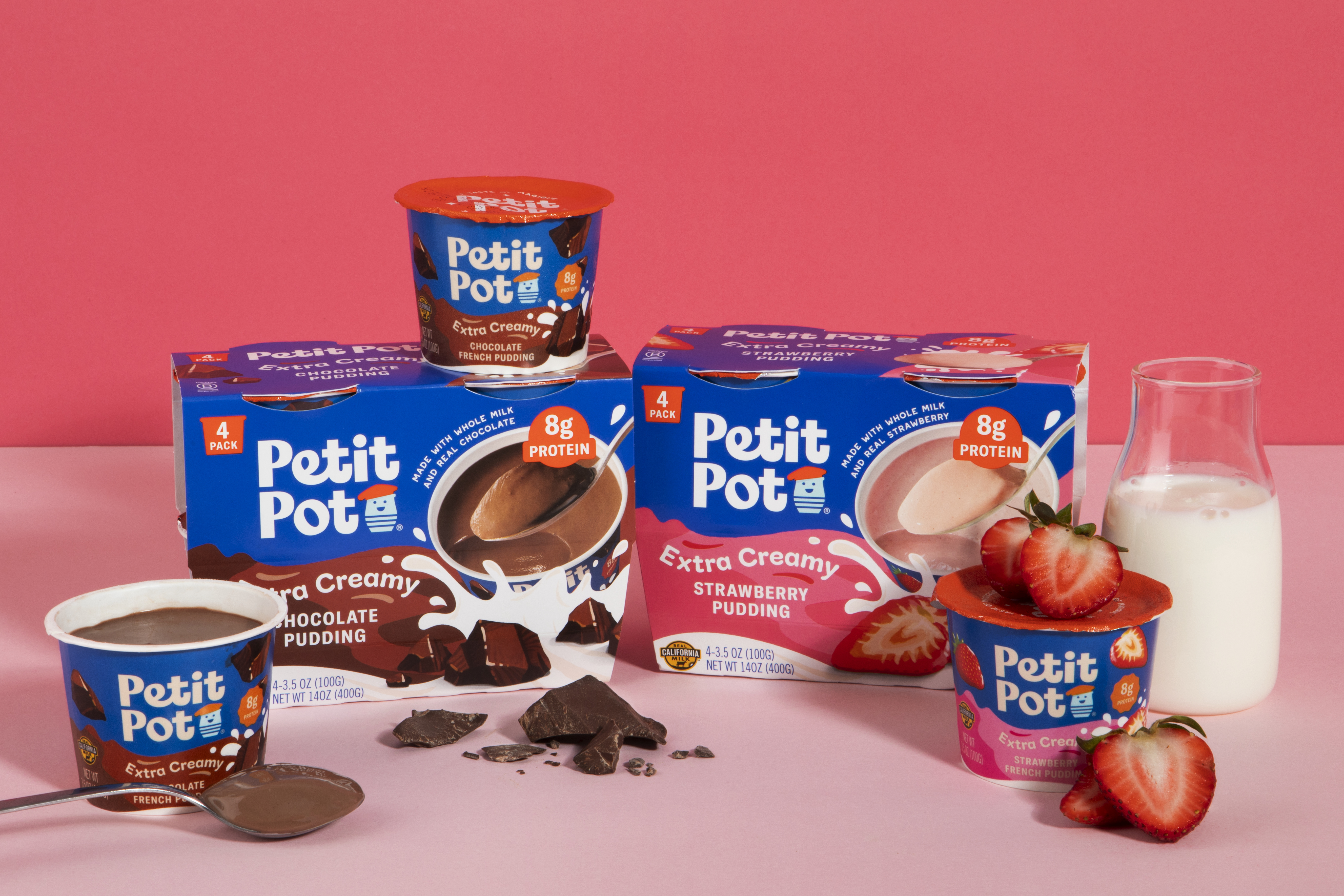
PACK MATTERS: 8g PER CUP IN THE FOUR-PACKS; 10g IN THE COSTCO CHOCOLATE 12-PACK.
The company still has to compete for an ordinary shopper’s attention. Kozy Shack, Jell-O, Snack Pack and store-brand puddings offer familiar alternatives; premium yogurts occupy a neighboring treat occasion. Petit Pot’s proposition combines French dessert identity, ready-to-eat convenience and manufacturing control. Those features have to earn their place in the basket through taste and value.
In November 2024, the California Milk Advisory Board reported distribution through 6,000 stores and awarded Petit Pot $100,000 in marketing support through its Excelerator competition. Sampling, coupons and in-store signs were among the intended uses. Even an appealing dessert benefits from someone being handed a spoon.
07 / THE NEXT SPOONFULSmall pleasure, larger distribution
On September 8, 2026, Petit Pot announced a seven-figure Series A co-led by Eclair Partners and Terri and John Penshorn, with existing shareholders participating. The proceeds will support product innovation and wider distribution. CEO Eric Lallart and founder Pouvreau are taking a business rooted in one dessert into a broader refrigerated range.
“Growing up in France, dessert was never just an afterthought.”
Maxime Pouvreau · September 2026 financing announcement
The wager is that an everyday pleasure can travel if you pay attention to the everyday part. Sometimes that means a glass jar worth keeping. Sometimes it means a paper cup that asks less of the grocery budget. The beret can stay; the business has learned to change clothes.
Find a pot. Hear the chef.
Explore the desserts, check nearby stockists or hear Pouvreau discuss the business in his own words.