The first jar was disgusting. This is Gardar Stefansson's description, not a critic's. In an Icelandic kitchen, he and his GOOD GOOD co-founders Johann Ingi Kristjansson and Agnar Lemacks tipped blueberries and sweetener into IKEA pots and produced something nobody should have been asked to spread on toast. It was also, inconveniently, the promising alternative their company needed.
The business then called Via Health sold stevia drops and tabletop sweeteners. Sales had disappointed. Several tons of inventory were moving toward expiration, which gave the founders two unpleasant prospects: food waste and a painful write-off. Gardar had a domestic clue. Every autumn he picked wild blueberries in the mountains and made jam. The customary quantity of sugar always struck him as absurd. Perhaps the stranded sweetener could replace it.
The answer was not in batch one. Nor did it arrive with a thunderclap. The three men kept cooking, tasting and correcting. Gardar has put the count at roughly twenty attempts before they had something worth selling. The eventual product moved from Icelandic production to a specialist manufacturer in the Netherlands. A rescue experiment became the line that changed the company.
First, learn to make salt
Gardar arrived at the jam problem with an unusual apprenticeship. He studied economics at the University of Iceland, then Experience Economy at Aarhus University in Denmark. While in Aarhus, he developed a business plan based on a 17th-century Icelandic technique: use geothermal heat to evaporate seawater. The idea became Saltverk Reykjaness. He later co-founded Nordur Salt, which produced delicate salt flakes designed to break easily between the fingers.
Salt taught him the unpicturesque parts of food entrepreneurship: build a production operation, create packaging, persuade buyers, manage exports, and keep the product moving. He has described those ventures as a practical education. When he left the salt business in 2015 and was asked to help restructure Via Health, he did not join as a laboratory technician. He joined as a food operator who understood that a commodity earns character through method, design and story.
There is a revealing piece of anti-romance in GOOD GOOD's next decision. The founders sold the stevia production machine. They kept product development, recipes and brand judgment close, but worked with certified producers, logistics brokers and warehouses nearer to Europe and North America. Iceland remained a place to design and test. It did not need to be the place where every jar was filled.
“The product was never the problem. The messaging was.”Gardar Stefansson
The ingredient was proud of itself
GOOD GOOD's early package led with “made with stevia.” The founders were proud of the ingredient and its place in the origin story. A shopper, however, was not standing in the jam aisle hoping to reward a mechanism. Gardar eventually recognized that the label was asking the customer to care about what fascinated the company.
The team changed the order of the message. Taste and recognizable ingredients came forward. “No added sugar” became the immediate point. Stevia moved to the fine print. The recipe did not change. The explanation did.
The shelf test: Gardar says a package may get only half a second of attention. Spend that moment explaining the shopper's outcome, not reciting the founder's favorite mechanism.
This is the sort of correction that looks cosmetic only to people who have never sold a physical product. Packaging is the salesperson already standing in every store. For a company without the advertising budget of an incumbent, the jar has to attract attention, establish the category and make its distinction legible before the hand moves on.
Amazon gave GOOD GOOD early evidence that strangers would buy. National retail required another education. A listing is not demand; it is permission to attempt demand. The work becomes sampling, promotions, placement, data and repeat purchase. Gardar still talks about in-store demos with the enthusiasm of a first launch. The founder who once obsessed over stevia now obsesses over whether the second jar follows the first.
That distinction explains why Gardar resists treating distribution announcements as the end of the story. Every new door creates a local test: does the jar sit in the right place, does its message survive a crowded shelf, and does the store see enough movement to keep it there? Expansion increases the number of those tests. It does not make any one of them optional.
Reported U.S. retail footprint
Selected public milestonesThe coach in the jar
By 2026, GOOD GOOD described itself as present in more than 10,000 U.S. stores and about 30 countries. Gardar was running the American operation from Austin while his co-founders remained in Iceland. Their lanes had sharpened over time: creative, finance and the entrepreneur in the field. Weekly founder calls could proceed without a written agenda, leaving room for the business and whatever else was on their minds.
His preferred management metaphor is coaching. “My job is to support them so they will succeed,” he has said. He looks for colleagues who will tell him when he is wrong, an event he cheerfully admits has occurred more than once. Job interviews begin with hobbies or a favorite karaoke song. The question is not a cute preamble. It signals that the conversation is between people before it is between titles.
The title itself receives little ceremony. Around one interview, Gardar had been driving a truck to a Costco road show because the opportunity needed doing. On LinkedIn, he turned a misunderstanding of the phrase “dogfood your product” into an outing with peanut butter at the City of Austin Animal Center. The dogs were pleased. The idiom was clarified later.
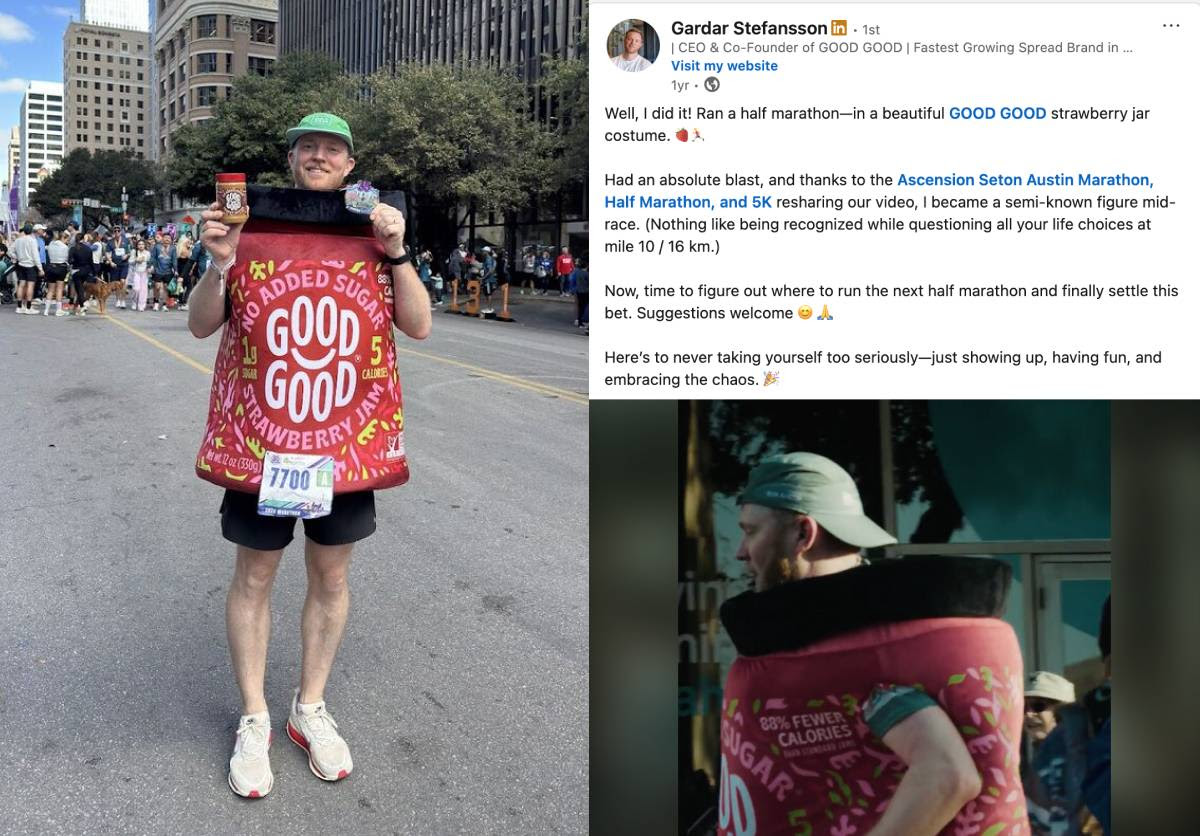
Then there is the costume. Gardar bet his marketing team that if it reached an ambitious follower target, he would run a marathon dressed as a jar of GOOD GOOD strawberry jam. The team reached the mark early. On February 15, 2026, he ran all 26.2 miles of the Austin Marathon in the bulky red cylinder. Around mile eighteen, he began questioning his choices. He finished in four hours and forty-three minutes. Two weeks later, he did it again in Atlanta.
“No matter your title, no matter your past experience, we can still have fun and do things that are quite insane.”Gardar Stefansson
A strawberry suit is not a management system. It is evidence. A leader made a silly promise in public, the team delivered its side, and the leader accepted a hot, heavy afternoon. Gardar's version of culture lives in such moments: keeping the wager, loading the truck, letting the colleague correct him, asking the human question first.
What remains after the pivot
GOOD GOOD has raised meaningful capital: a $3 million Series A announced in 2020 and a $20 million Series B led by Icelandic private equity group SÍA IV in 2022. Its products have moved through Amazon, Whole Foods, Walmart, Kroger and other retailers. In 2026 the company said a Target rollout of roughly 1,200 stores was planned for the fall, while it worked to expand the Austin team and bring more production closer to Texas.
Those milestones make the original kitchen scene look destined. It was not. There was merely expiring stock, a founder who remembered his blueberries, and the willingness to serve an embarrassing first attempt. The later lessons follow the same rhythm. Sell the machine when ownership adds little. Move closer to the market when distance obscures it. Change the label when it flatters the maker more than it helps the buyer. Earn the shelf again after the buyer grants it.
Gardar once framed entrepreneurship as doing fewer things particularly well, then repeating them before building outward. Jam is a neat object for this philosophy. It is not mysterious. It sits in a glass jar and receives a few seconds at breakfast. The complexity is backstage: recipe, supply, freight, cash, packaging, buyer meetings, demos and the quiet arithmetic of whether a household returns.
The useful theft from his story is not a flavor or a slogan. It is a habit of demotion. Demote the sacred ingredient when the customer does not care. Demote the title when a truck needs driving. Demote the first strategy when the inventory says otherwise. Even the CEO can be demoted, briefly and photogenically, into a jar of strawberry jam.