Every fashionable drink eventually encounters an unfashionable question: who is going to put it in the refrigerator? The answer involves loading docks, route maps, retailer meetings, production schedules and a small civilization of people who wake before the advertisement does. Christian Patiño Webb has spent much of his career in that civilization. In August 2026, OLIPOP handed him its chief executive job, entrusting an operator trained across several corners of consumer goods with the work that arrives after a brand becomes too large to run on momentum alone.
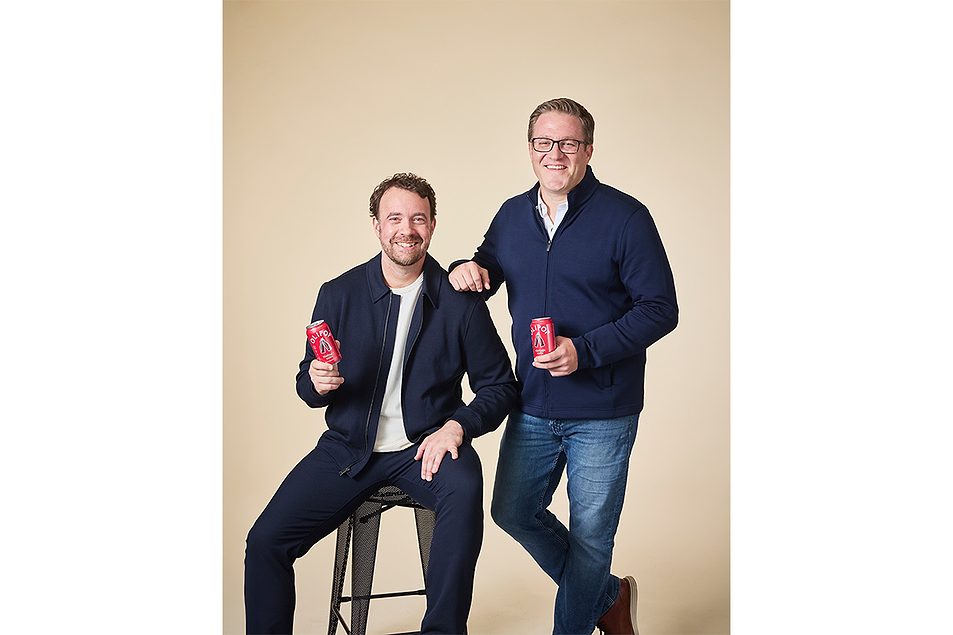
The appointment has a pleasing clarity. OLIPOP co-founder Ben Goodwin moved into the roles of executive chairman and head of innovation. Patiño Webb took charge of operations, distribution, organizational execution and expansion. One would keep a hand on the formula and the long view. The other would keep a hand on the machinery that turns those ideas into a business. The cans they held in the appointment photograph were the cheerful part. The division of labor was the consequential part.
Patiño Webb arrived with a record suited to the assignment. During his four years as chief executive of Electrolit, the Mexico-born beverage brand signed a long-term US sales and distribution agreement with Keurig Dr Pepper, announced a $400 million American factory and widened an international business that reached 13 countries. None of these achievements fits neatly into a thirty-second spot. All of them make the spot worth buying.
“Strong principles and humility combined with a robust competitive hunger.”Ben Goodwin on Christian Patiño Webb
An engineer enters the beverage aisle
Patiño Webb grew up in Mexico City and studied industrial engineering at Universidad Anáhuac. The pairing of place and discipline later proved useful. Mexico gave him intimate knowledge of brands that American executives could mistake for regional curiosities. Engineering gave him a habit of seeing systems where other people might see only products. He added an MBA from Duke University's Fuqua School of Business in 2012, where he served as president of the Latin American Student Association.
His education did not send him to a drafting table. It sent him into consumer goods. He began at Procter & Gamble, progressing from internships in finance and sales to brand work that included Herbal Essences. Johnson & Johnson followed, with a role on Neutrogena. These companies have long served as finishing schools for the people who give supermarket shelves their grammar: how a promise is framed, how a category is read, how a household name is kept familiar without becoming furniture.
Then came Red Bull, where Patiño Webb spent about five years moving through senior brand management, regional general management and senior marketing. Red Bull's famous media antics are only the visible crest of a rigorous field operation. A can gains cultural voltage through events and storytelling, then earns commercial value through disciplined execution in stores, bars and vending channels. Patiño Webb's résumé began to look less like that of a conventional marketer and more like that of a general manager who understood why marketing and distribution should share a calendar.
Brand school meets the startup corridor
After Red Bull, he crossed into younger companies. At Brandable, an incubator designed to create and launch consumer brands quickly, he worked in executive marketing. At Natural Hemp Company, associated with the Day One sparkling-water brand, he held a general-management role. The settings were smaller, the feedback loops shorter and the margins for error visible without a quarterly microscope. In 2020 he joined SmartyPants Vitamins as vice president of marketing, working under Unilever after the consumer giant acquired the company.
It was an unusually complete apprenticeship. Large companies taught stewardship. Startups taught speed. Red Bull connected culture to fieldwork. His engineering education sat quietly beneath the lot, a reminder that each dazzling brand is also a collection of constraints. A former colleague offered a more human observation in a public recommendation: Patiño Webb made projects more fun. The detail matters. Operations can be a grim noun. People still have to volunteer their best attention to it.
He also carried a cross-border fluency that cannot be manufactured in a workshop. Patiño Webb speaks English, Spanish and French, and his work has stretched across Latin America, the United States and Asia. When Grupo PiSA approached him in 2022 to lead Electrolit, he knew the brand from ordinary life in Mexico City. He said it had been present among his family and friends for years. Familiarity gave him a starting point. Ambition supplied the route.
The familiar bottle goes national
Electrolit's American expansion began with a sensible constituency: Hispanic consumers in Texas and California who already knew the bottle. The company did not have to invent recognition there. It had to convert recognition into availability, then use the resulting foothold to reach a broader public. Patiño Webb described the approach plainly. Win with the people who know you. Prove the product in a few markets. Add territory. Keep the message simple enough to survive the journey.
In October 2023, Electrolit and Keurig Dr Pepper announced a long-term agreement covering sales, distribution and merchandising across most of KDP's company-owned direct-store territories. At the time, Electrolit was already generating more than $400 million in US retail sales and had grown more than tenfold over five years. The agreement attached that demand to a system capable of reaching more coolers, stores and occasions. Distribution is easy to treat as plumbing until the pipe arrives at precisely the place a customer is thirsty.
The next decision was heavier. In November 2024, Electrolit announced plans for a 600,000-square-foot manufacturing and distribution plant in Waco, Texas. The projected investment was $400 million, with more than 200 skilled jobs and an opening planned for 2026. It would be the company's first production site outside Mexico. A bottle familiar from Mexico City was acquiring an industrial address in central Texas.
By late 2025, Patiño Webb could describe a business operating in 13 countries, with Mexico, Colombia and the United States as key markets and Spain serving as an entry point to Europe. The grand strategy had a practical backbone: follow existing affinity, partner for reach, then localize production when volume justifies the concrete. It is a method with little theatrical flourish. Fortunately, concrete does not need a launch party to be persuasive.
Two jobs hiding inside one title
OLIPOP's board hired Patiño Webb at a particular moment. The company had passed the half-billion-dollar sales mark. It had become available in tens of thousands of stores, and its 2025 financing valued the business at $1.85 billion. At that altitude, the CEO's job changes shape. The scrappy habits that produce early success must coexist with systems that make success less dependent on heroics. Forecasting gets less romantic. A missed shipment gets more expensive. Culture becomes something an organization has to transmit across layers.
Goodwin's move to executive chairman and head of innovation acknowledges another reality. Founders often remain the clearest custodians of product instinct, yet scale keeps inventing new administrative weather. The OLIPOP arrangement gives Goodwin room to work on product, research and long-term direction while Patiño Webb runs the expanding institution. Goodwin called the structure a partnership. The photograph of them together reinforces the point: two people, two cans, one company, no coronation scene.
Patiño Webb's stated priorities were equally revealing. He spoke of investing in people and capabilities, strengthening execution, preserving the culture and listening before acting. Those phrases can become executive wallpaper. His record gives them physical weight. At Electrolit, capability looked like a major distribution contract. Investment looked like a factory. Expansion looked like a progression from familiar regional buyers to a wider national audience. The nouns had addresses.
“Most importantly, I’ll be listening, learning, and working alongside this exceptional team.”Christian Patiño Webb on joining OLIPOP
The shelf is where strategy becomes visible
There is a temptation to describe Patiño Webb as a brand builder, which is true and incomplete. His career suggests that a brand is built twice. First it is made legible in the customer's mind. Then it is made available in the customer's world. One task belongs to language, design and memory. The other belongs to routes, capacity and the patient negotiation of physical space. Patiño Webb has worked on both sides of that border.
His new assignment will test whether those skills travel from bottled hydration to fizzy cans, from an established Mexican name expanding northward to an American upstart becoming an institution. The categories differ. The central question is familiar: how does affection become a dependable operating system without losing the character that created affection in the first place?
Patiño Webb has offered no grand theory in public. His preferred vocabulary is modest: listen, learn, invest, execute. There is wisdom in the order. A new chief executive inherits a living company, complete with habits that spreadsheets cannot fully capture. He has also inherited a founder who is staying close and a product with a strong identity. The task is to add capacity without adding drag, process without starch, reach without dilution.
The beverage aisle will provide the verdict. It is a ruthless little parliament, forever voting with facings, cooler doors and the inch-by-inch diplomacy of the shelf. Christian Patiño Webb understands its procedures. His career has been a long education in how a can earns its place there, and how a company learns to keep it filled.