Protein soda has the pleasant absurdity of a product invented during a dare. Soda is supposed to be a treat. Protein is supposed to arrive in a tub with a scoop, or in a beige bottle consumed beside a gym locker. SkyPop puts the two together and asks a much more commercially useful question: what if getting a little more protein felt exactly like opening a cold can at 3 p.m.?
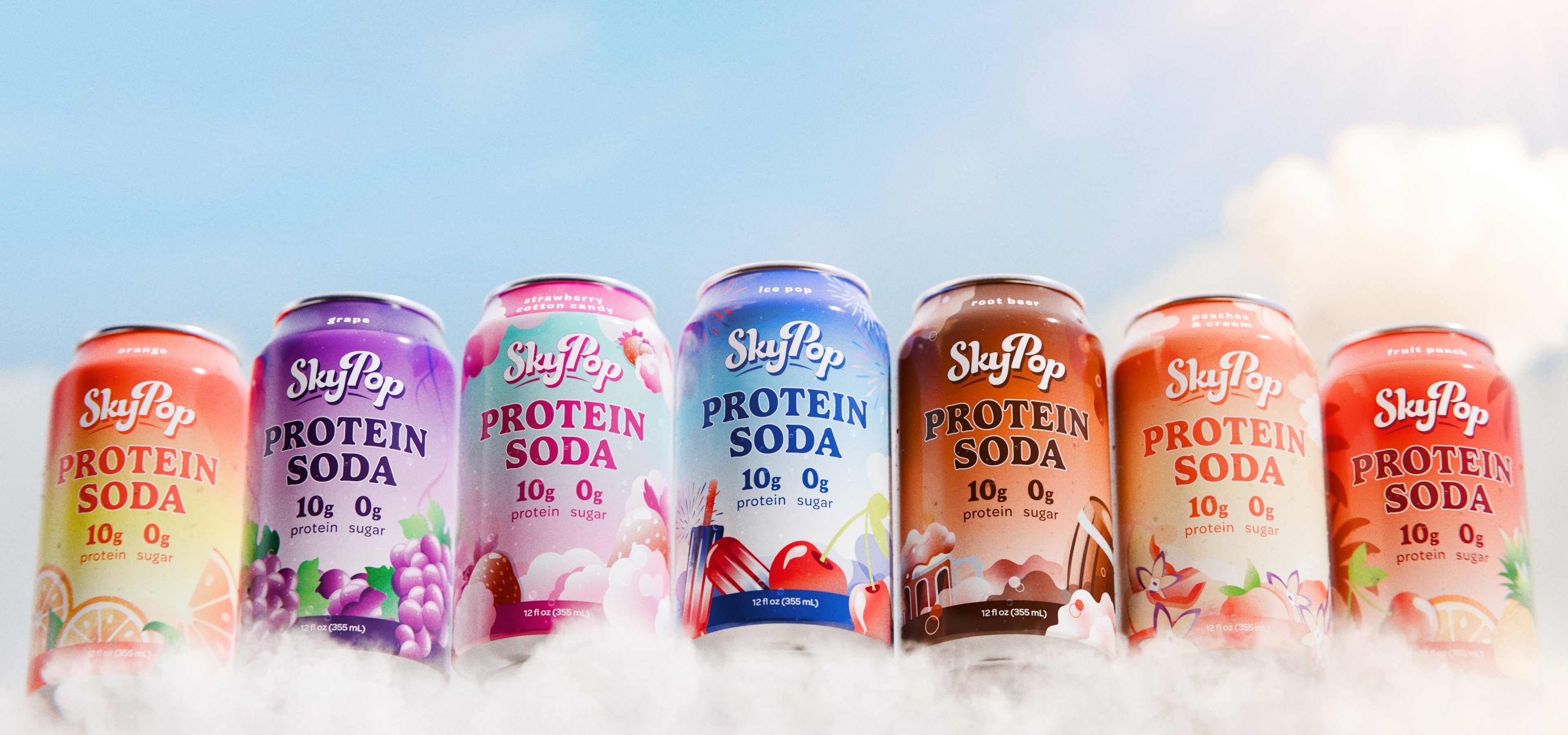
The Los Angeles company sells seven brightly illustrated flavors - Root Beer, Grape, Orange, Fruit Punch, Ice Pop, Peaches & Cream and Strawberry Cotton Candy. Every 12-ounce can carries the same front-of-pack arithmetic: 10 grams of complete whey protein, zero sugar and 45 calories. They are caffeine-free and gluten-free, but not dairy-free; whey means the label contains milk. The pitch is deliberately modest. This is not lunch in a can. It is soda with one obvious extra job.
01 / The first product was not the answer
The company took six years to write a one-sentence pitch
SkyPop began life in 2020 as Don't Quit, a clean-label meal-replacement shake created by fitness entrepreneur Jake “Body by Jake” Steinfeld with beverage incubator L.A. Libations and Keurig Dr Pepper. The original line aimed at Ensure and Boost, with 10-gram shakes priced at a suggested $8.99 per six-pack and 30-gram “MAX” shakes at $9.99 per four-pack. Its name came with a perseverance story; its bottles came with 26 vitamins and minerals.
That was version one. By 2023, after Don't Quit merged with Mark French's energy-drink company X2 Performance, French became CEO and the ambition widened into a sports-nutrition platform. Protein drinks became “Sports Protein.” Energy drinks joined the plan. Investors included Madison Square Garden Sports, L Catterton and Sweetwater Private Equity. The shakes reached professional baseball through NSF Certified for Sport status. It was credible, connected and increasingly complicated.
Meal replacement
Don't Quit launches as clean-label nutrition shakes.
Sports platform
X2 merges in; protein and energy products share the roster.
The fizzy signal
Four protein sodas earn unusually fast retailer adoption.
One category, one name
Shakes go. SkyPop takes the soda aisle.
The first thing to fail was not necessarily sales. It was focus. X2 itself disappeared after the merger. Then the wide sports platform gave way to one product whose appeal reached beyond post-workout recovery. When Don't Quit introduced protein soda in 2025, retailers responded faster than the team expected. French said they had never seen adoption like it. The company later reported more than 65,000 retail facings lined up across Target, Walmart, Kroger, Albertsons and Safeway banners, CVS and Gopuff.
Retail pull did what another brand workshop could not: it identified the company’s actual product.
YesPress analysis
That signal changed the brief. In January 2026, Don't Quit became SkyPop and stopped selling shakes. The new identity traded a command for a mood. “Don't Quit” sounded like the final rep of a punishing set; “SkyPop” sounded like opening something cold on a sunny day. The packages put “PROTEIN SODA” in billboard-size type, then reduce the nutritional story to three numbers. A shopper can understand the entire company before the cooler door closes.
02 / The middle of two aisles
It is not the strongest shake or the cheapest soda. That is the point.
SkyPop sits between modern soda brands such as Poppi and Olipop and ready-to-drink protein names such as Core Power and Muscle Milk. Its 10 grams are fewer than a typical recovery shake and more than ordinary soda's zero. That apparent compromise creates the occasion: lunch accompaniment, afternoon snack, commute, desk drawer, anywhere a 30-gram milkshake-style bottle feels like too much.
Benefit intensity / illustrative shelf map
This is a positioning diagram, not a nutrition ranking. The useful space is between refreshment and recovery.The formula explains both the advantage and the limits. Whey protein isolate supplies all essential amino acids, unlike collagen-only claims, and keeps the calorie count low. Natural flavors, sucralose and carbonation do the soda work. A mushroom extract appears in a small amount to protect quality. The result is approachable only if the last sip still feels like soda. Protein sediment, acidity or a lingering sweetener note can wreck the trick faster than any competitor can.
Public pricing exposes another test. Target has listed singles around $2.39 to $2.59, while SkyPop's TikTok Shop has shown 12-packs at $39.99 before promotions. That is a premium over mainstream soda and, depending on the store, close to ready-to-drink protein territory. The consumer must value convenience and the extra 10 grams enough to pay, then like the flavor enough to return after curiosity wears off.
SkyPop has unusual help. Keurig Dr Pepper is a strategic backer and reported controlling owner, with a distribution system that young beverage companies normally spend years trying to access. L.A. Libations supplies incubation and retail expertise. MSG Sports brought capital and athlete adjacency. iHeartMedia adds national reach. A 2025 growth round was announced at $15 million, led by Solyco Capital, after a planned $10 million strategic round in 2023. Russell Westbrook later joined the investor roster. The company has not publicly disclosed its valuation or revenue.
Those numbers put a useful price tag on the phrase “national launch.” A beverage cannot be copied and pasted into 65,000 shelf positions. It must be formulated at scale, canned, warehoused, shipped, slotted, sampled and supported with enough marketing that a baffled shopper gives protein soda one chance. The public record does not break out SkyPop's rebrand budget or per-can margin, but its financing history makes the broader point: physical distribution is a capital event. The 2023 strategic raise was described as a $10 million plan; in 2025, the company was closing a further $15 million round. A founder copying the colorful cans without planning working capital would be copying the cheapest part.
The operating model mixes wholesale distribution with online multipacks. National chains create reach and the credibility of a familiar cooler. Shopify and TikTok Shop let the brand sell cases, capture customer data and test demand away from a retailer's reset calendar. The two channels solve different problems. Direct commerce is a useful laboratory, but soda is heavy and expensive to ship. Retail is efficient for trial, but the store owns the relationship and can remove a slow flavor. SkyPop's partner network reduces those disadvantages; it does not repeal them.
Its customer is best understood as an occasion rather than a demographic. The gym regular already has a shake. The committed soda drinker may not care about protein. SkyPop is hunting the moment when someone wants refreshment, notices a modest nutritional bonus and prefers a can to another bar or milky bottle. GLP-1 use and wider interest in protein make that moment more common, but the brand wisely avoids presenting itself as a medical product. It sells a beverage, not a treatment plan.
03 / The copyable part
Steal the sequence, not the celebrity cap table
Most founders cannot borrow Keurig Dr Pepper's trucks or Madison Square Garden's credibility. They can copy the sequence that made those assets useful. Start with a weirdly clear wedge. Put it into the real buying environment. Treat retailer enthusiasm as a clue, not proof. Watch whether consumers buy again. Then remove every product, slogan and audience that makes the winning behavior harder to explain.
Ask when the product gets used, not only who says they like it.
Retailer adoption can reveal a category opening before survey language catches up.
One benefit, one format and one shelf beat an ambitious platform customers must decode.
SkyPop's 10 grams leave room for taste. The maximum claim is not always the best product.
The conditions matter. This playbook fails when the first purchase is novelty without repeat demand; when a retailer says yes but the shelf goes empty because operations cannot follow; when the functional ingredient damages taste; or when the accessible dose is too small to feel valuable. SkyPop also cannot serve people avoiding dairy, and sucralose will repel a portion of ingredient-conscious shoppers. A protein halo does not make soda essential nutrition.
Nor is the category empty. Protein Pop and newer sparkling protein drinks are chasing the same white space. Poppi and Olipop trained consumers to accept function in a soda can, while Core Power taught them to pay for portable protein. SkyPop's reported patent around carbonated ready-to-drink protein may help, but shelf position, price, flavor and repeat purchase form the moat shoppers can actually taste.
The final irony is useful. Don't Quit was built around perseverance, yet its smartest move was quitting products that no longer clarified the future. The company did not abandon its belief in accessible nutrition. It translated that belief into a lighter ritual and a less demanding name. In consumer goods, persistence is not keeping every idea alive. Sometimes it is keeping the learning and changing the can.
SkyPop contains milk. Nutrition and ingredient details can change; shoppers with allergies or dietary restrictions should read the package sold in their market. The company’s retail-facing count is a company-reported distribution measure, not a count of stores or customers.