There is an old joke in packaged food: the customer pays the company to ship water. A jar of puree is mostly water. A refrigerated pouch is mostly water. Water makes the product heavy, fixes its texture in advance, and demands either heat or a cold chain to keep trouble away. Amara Organic Foods looked at that arrangement and made a sly proposal: what if the parent supplied the water?
The packet, opened
- Organic baby meals arrive as powder; caregivers add breast milk, formula, or water.
- The range now includes smoothie melts, oat melts, fruit bites, and functional snacks.
- Sales run through Amara, Amazon, and retailers from Whole Foods to Walmart and Costco.
- The repeatable lesson: learn in a small market, explain plainly, and vary the channel experience.
The result is a packet of organic fruit, vegetables, grains, or plant proteins that can sit on a shelf. Add liquid and it becomes a puree. Add less and it is thick; add more and it is loose. The factory no longer gets the final word on consistency. This is a small liberty, perhaps, but infancy is composed almost entirely of small liberties negotiated at high volume.
Amara calls its proprietary method Nutrition Protection Technology. The company says it uses very cold temperatures and ingredient-specific preparation to remove water while retaining the food's color, flavor, texture, and nutrient structure. It avoids the repeated high heat used in conventional shelf-stable processing. It also produces a powder that needs no refrigeration and, by Amara's calculation, uses 12 times less packaging.
A magnificent machine, described badly
Jessica Sturzenegger, now founder and CEO, came from finance rather than food manufacturing. The company had to build its process and supplier network instead of phoning a standard co-packer with a flavor request. A PhD nutritionist, a chef, and food scientists helped formulate the food. Co-founders Cristian Boada and Vicki Johnson were part of the founding team. The product took three years to reach the shelf.
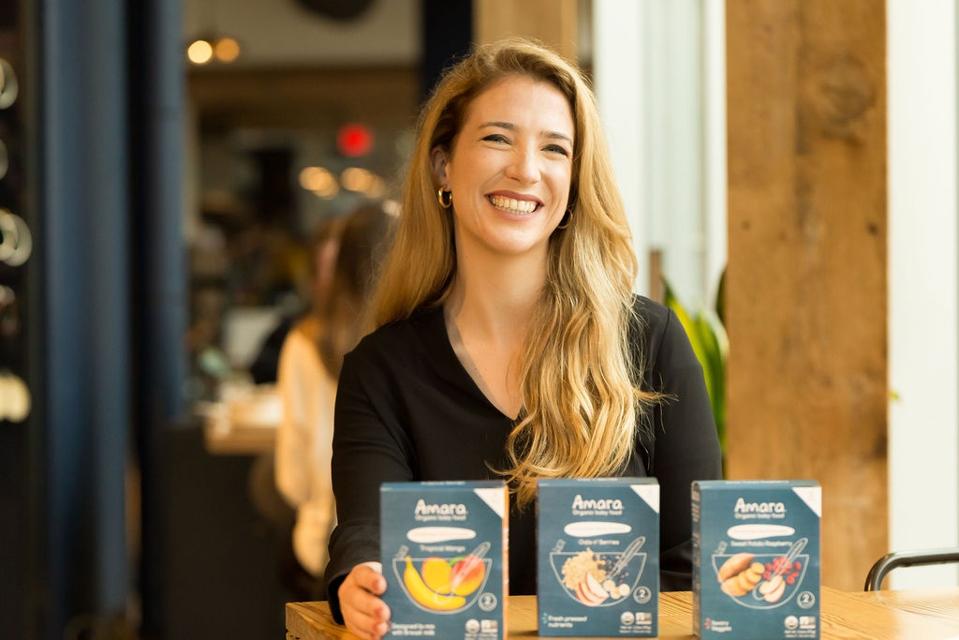
Then came the anticlimax. Sturzenegger spent weeks preparing Amara's first Amazon listing, nervous about making it public. It went live. Orders did not flow. For a while she wondered if the system was broken. The technology was doing what it should; the market was under no obligation to applaud.
The first explanation was too technical. Amara talked about nutrient structure. That pleased a certain strain of San Francisco biohacker and left ordinary shoppers staring politely into the middle distance. “We started off being really techy, and you'd see their eyes glaze over,” Sturzenegger later recalled. The better sentence was almost embarrassingly simple: Amara starts with fruits and vegetables and takes out the water.
We want to be the first choice after homemade for Moms.Jessica Sturzenegger, 2017
That change matters because a company may own a complicated process while selling a very ordinary relief. Parents are not browsing the baby aisle in search of an elegant dehydration thesis. They are trying to feed a child between the lost shoe and the late meeting. The science earns the right to make the promise; it need not consume the promise.
Organic ingredients are sourced and prepared separately.
Water comes out through the company's low-temperature process.
The dry result travels without refrigeration and with less weight.
A caregiver adds liquid and chooses the final texture.
The grocery aisle became the laboratory
Amara's more consequential decision was to learn locally. In 2017 it was in roughly 400 stores across California, Nevada, and Utah, including Whole Foods, Bristol Farms, and Lazy Acres. Sturzenegger could still visit the Northern California locations herself. She asked customers why they picked up the box, watched what sat beside it, and learned how quickly a package must explain itself.
This is the most useful part of the story for another founder. Start in a footprint small enough to observe. Know the rate at which product leaves each shelf. Fix the packaging before assuming the formula is wrong. Amara's original food changed little after launch; its packaging, channel strategy, and story changed a great deal.
The sequence was regional stores, then wider retail, then scale. By late 2021, the company had grown from about 100 to 1,000 stores in 18 months. Its then-investor later reported roughly 6,000 North American points of distribution at year end. In 2024, Amara ranked No. 44 on the Inc. 5000, up from No. 2,754 the year before. By 2026, Nosh reported that newer Target and Walmart placements had helped distribution jump another 72 percent.
The child grew, so the company followed
Baby-food customers eventually presented Amara with a pleasant problem: their babies became toddlers. Parents asked what came next. The answer was Smoothie Melts - small, dissolving fruit-and-vegetable snacks made without added sugar - followed by Breakfast Oat Melts, Organic Fruit Bites, and a 2026 line of Superfood Smoothie Melts built around Protein, Brain, Immunity, and Gut Health formulations.
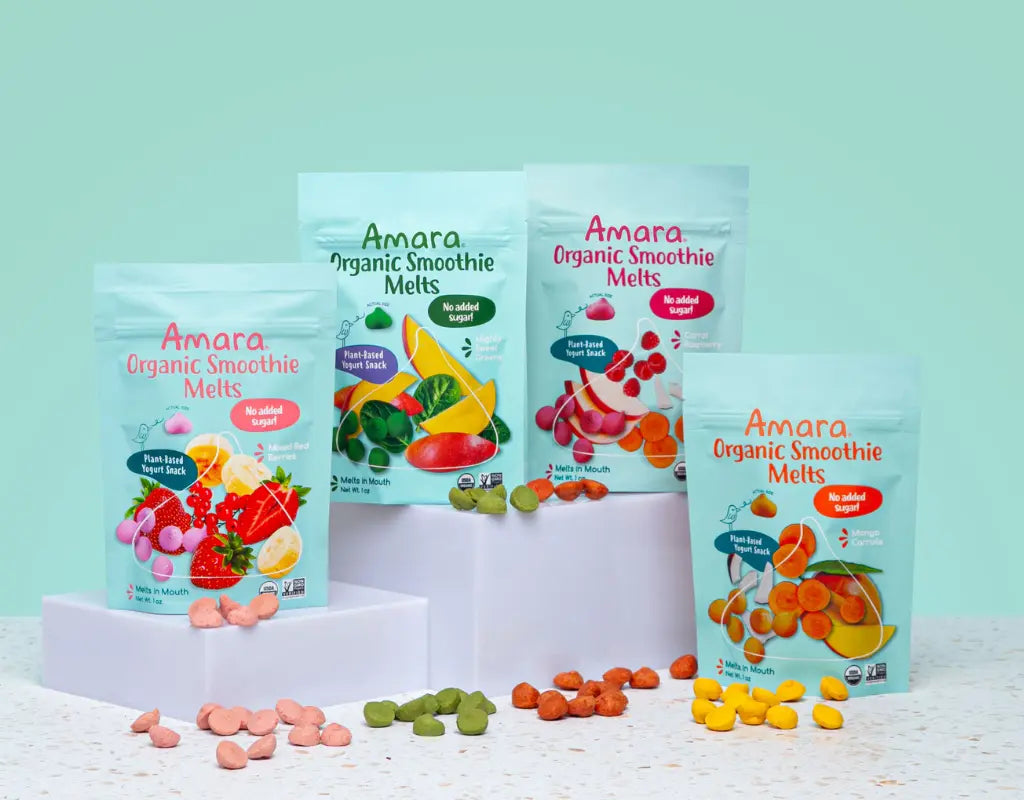
The melts reveal the less visible edge of the business. “No added sugar” is a pleasant phrase on a package; making a snack dissolve properly without sugar, starch-heavy binders, or a thicket of additives is a manufacturing constraint. Amara says it was initially told sugar was necessary for the melt. Its team kept developing until the texture worked through the properties of the fruits and vegetables themselves.
That is where Amara sits in the market. Conventional jars and pouches win on immediate readiness. Refrigerated brands such as Once Upon a Farm sell a cold, fresh proposition. Little Spoon delivers prepared meals. Cerebelly, Serenity Kids, Tiny Organics, and Earth's Best each make their own argument about nutrition, format, or ingredients. Homemade food remains the moral ideal and the logistical nuisance. Amara occupies the middle: shelf-stable like the old aisle, ingredient-conscious like the new one, and slightly participatory at the moment of eating.
A business with several front doors
Amara makes money as a consumer packaged-goods company, not as a licensor of laboratory magic. It sells bundles and subscriptions through its own Shopify store, lists on Amazon and TikTok Shop, and supplies grocery, mass, and club retailers. Whole Foods, Target, Walmart, Sprouts, and Costco are among the names. The same household may meet the brand in a single pouch at Target, a multi-pack at Costco, or a variety subscription online.
Sturzenegger's view is that each channel contains a different shopper. Direct customers need a reason to type in a card number. Amazon customers value speed and familiar mechanics. Club shoppers expect volume. Grocery shoppers decide with the shelf in front of them. The product may remain constant, but the pack, assortment, and buying experience should not pretend those people are identical.
Reported venture funding
Capital helped widen those doors. A $2 million seed round in 2020 was followed by a $12 million Series A in 2021, led by Eat Well Investment Group. That transaction created a majority partnership and carried a reported $100 million valuation. HumanCo, Melitas Ventures, and Touch Capital backed a $20 million Series B in March 2024. Eat Well later sold its remaining PataFoods stake in March 2025 for $1.25 million, ending its ownership position.
The useful limit
Amara works best when a family wants shelf life, recognizable ingredients, and some control over texture. It is less suited to the moment when even adding liquid and finding a spoon is too much. Its powdered meals also ask shoppers to understand an unfamiliar format, while refrigerated rivals can show a ready-made puree through the package.
The broader playbook has its boundary too. Slow regional learning is valuable when a founder can visit stores and when the product has enough margin and shelf life to tolerate experimentation. It becomes harder with a short-lived product, a retailer demanding instant national volume, or a category where the purchase cannot be observed at the shelf.
The transferable trick
The obvious thing to copy from Amara would be the powder. That would also be the least copyable thing. The company has spent years on process engineering, supplier qualification, taste, safety, and texture. The more portable idea is organizational: keep the complexity backstage.
Build the difficult product carefully. Launch where the team can watch it fail in small ways. Ask the embarrassing question - why did you buy this? - often enough to hear an answer rather than confirm a theory. Give each channel a reason to exist. And when the customer finally understands the benefit, resist the engineer's urge to explain the mechanism all over again.
Amara's first useful insight was that baby food did not need to carry its own water. Its second was even lighter: neither does a good story.