The first thing Graza sold was permission. Permission to stop treating good olive oil like a bottle of perfume, uncorked for company and guarded from Tuesday-night eggs. Its dark-green squeeze bottles sat on the counter, not in the cupboard. Their labels issued tiny orders - Sizzle for the pan, Drizzle for the plate - and the point was obvious before anyone read a harvest note. Squeeze more. Cook more. Finish with a bright green stripe and move on with dinner.
That behavioral trick helped a Brooklyn startup enter one of the oldest and most crowded grocery categories. Co-founders Andrew Benin and Allen Dushi launched the first two oils in January 2022. Graza sold out in its first week, booked roughly $100,000 in revenue and crossed $500,000 by April, all before buying a paid ad. By 2025, it was stocked in more than 18,500 stores and had been reported as the fifth-largest olive-oil brand in the United States. CNBC projected $48.4 million in 2024 sales. An early investor later marked the private company at a reported $240 million valuation.
01 / The productAn olive-oil decision tree you can hold
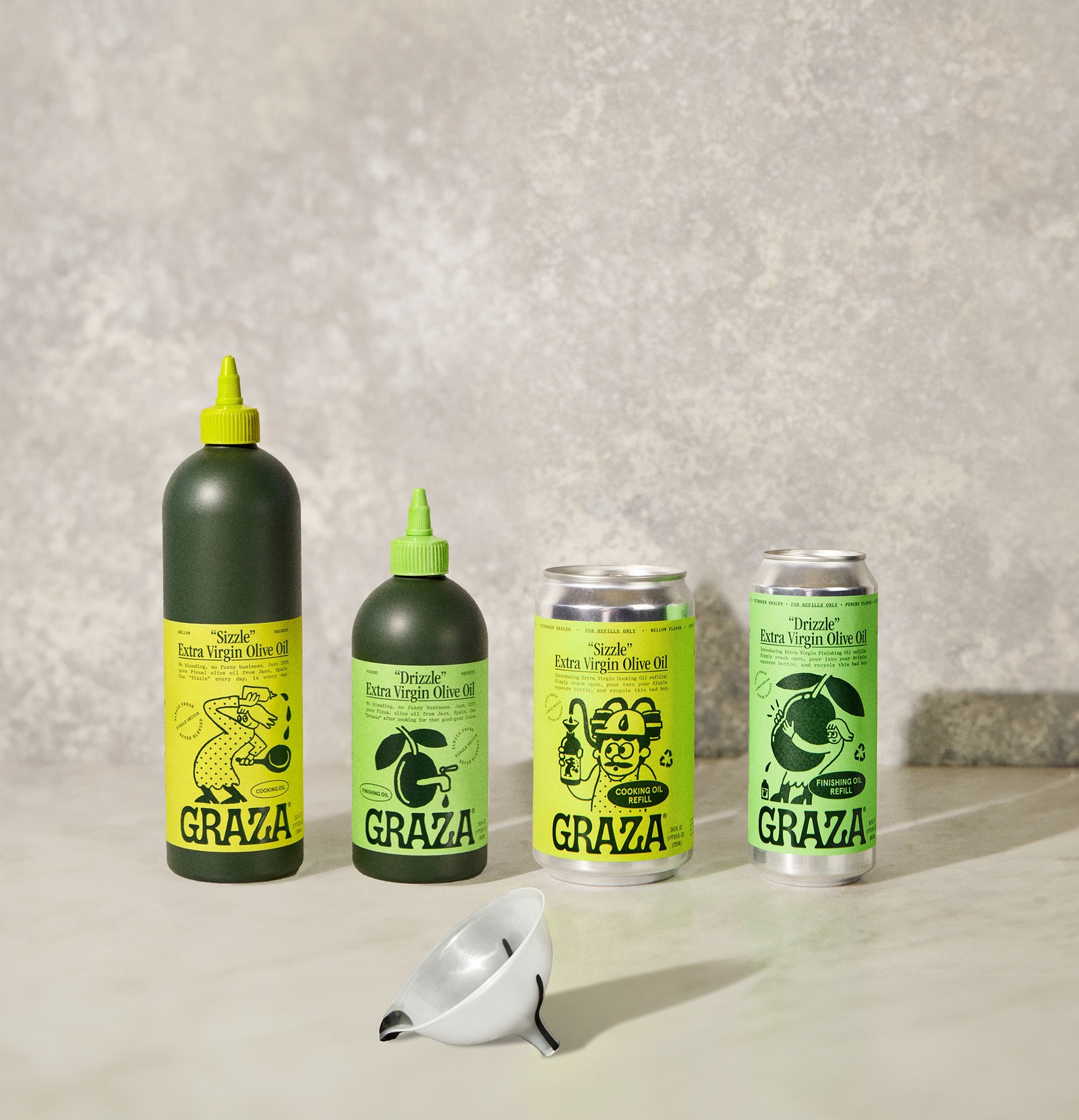
Graza's original system begins with Picual olives, sourced primarily from Jaén in southern Spain. Drizzle uses younger, early-harvest fruit. The lower yield costs more, but produces a greener, pepperier finishing oil. Sizzle comes from more mature olives, with a mellower flavor for roasting, sautéing and baking. Same broad ingredient, different harvest moment, different job.
The design matters because olive oil has a translation problem. Labels usually talk about acidity, origin and extraction while a cook is asking, “Can I fry an egg with this?” Graza names the use. It separates a pantry category by task, then puts both answers in bottles that dispense a neat line instead of a hopeful glug. The package is product education, measuring tool and cameo-friendly prop at once.
02 / The shower thoughtMicrosoft Paint, Dr. Bronner's and a useful theft
Benin had lived in Spain, become fixated on fresh olive oil and spent time in the kitchen at Gramercy Tavern, where chefs already kept oil in utilitarian squeeze bottles. Yet the consumer package did not click immediately. His team considered pouches and Tetra Paks with nozzles. Then he ran out of Dr. Bronner's liquid soap in the shower, washed the cylindrical bottle and filled it with olive oil. The next day he opened Microsoft Paint, grabbed a still of Gordon Ramsay and drew a lime-green squeeze bottle into the chef's hand.
The anecdote is funny because it makes the result sound instant. It was not. Graza tested about 300 squeeze bottles before settling on its package. The chosen PET construction was less permeable than the cheap squeeze bottles on restaurant lines, while the opaque green blocked light. It still invited a reasonable objection: oil stored in plastic can age faster than oil in glass, particularly when kept warm for months. Graza's answer was behavioral. The bottle was made for oil people would use, not archive.
The package did not make olive oil new. It made the hand movement better.The Graza thesis in one line
A chef friend changed the business ambition as sharply as the bottle changed the motion. Benin initially imagined importing exceptional, small-batch European oils. Mike Anthony, the executive chef at Gramercy Tavern, told him the world did not need another scarce and expensive olive oil. The open space was quality at a price and volume ordinary shoppers could reach. Benin later said that conversation changed his perspective completely: mass and scale became the operating principles, without surrendering quality.
03 / The launchGive creators a prop, then get out of frame
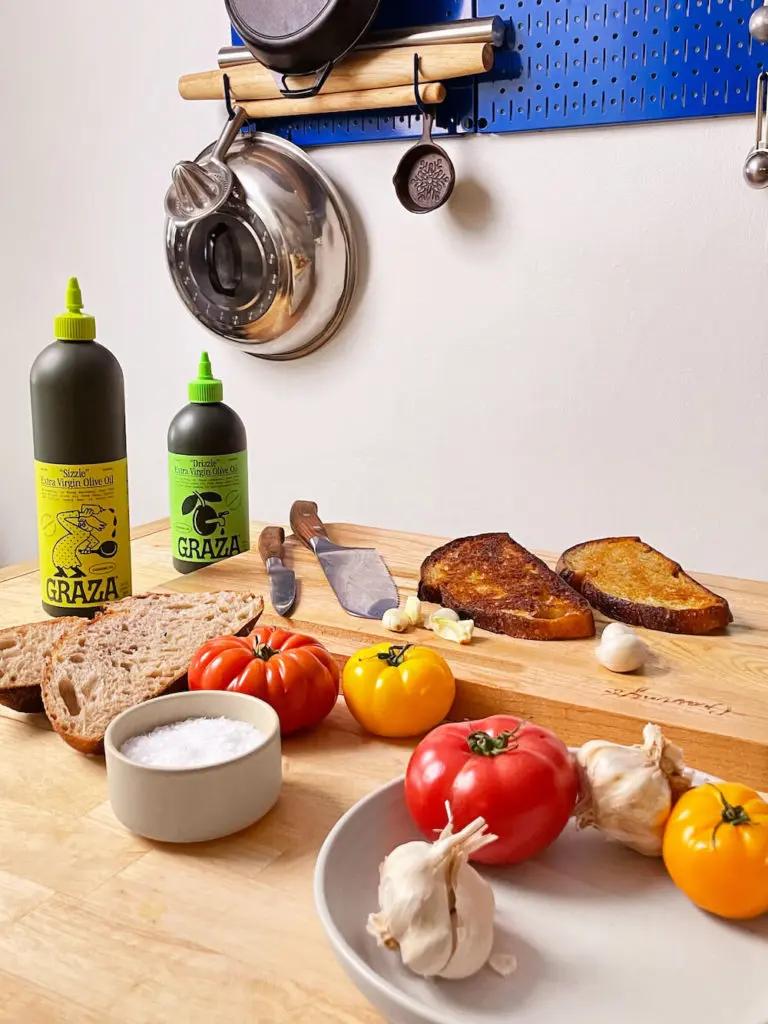
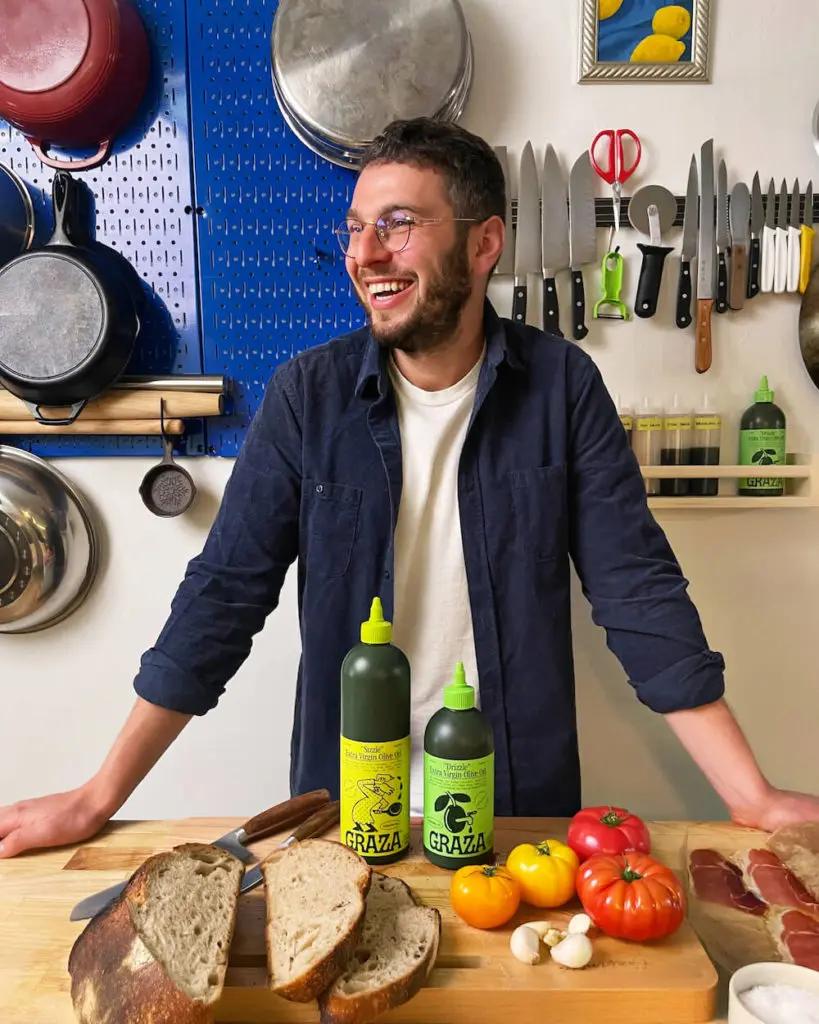
Three weeks before launch, Graza began sending around 25 packages a week to food creators. There were no scripts, mandatory posts or talking points. That matters. A cook could make pizza, barbecue, ice cream or a joke, and the green bottle still supplied visual continuity. The product was easy to recognize at phone-screen size and entertaining to operate on camera.
When cookbook author Molly Baz ran through her gifted bottles, Graza sent restaurant-sized jugs. Her late-night Instagram story helped trigger a rush. The team watched traffic pile into its Shopify dashboard and sold through the first inventory within the week. The campaign cost oil, packaging, postage and relationship work. It did not require an audience rental fee, but it was not free: the bet only worked because the recipients genuinely liked using the thing.
From browser tab to grocery shelf
Graza also understood the limit of its origin story. Benin argued in 2022 that “there is no such thing as DTC anymore.” Digital channels could create attention and tell the story, but the purchase had to become omnichannel. A Whole Foods buyer contacted the company on launch day. From there came national grocery distribution, independents, Costco-scale formats and a replenishment loop online. Social made the bottle familiar; retail put it beside dinner.
04 / What brokeThe holiday box that arrived looking hungover
What failed first: fulfillment, not demand
During the 2022 holiday rush, Graza's popularity outran its operating capacity. Some gift sets arrived late, damaged or missing a bottle. Benin sent an 835-word apology to 35,544 people who had ordered in the previous 60 days - not only to customers who complained.
The email did not make a dented gift presentable. It did show a useful instinct: tell the truth at the same scale as the mistake. Nearly 1,000 replies reportedly arrived within minutes. The company offered a discount and described what had gone wrong. For a chatty brand, a bloodless “we regret any inconvenience” would have sounded stranger than the failure itself.
There was another, self-inflicted stumble. When rival Brightland released Pizza Oil in a squeeze bottle in 2023, Benin publicly accused the company of copying Graza. The internet mostly reminded him that restaurants had used squeeze bottles for decades. The episode exposed the danger of confusing a signature with ownership. Graza made the format culturally visible; it did not invent squeezing.
05 / The second actRefill the icon, widen the pantry
A recognizable bottle can become a trap: every repeat order creates more plastic, while every competitor can copy the silhouette. Graza's 2024 response was an aluminum “beer can” refill. Each opaque can is nitrogen sealed, recyclable and portioned to refill one Sizzle or Drizzle bottle. The company currently sells the paired cans for $37; a starter subscription combines bottles, cans and a funnel for $65, with subsequent refill shipments listed at $33.30.
Then the verbs expanded. Frizzle, launched in 2025, is a neutral high-heat oil made from physically refined olive pomace oil blended with extra-virgin olive oil. It uses material left after the first extraction and works for frying, grilling, wok cooking and baking. Graza sells it in squeeze, non-aerosol spray and jug formats. The launch had been teased for years, then delayed by the scale needed for natural refining, the shock to oil markets after Russia's invasion of Ukraine and two poor Spanish harvests.
Glass bottles, bag-in-box Sizzle, sprays, chips, mayonnaise and garlic aioli now fill out the assortment. Collaborations with Ithaca Hummus, RIND, Aura Bora, Little Spoon and Fishwife keep the brand traveling into neighboring categories. The business is becoming a kitchen platform, though one with a discipline problem to avoid: every clever extension must still answer a real cooking question.
06 / The stealable partsCopy the mechanics, not the green bottle
The hardest piece to copy is the stack. A squeeze bottle alone is a kitchen-supply item. Add credible single-origin sourcing, prices below trophy oil, simple use-case architecture, cheerful design, creator fluency and national shelves, and it becomes an operating system for a category. This is why copycat bottles can validate Graza even as they weaken its visual moat.
When the Graza playbook will not work
- The behavior is not frequent. A tactile package matters less for a product used twice a year.
- The format harms the product before customers finish it. Slow consumption and hot, bright storage make plastic a worse bargain.
- The visual novelty has no repeat-purchase reason behind it. Cute packaging may win the first basket and lose the second.
- Creators need heavy scripting to explain the value. That usually means the product is not doing enough communication itself.
- Operations cannot survive the spike. Demand that produces late or damaged orders is expensive applause.
Graza fits between supermarket commodity oils and estate bottles treated like wine. Its customers are home cooks who care about freshness and flavor but still want to roast vegetables without doing arithmetic. Its competitors range from Brightland and Cobram Estate to California Olive Ranch, private labels and a five-dollar reusable squeeze bottle filled with bulk oil. That last alternative is the most revealing. Plenty of customers reuse a Graza bottle with cheaper oil. The brand's defense cannot remain the nozzle. It has to make what is inside worth refilling with Graza.
For now, the company has changed the shelf's grammar. Olive oil can be Sizzle, Drizzle or Frizzle. It can arrive in a can, jump into mayonnaise and wink from a cooking video without a sommelier in sight. Graza's payoff is not that an ancient product became new. It is that the premium choice became easy enough to reach for before the pan got hot.