The first useful thing to know about Rambler is that its founders were not beverage lifers. They were Austin friends with a consumer problem. James Moody had been a diet-soda regular until he was urged to cut back. Flat water could not hold his attention; bubbles could. Around him, other people were making the same migration away from sweet soda, while Texas remained devoted to the cold, hard snap of mineral water. Moody, Dave Mead and Jeff Trucksess saw room for a local answer.
The business that became Riptide Waters began taking shape in 2015. The product took longer. The team worked through mineral combinations, carbonation and package design before cases of Rambler began rolling from an Austin canning line in 2018. That patience matters because the company's pitch is not really "water, but from Austin." It is a designed drinking experience: purified water, a proprietary limestone-inspired mineral blend, precise bubbles and a can that borrows the visual grammar of old beer.
The minerals are the product
A crowded sparkling-water aisle encourages tiny claims. One flavor is brighter. One package is taller. One brand is cheaper this week. Rambler chose a difference that can be named and tasted. It starts with sustainably sourced U.S. water, strips impurities through reverse osmosis, then adds back calcium, magnesium and potassium. Carbon dioxide supplies the snap. The result is sugar-free, calorie-free and sodium-free, but it has more body than plain canned seltzer.
Original is the cleanest expression of that formula. Lemon-Lime, Grapefruit, Satsuma, Blackberry and Wild Cherry extend it without turning it into soda. Cranberry has appeared seasonally. The flavor language stays intentionally light - grapefruit as a whisper, not a glass of juice. Consumers can buy fixed cases or assemble a 16-pack online, and the same water can serve as a cocktail mixer, a mocktail base or, less predictably, a carbonated addition to batter for crisp fried food.
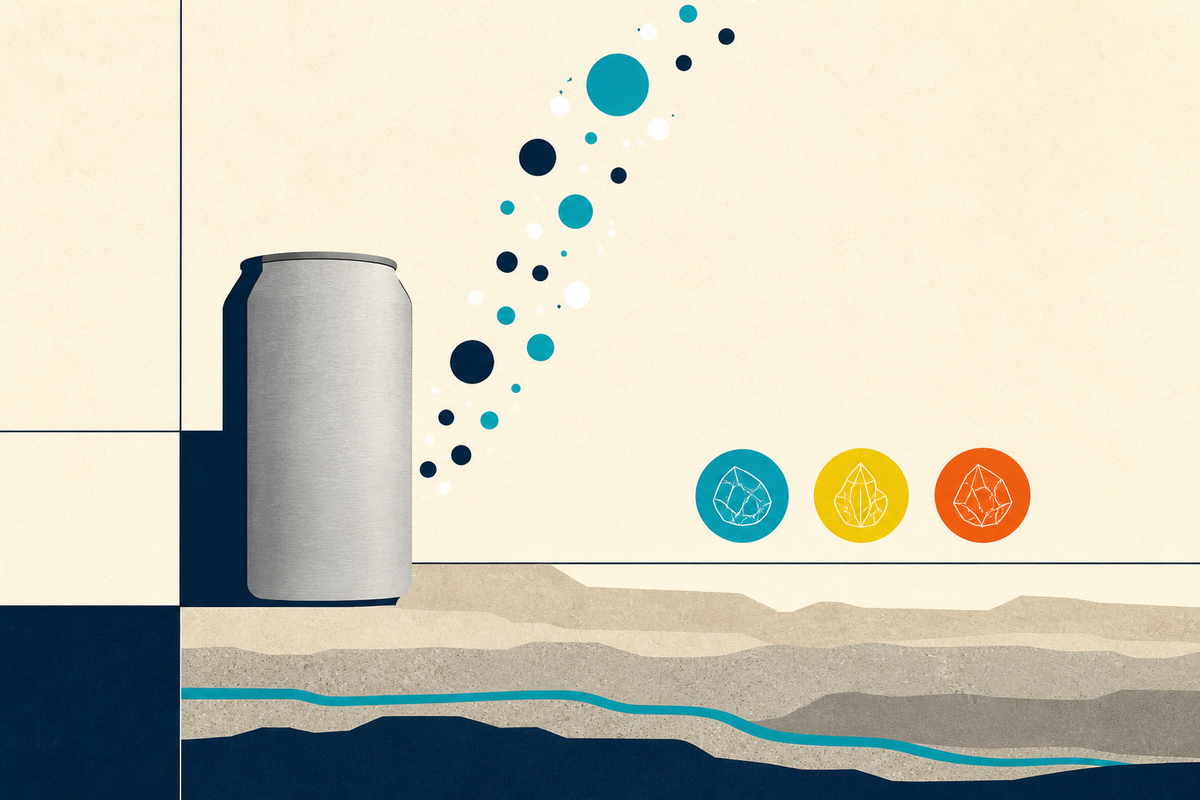
A water can with bar manners
Mead, a photographer and advertising veteran, helped give the package its second job. Rambler's retro script, squat 12-ounce format and high-low Texas look make it resemble something pulled from a vintage beer cooler. That is aesthetic, but it is also distribution strategy. A recognizable can fits behind a bar, in a brewery taproom or at a music venue. For a sober customer, a designated driver or somebody pacing a long evening, it avoids the visual announcement made by a stemmed glass of tap water.
Austin Beerworks was crucial to making the idea physical. The brewery had filtration knowledge and available canning capacity. Its team joined mineral and carbonation tastings, then helped filter, remineralize and package Rambler in Texas. The relationship also supplied an early route into brewery culture, where a water that "drinks like a beer" was not merely copy. It solved a small hospitality problem.
That social permission expands the customer map. Rambler is for the person replacing soda at lunch, the runner looking for a mineralized cold drink, the family loading a lake cooler and the festival attendee taking a night off alcohol. It is also for the bar manager who wants a non-alcoholic option with enough identity to earn cooler space. Lifestyle is not pasted onto the water afterward. It determines where the product can plausibly be sold.
The shelf is the hard part
Rambler's business is familiar consumer packaged goods: sell cases wholesale to grocery, natural-food, mass retail, convenience and hospitality accounts; supplement them with direct online sales and merchandise. The difficult part is access. Grocery resets happen on annual clocks, and every new slot may displace another brand. Early placements at Franklin Barbecue, Mohawk and Royal Blue Grocery gave Rambler cultural proof in Austin. H-E-B expanded the Texas map. Whole Foods carried it regionally. Later wins included more than 500 Walmart stores and, according to Mead, roughly 1,100 stores across Kroger banners.
Sampling fills the gap between unfamiliar can and repeat purchase. At the 2023 GoPro Mountain Games in Vail, Rambler put 16,000 cans into hands over a long weekend. It did not need to explain a software workflow or persuade anyone to schedule a demo. The trial happened in one sip. Mead's blunt internal phrase for the tactic is "juice on the lips." The company reported first-half 2025 sales rising roughly 125 percent from a year earlier, with national accounts doing much of the work.
In June 2026, asset-based lender JPalmer Collective provided a $2.5 million working-capital facility. That is less glamorous than a splashy equity round and arguably more revealing. Fast-growing beverage brands pay for ingredients, cans, production and inventory before retailers pay them. Working capital lets Rambler support larger orders and new markets without pretending those physical constraints do not exist. The announced use was inventory and national distribution, including an expanding relationship with Acosta.
Mineral water without the pilgrimage
Traditional mineral-water romance begins at one famous spring. Rambler deliberately separates taste from a single geological address. It sources water from well-managed supplies, purifies it near regional production and adds a controlled mineral recipe. The company has described partners in Texas, Georgia, Washington and New York. That makes consistency an operating capability: the mineral profile can travel even when the water does not travel as far.
The model has tradeoffs. Reverse osmosis requires water and energy, co-packers must hold a quality standard, and recyclable aluminum is not impact-free. Still, the architecture addresses two obvious burdens of imported glass mineral water: heavy freight and dependence on a sensitive source. Cans stack, chill, travel to pools and trails, and enter established recycling streams more easily than glass does in many settings.
Conservation is the public counterweight. Rambler puts American Rivers and Texas Parks & Wildlife Foundation on its packaging and supports both through an on-pack giveback program. American Rivers lists the company as a corporate supporter; the Texas foundation has listed Rambler among its corporate contributors. The placement is commercially intelligent. A badge on the can reaches the shopper at decision time, where a sustainability report buried three clicks deep does not.
A useful place in a noisy category
Rambler sits between several powerful alternatives. Topo Chico owns deep mineral-water nostalgia and global distribution through Coca-Cola. Waterloo and LaCroix crowd the flavored-sparkling shelf. Spindrift uses real fruit. Liquid Death turned water into entertainment with tall cans and aggressive theater. Store brands win on price. Rambler cannot outspend all of them, so it needs its differences to cooperate: mineral texture, beer-like format, American production and conservation.
The brand's culture reinforces that package. Its careers language favors road trips, campfires, scenic routes and a refusal to take life too seriously. "Pinkies down, thumbs up" is a useful summary of the intended market position: better than basic seltzer, without the ceremony of a green glass bottle. The voice can get rowdy, but the product remains simple enough to survive the joke.
For founders outside beverages, the stealable lesson is not to add minerals to everything. It is to make multiple choices point at the same human moment. Rambler's formulation produces body. The carbonation produces sensation. The can produces belonging. The conservation marks produce a reason to prefer it. Regional manufacturing makes wider distribution plausible. Each decision supports the next, and the entire story is legible while the customer is still standing at the cooler.
Rambler still has the ordinary hazards of a physical brand: thin shelf space, expensive inventory, retailer leverage and competitors with enormous budgets. But it has answered the first question a challenger must face - why this can, now? The answer is compact enough to hold in one hand: a sparkling water with actual minerals, built for places where people used to assume the interesting drink had to be soda or alcohol.
The everyday applications are almost deliberately unremarkable. Chill it for the commute, pack it for a hike, put Original beside whiskey, use Satsuma in a zero-proof highball or hand Wild Cherry to the guest who wants flavor without sweetness. That range is commercially valuable because it turns one formulation platform into a household staple, a hospitality tool and an event product. The can does not require a new ritual. It slips into rituals people already have.