Breaking  True Anomaly closes $650M Series D at a $2.2B valuation Total raised now tops $1 billion in under four years Jackal deploys to LEO & captures first-light image from orbit Named to U.S. Air Force $1.8B Andromeda contract pool GEO & cislunar Jackal variants announced Breaking  True Anomaly closes $650M Series D at a $2.2B valuation Total raised now tops $1 billion in under four years Jackal deploys to LEO & captures first-light image from orbit Named to U.S. Air Force $1.8B Andromeda contract pool GEO & cislunar Jackal variants announced
Company Profile · Defense & Space

True Anomaly

Four Space Force veterans looked at orbit, decided it was a contested neighborhood, and started building the spacecraft to patrol it. The Pentagon agreed. So did $1 billion in investors.

Founded 2022 HQ Englewood, CO Valuation $2.2B Team ~250
True Anomaly Jackal spacecraft hardware at the launch tower

A refrigerator-sized spacecraft, photographed looking far more serious than a refrigerator has any right to. True Anomaly's Jackal, ready for the ride to orbit.

FILED FROM ENGLEWOOD, COLORADO  ·  SPACE SECURITY  ·  UPDATED JUNE 2026

01 — Who They Are Now

A startup that ships spacecraft, not slide decks.

The state of play in mid-2026

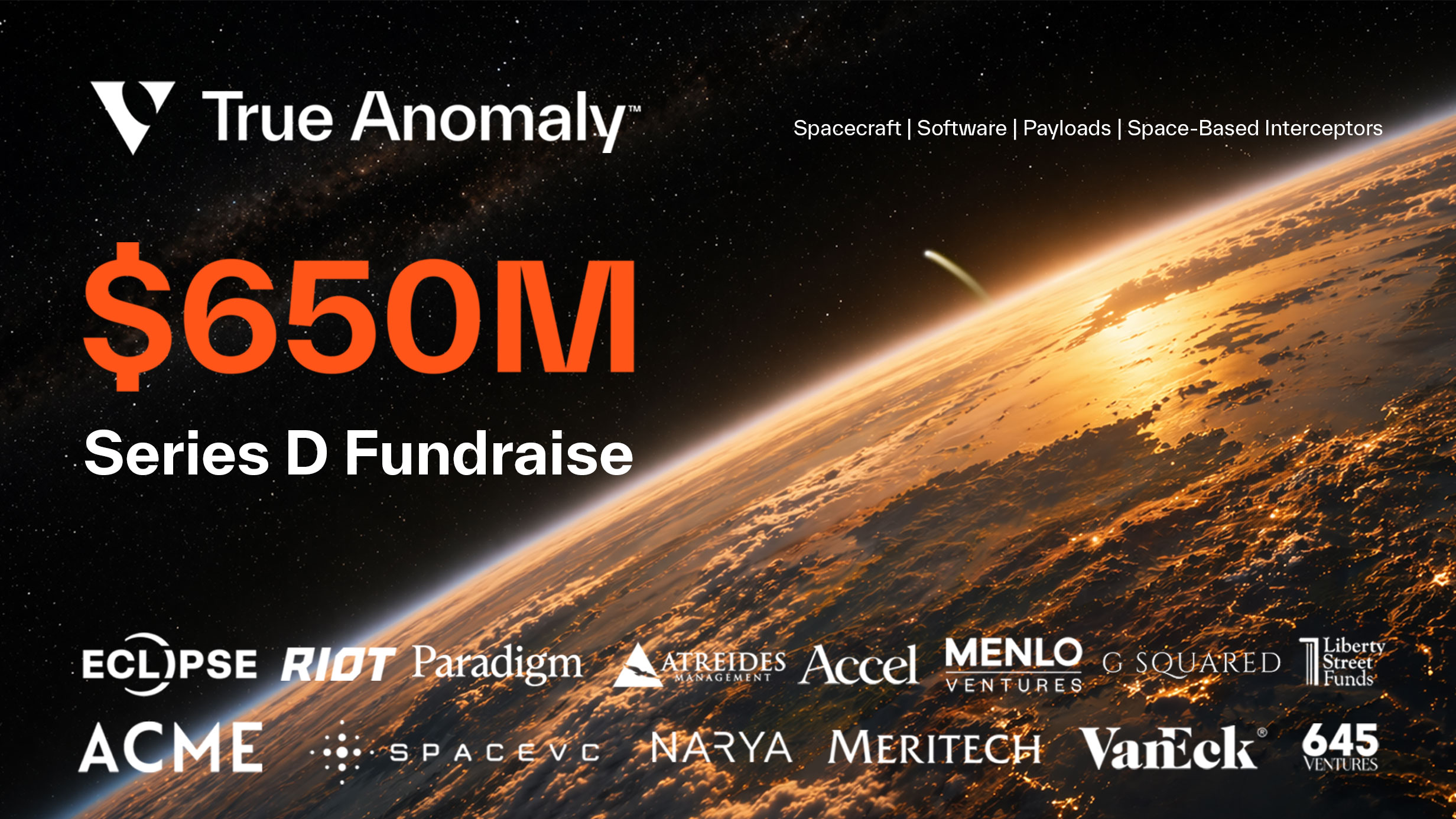
In April 2026, a four-year-old company in suburban Denver raised $650 million and walked away worth $2.2 billion. That alone would be a story. The detail that makes it interesting: True Anomaly does not sell software you can demo over coffee, nor a consumer app, nor an idea. It sells maneuverable spacecraft and the software to fly them - hardware designed to approach another satellite in orbit, look at it closely, and, if a future government decides it must, do something about it.

That is an unusual product to build a billion-dollar company around. Most space startups chase imagery, broadband, or launch. True Anomaly chose the part of orbit almost nobody wanted to name out loud: space as a place where things can go wrong on purpose. Its flagship, Jackal, is roughly the size of a small refrigerator and carries about twenty thrusters. Its software platform, Mosaic, runs the mission. Its customer, overwhelmingly, is the United States Space Force.

"Deliver decisive capabilities for space superiority." It fits on a coffee mug. It also explains a $1.8 billion contract pool.

— The company's stated purpose, paraphrased

Walk into the conversation skeptical and you will find plenty to poke at - defense-tech valuations are running hot, and a maneuvering satellite is easier to fund than to fly. But the company has put hardware in orbit, won a place on a marquee Pentagon program, and convinced some of the most disciplined investors in venture to write very large checks. The skeptic's job here is to separate the noise from the thrust.
02 — The Problem They Saw

Orbit got crowded, and then it got contested.

Why this company exists at all

For decades, the polite fiction held that space was a sanctuary - somewhere expensive, fragile, and tacitly off-limits. Satellites watched, relayed, and timed the modern world while everyone agreed not to bother them. The fiction is over. There are now more than fifteen thousand satellites overhead, a growing fraction of them owned by rivals, and the maneuvers some of them perform are not friendly.

The founders saw this from the inside. They served in the Air Force's 4th Space Operations Squadron, where the job was to operate satellites and watch what other people's satellites were doing. Their conclusion was uncomfortable: the existing defense industrial base, built around exquisite spacecraft that take a decade and a fortune to deliver, could not move fast enough for a domain that had suddenly turned tactical.

The old model builds one perfect satellite over ten years. The new problem needs many good-enough ones, soon.

— The central tension, stated plainly

That gap is the whole company. If space is contested, you need vehicles that can actually go somewhere - chase, inspect, deter - and you need a lot of them, built fast and flown by software rather than by armies of operators. True Anomaly's bet is that the side which can maneuver, see, and decide quickest wins. The unglamorous corollary: somebody has to manufacture those vehicles at a rate the primes never attempted.

03 — The Founders' Bet

Quit the squadron. Build the fleet.

Even Rogers, Daniel Brunski, Kyle Zakrzewski & Tom Nichols

In 2022, four officers left government service to do the thing they had decided the government needed but could not buy. Even Rogers, a Colorado Springs native with a background spanning the Air Force, DARPA, and the Space Force, became CEO. Kyle Zakrzewski took engineering. Daniel Brunski and Tom Nichols rounded out the founding team. They had met operating satellites together; they would now build them.

The bet was specific and a little contrarian: that a software-first, vertically integrated startup could out-iterate the incumbents on a problem the incumbents were not really attacking. Build the spacecraft and the command software under one roof. Manufacture at rate. Sell to the Space Force not as a science project but as an operational capability.

2022
Founded
4
Veteran founders
$1B+
Total raised
~250
Employees

The pitch was not "we love space." It was "we operated this domain, and the tools to defend it do not exist yet."

— The founding thesis, as told by the team

Investors bought it in stages. A $17M Series A from Eclipse Ventures in 2023. A $100M Series B led by Riot Ventures later that year. A $260M Series C led by Accel in 2025. Then the $650M Series D in April 2026, co-led by Eclipse and Riot, that pushed the company past a billion dollars raised and into a $2.2 billion valuation. Not every founder stayed for the whole ride - Brunski and Nichols left in 2024 to start another venture - but the thesis held, and the checks kept clearing.

Milestones

Four years, from squadron to orbit.

The short, fast history

AUG 2022

The company is founded

Four Space Force veterans incorporate True Anomaly in Colorado to build hardware and software for space superiority.

APR 2023

$17M Series A & the rebrand

Eclipse Ventures leads the first round. A new identity by Kontrapunkt builds the logo from the Greek letter Nu.

DEC 2023

$100M Series B

Riot Ventures leads, valuing the company at $360M as Jackal moves toward flight.

MAR 2024

Mission X-1: the anomalous debut

The first Jackals reach orbit, but a communications loss prevents the proximity-ops demo. The CEO calls it a lesson, in public.

DEC 2024

First light from orbit

A Jackal deploys in LEO aboard a Falcon 9, completes checkout, and captures its first image from space.

APR 2025

$260M Series C

Accel leads at a $916M valuation; GravityWorks manufacturing expands in Long Beach.

APR 2026

$650M Series D · $2.2B valuation

Eclipse and Riot co-lead. Total raised tops $1B. Days earlier, True Anomaly lands in the $1.8B Andromeda contract pool.

04 — The Product

A spacecraft, its brain, and a factory.

Jackal · Mosaic · GravityWorks

The product is really three products that only make sense together. The vehicle does the moving. The software does the thinking. The factory makes the first two affordable enough to lose one and not lose the company.

The Vehicle

Jackal

A highly maneuverable autonomous orbital vehicle, roughly the size of a small fridge, with around 20 thrusters and 800-1,000 m/s of delta-V. Built to rendezvous with other satellites, inspect them, and capture high-resolution imagery. Variants for LEO, geosynchronous orbit, and cislunar space.

The Brain

Mosaic

A full-stack command-and-control and mission-autonomy platform: battle management, a digital range for testing, the Ascension training tool, and autonomous control. Written in Elixir - a language better known for chat servers than spacecraft.

The Factory

GravityWorks

High-rate spacecraft manufacturing across Centennial, Colorado and Long Beach, California - the part of the plan that turns "we built a satellite" into "we can build a fleet."

Most satellites are precious. Jackal is designed to be numerous. That single word - numerous - is the strategy.

— On why manufacturing rate is the real product

What can you actually do with it? If you are the Space Force: launch a vehicle that can quietly approach an object of interest, image it, characterize it, and stay on station - then command a constellation of them through one software layer instead of a roomful of operators. The delta-V number matters here. Most satellites have just enough fuel to hold their slot. Jackal carries enough to go somewhere and do something.

05 — The Proof

The receipts, for the skeptics.

Contracts, capital, and a chart

Vision is cheap in defense tech. So here is the evidence that does not depend on a pitch deck. The company flew hardware - a Jackal deployed in low-Earth orbit in December 2024 and returned a first-light image. It won real programs: the Space Force's VICTUS HAZE tactically responsive mission, a place among fourteen firms eligible for the Air Force's potential $1.8 billion Andromeda space-domain-awareness contract, and an early $17.4M award for Mosaic. And it raised money from investors who tend to ask hard questions.

The funding climb

Capital raised per round, $ millions · 2023–2026

Series A '23
$17M
Series B '23
$100M
Series C '25
$260M
Series D '26
$650M

Bars scaled to the $650M round. The curve is the point: each round is roughly the previous one, then some.

A first mission that lost contact before it could maneuver. The company published the setback and flew again. Skeptics noticed both.

— Mission X-1, 2024

Partnerships fill in the rest of the picture: a collaboration with Viasat and Microsoft Azure Space around Mosaic, a multi-launch agreement with Firefly Aerospace, and rides to orbit on SpaceX. None of it guarantees the long arc works. All of it is more than a story.

06 — The Mission

Make space defensible for democracies.

What they say they are really doing

Strip away the hardware and the mission is a claim about the next decade: that space will be operated as a warfighting domain whether anyone likes it or not, and that open societies should be able to defend their assets there rather than hope nobody touches them. True Anomaly's answer is maneuverable vehicles, autonomous software, and a manufacturing line - the un-romantic plumbing of deterrence.

It is a serious mission with serious questions attached, and the company does not pretend otherwise. A satellite that can approach a friendly target can approach an unfriendly one. The same capability that reassures one government unsettles another. None of that is unique to True Anomaly; it is the nature of the domain it chose. The honest framing is that the tools are being built, by someone, and the company would rather it be a democracy.

The competitors are real - Sierra Space, the Impulse-Anduril pairing, the legacy primes. The race is to ship, at rate, before the doctrine catches up.

— On the competitive field
07 — The Margins

Things worth knowing.

For the dinner party, not the data room

The name is orbital mechanics. "True anomaly" is the angle that tells you exactly where an object sits along its orbit - and the logo is built from the Greek letter Nu, its symbol.

Mosaic, the software that flies spacecraft, is written in Elixir - a language far more famous for powering messaging apps.

Jackal is fridge-sized but carries about 20 thrusters and enough delta-V to chase down another satellite. Most satellites can barely keep their parking spot.

The first orbital mission lost comms before its big demo. The CEO went on the record about the setback rather than burying it.

The Jackal roadmap reaches LEO, geosynchronous orbit, and cislunar space - effectively the whole neighborhood out to the Moon.

The April 2026 round included $50M of debt from Stifel Bank on top of the equity - a vote of confidence from a notably cautious corner of finance.

08 — Why It Matters Tomorrow

Back to the refrigerator.

Return to that photograph at the top - the fridge-sized box that looks too plain to matter. A few years ago it would have been a curiosity, a startup's prototype in a domain everyone agreed to leave alone. The agreement is gone. The box now stands for a thesis that has attracted a billion dollars and a place on one of the Pentagon's largest space programs: that orbit is contested, that the side which can maneuver and decide fastest holds the advantage, and that the vehicles to do it should be numerous, software-flown, and built at rate.

Whether True Anomaly is right is still an open question, and a fair one. Defense valuations can deflate. Maneuvering satellites are hard to fly, as the company's own first mission showed. But the central tension it was founded on has only sharpened. Someone is going to build the hardware for contested orbit. True Anomaly is betting it gets there first - and so far, the people writing the checks agree.

A refrigerator that can chase satellites. In 2026, that is no longer a punchline. It is a $2.2 billion company.

— True Anomaly, Englewood, Colorado
· · ·