Tony Liu's mother knew how to do the job. Getting someone to let her do it again was the difficulty. After losing her position as a cook, she asked her son for help finding another one. He encountered questionnaires, cover letters and application portals that could run to five pages. Then came the waiting. A kitchen needed staff. An experienced cook needed work. Somehow, between those two fairly compatible facts, there was an administrative obstacle course.
Liu had seen enough of professional finance to recognize a badly arranged transaction. But this one arrived with a family connection. Helping his mother made an old routine look suddenly peculiar: why should applying for an hourly job consume so many unpaid hours? The question would become the starting point for JobGet, the hiring marketplace he built with Billy Lan and Peter Lee.
The cook and the finance graduate
His family moved from China to Canada when he was nine. His mother had worked in accounting; limited English narrowed her options, and she became a cook. Years later, when she needed a new position, the search still involved the same cumbersome rituals Liu remembered from his own teenage job hunting. The software had changed its clothes. The paperwork had kept its chair.
Liu graduated from the University of British Columbia's Sauder School of Business in 2013, with a commerce degree focused on finance. His career included investment banking at Citi and private equity at Siguler Guff & Company. Consulting also appears in his professional background. He had learned to examine businesses through their financial statements. His mother's experience supplied a different sort of evidence: the experience of someone trying to get through the front door.
The founders brought related family histories to the problem. Lan and Lee also came from immigrant families. Their proposed change was practical: let a worker make a mobile profile, find nearby openings and speak directly with someone who could hire them. Remove the repetitive documents that stood between an initial expression of interest and a conversation.
- 01 Make a profile
- 02 Find work nearby
- 03 Start a conversation
A shorter route from interest to interview.
A first customer called Cheers
There is a pleasing detail in JobGet's early history: its first customer was Boston's Cheers bar. For a business trying to make employment more conversational, that is almost suspiciously good casting. The early work began in 2018; the company identifies 2019 as its founding and launch year. The distinction matters less than the small scale of the beginning. Before a national network, there was one employer willing to try it.
Growth travelled through employers' existing relationships. A hiring manager could introduce another manager. The founders could take the product to people who shared the same daily difficulty. By the time their alumni magazine revisited them in 2021, the business had spread to 10 major American cities. Its distributed team worked across four continents, with a shared WeWork desk in Boston serving as a modest physical base.
That arrangement makes the early company easier to picture than the usual startup vocabulary. People were building a tool for local work while collaborating across borders. The thing they were selling remained close to the ground: a restaurant, shop or other employer needed someone available nearby. Each new location still had to produce a useful match.
Two minutes is a design decision
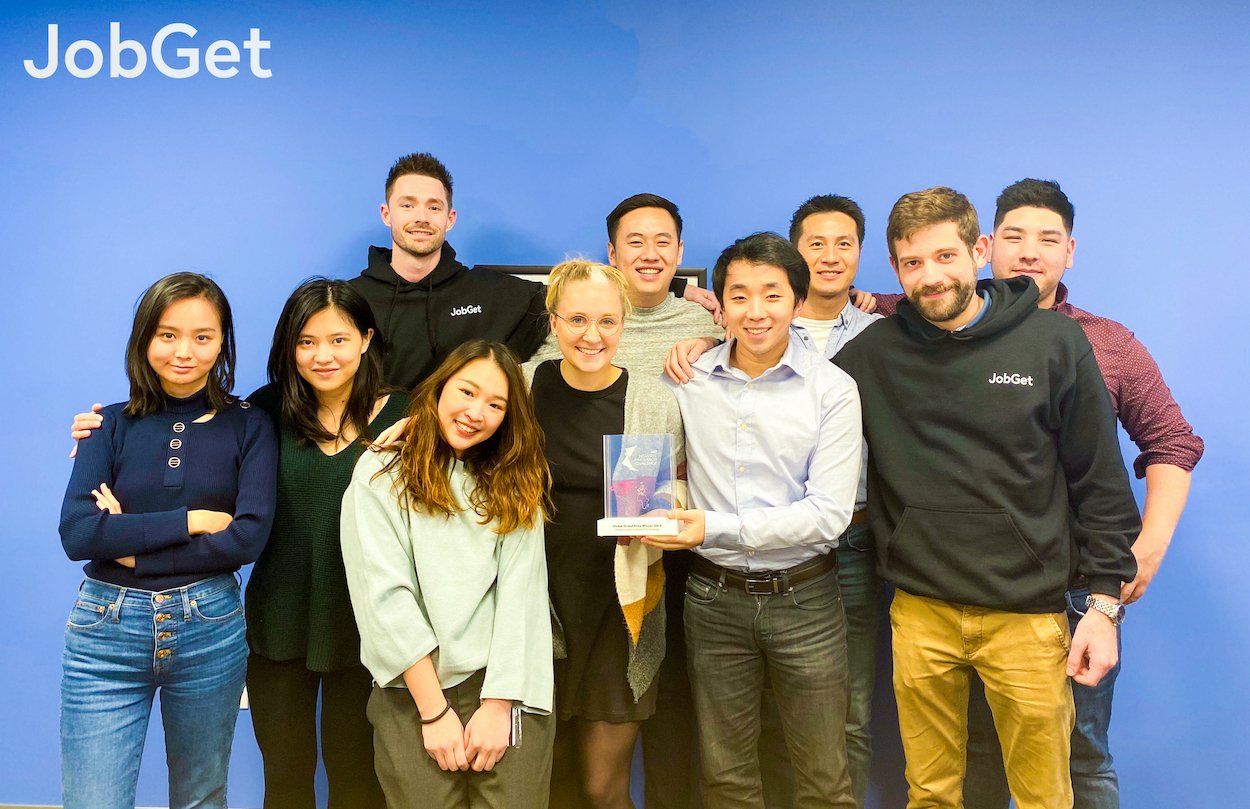
In November 2019, JobGet won a $250,000 grand prize at MIT's Inclusive Innovation Challenge, in the income growth and job creation category. It was one of four grand prize winners selected from 20 finalists. The competition recognized technology that widened economic opportunity, giving the young business an early test beyond its own sales pitch.
At that point, JobGet had been onboarding workers and employers for about eight months. Its community director, Caroline Forrest, described a profile that took two to five minutes to create. Candidates could then apply without preparing a separate résumé or cover letter. That small interval is worth lingering over. Five minutes can fit into an ordinary day. A succession of lengthy applications asks for a much larger investment before anyone has even replied.
The design treated access to a hiring manager as something software should make easier. Messaging and video interviews brought the conversation onto the same device used to search. A phone became a place where an applicant could move several steps forward, rather than merely discover that the next step required a computer.
The family group chat takes over
The recognition acquired a more domestic distribution channel when Liu and Lan were named to the Forbes 30 Under 30 Social Impact list for 2021. His mother promptly circulated the news to the extended family. “She shared the Forbes link,” Liu recalled, describing congratulations arriving from distant relatives. The person whose job search had helped inspire the company now had a much more enjoyable link to pass around.
The founders also stayed connected to their university. They credited Sauder faculty members Paul Cubbon, Darren Dahl and Jeff Kroeker with guidance and support, and continued sharing updates after graduation. That is a useful corrective to the solitary founder portrait. JobGet's history includes co-founders, teachers, community staff and employers who agreed to experiment.
In 2024, Liu joined the Aspen Institute's Henry Crown Fellowship class. The programme brings business leaders together around leadership and their responsibilities to society. He was listed as JobGet's co-founder and CEO, based in Seattle. It added another circle of peers to a career that had already moved between finance, entrepreneurship and employment services.
When the cheque gets larger
JobGet announced $2.1 million in seed funding in 2020. Alongside the app, the company described job-training workshops and relationships with nonprofit organizations including Goodwill, Community Work Services and Women's Lunch Place. Its route to workers included institutions already helping people find employment. Distribution involved showing up where the job seekers were.
By June 2022, the company was raising a different amount: a $52 million financing package, including $12 million in venture debt. JAZZ Venture Partners and Sanabil Investments co-led it. JobGet reported nearly two million app downloads and more than 50,000 companies having used the service to post jobs. Those were measures of adoption at that time, rather than a count of completed hires.
The larger cheque came with changes to the executive team. Ryan Eberhard, previously chief product officer at ZipRecruiter, joined as president. Louisa Cartwright joined to lead people operations. Liu's role now included assembling an organization capable of carrying the idea further. A useful app and a company able to maintain it require different kinds of attention.
“Our app is just the beginning.”
Tony Liu · June 2022
A buyer with a particular shopping list
Acquisitions became a visible part of that expansion. In May 2023, JobGet bought Heroes Jobs, a social hiring app aimed at Gen Z workers in retail and hospitality. Its community and video features offered another way for job seekers to establish a professional presence. The purchase fitted Liu's interest in relationships around employment, alongside access to vacancies.
Wirkn followed in June 2024, bringing a network spanning more than 17,000 mall, retail and restaurant locations. Here the useful unit was a workplace: a store inside a shopping centre, a restaurant manager with openings to fill. The transaction added employer connections in physical places where hourly work happens.
Then came Snagajob in November 2024. JobGet said the combination brought its reach above 100 million hourly workers in the United States, with Snagajob continuing as a standalone entity. Reach is the operative word. The announcement describes the breadth of a candidate network; it does not mean that many people were hired through JobGet, or that every profile was active that month.
In an interview about the deal, Liu discussed Snagajob's relationships in rural areas as a complement to JobGet's metropolitan emphasis. Data on workers and employers, along with integrations into applicant-tracking systems, also mattered. Buying a hiring platform can mean acquiring a set of working connections that would take years to reproduce.
- 2023 · Heroes Jobs
- Social connections for younger workers
- 2024 · Wirkn
- Malls, retail and restaurant locations
- 2024 · Snagajob
- A wider national candidate network
- 2025 · Seasoned
- Restaurant hiring and automation
- 2026 · RippleMatch
- Students and early-career recruiting
Seasoned, acquired in March 2025, added a restaurant-focused hiring community and recruiting automation. Its tools included interview scheduling and connections to employers' existing systems. The shopping list had a discernible logic: each deal brought an audience, a relationship or a piece of hiring machinery. Making those pieces work together became part of the product itself.
The next applicant might be a graduate
On May 28, 2026, JobGet announced its acquisition of RippleMatch, calling it the company's sixth acquisition. RippleMatch brought early-career recruiting, campus relationships and technology for matching, screening and scheduling. Audrey Patenaude joined the combined business as general manager of RippleMatch. The scope now stretched from hourly hiring into the uncertain first steps of a graduate career.
In September, RippleMatch made its university product available to higher education institutions at no cost. Career centres gained access to student engagement and job-search analytics, alongside tools for connecting students with employers. It was a concrete change following the deal, giving the expansion a consequence beyond a longer list of company names.
Liu's public ambition is to build a home for everyday workers. The practical test remains wonderfully unglamorous. Can someone find an appropriate opening, get a response and reach a person able to make a decision? Every acquisition adds complexity behind that question. The person holding the phone still deserves a simple answer. His mother's original difficulty remains a useful standard for the business her search helped begin.