Avi Freedman was approaching the end of university life with a problem that would eventually become everybody’s problem: he had grown accustomed to being online. At Temple University, there were Unix machines, games to run and a connection to the wider world. Outside that environment, Philadelphia offered no straightforward way to buy the dial-up access he wanted. Leaving school threatened to mean leaving the network.
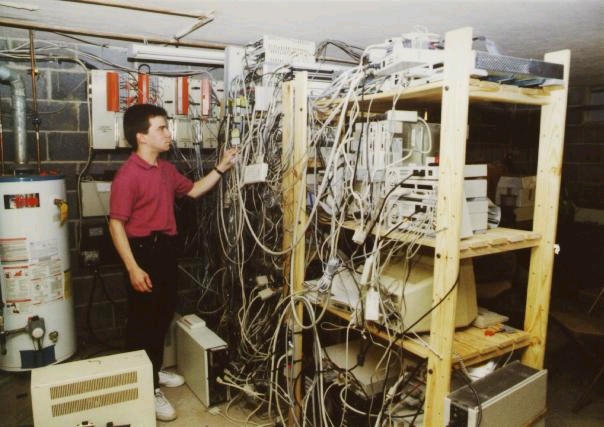
In 1992, he started Netaxs, the city’s first internet service provider. The early operation occupied a basement. There were modems and Sun workstations, with the complications that appear when equipment assembled for an enthusiast has to work for paying customers. Freedman’s initial calculation was that buying some modems should more or less do it. Experience supplied the remainder of the syllabus.
It is an appealingly practical beginning for someone who would go on to lead network work at Akamai and co-found Kentik. He wanted a connection. Building a company became the means of keeping it. The internet had acquired one more operator, and the operator had acquired rather more responsibility than the shopping list suggested.
A useful misunderstanding
Freedman had begun programming in 1978, aged eight. An uncle gave him a book about BASIC; a mentor, Steve Robinson, helped introduce him to Unix. Freedman would later credit Robinson with a lasting conviction: things built by people could be understood with enough patience. That is a generous idea to hand a child. It gives permission to ask how everything works.
The permission did not confer immediate accuracy. When he first typed BASIC programs, he left out lines containing RETURN. He was already pressing the Return key to enter each command. Why perform the same ceremony twice? Reading further cleared up the distinction. The episode survived because Freedman was willing to write it down, years after he had become someone other people asked for technical advice.
At Temple, he ran multi-user dungeon games on his machine and used them to learn about communicating between processes and working on complicated C programs. Then he set out to build an object-oriented adventure-game development system. He spent more than a week thinking through its data structures before settling into the business of writing and compiling.
A friend watched him work. The friend had apparently imagined a smoother relationship between expertise and execution.
“Wow, you make mistakes too… But you make them REALLY fast.”
A friend watching Freedman code at Temple, recalled in his 2013 blog
Freedman initially heard a little criticism in the compliment. Later, he came to value the method. Make enough of an idea work to discover what it requires. He called the result a “running specification.” There was still a substantial job afterward: documentation, awkward cases, configuration and the engineering that lets other people depend on the thing. He knew to bring in colleagues who wanted to do that work.
The accidental BGP inventor
Learning networking gave him another collection of avoidable frustrations. Routing terminology could obscure concepts that became quite manageable once explained. Cisco’s vocabulary and command-line peculiarities added their own obstacles. Freedman remembered where he had stumbled and began publishing routing articles and tutorials in the mid-1990s.
The memory of confusion became teaching material. By 2011, he was still meeting professionals who had used those explanations. Some mistakenly thought he had invented BGP, the protocol that lets networks exchange information about reaching destinations across the internet. A clear tutorial can acquire an unexpectedly grand reputation. Freedman’s achievement was making the subject accessible enough for people to get on with their work.
His advice to prospective teachers was precise: “write about something while you remember what confused you when you were learning it.” Expertise tends to erase the evidence of its own acquisition. The once-baffling term starts to look obvious. Freedman wanted people to document the missing steps before familiarity made them disappear.
- 1992Get connectedNetaxs
- 1999Deliver contentAkamai
- 2014Understand trafficKentik founded
- 2026Join the contextInfoblox acquisition
A longer cable, a larger problem
The basement operation led into a career at a different scale. Freedman ran engineering at AboveNet in 1998 and 1999, then joined Akamai late in 1999. His Akamai roles included network leadership, chief network architecture and chief network science. Instead of helping people dial into one provider, he was involved in the work of placing content closer to people across many networks.
The physical internet required agreements as well as equipment. Someone had to arrange interconnection, understand another operator’s constraints and make systems cooperate. These were engineering problems conducted partly through conversation. A network diagram can make the connections look impersonal; each line still depends on people accepting responsibility for their ends.
Freedman’s own career list puts his Akamai years at 1999 to 2009 and his tenure as ServerCentral’s CTO at 2009 to 2014. The titles changed, but the operating experience accumulated. By the time he started another company, he had spent years encountering the difference between having infrastructure and being able to explain its behavior.
The packets were there. The answers were harder.
Kentik began in 2014 under the name CloudHelix. Freedman, Ian Applegate and Ian Pye started building the company; Justin Biegel joined as a fourth co-founder to lead customer outreach. Their prospective users were network operators who could collect traffic information but struggled to store it, query it and make it useful quickly.
Routers already produced records of traffic flows. Operators wanted to combine those records with routing information, investigate attacks, retain detail and answer questions without maintaining another pile of servers. The founding team heard a preference for a hosted service. Their customers had networks to run; operating the analytics machinery could be somebody else’s job.
When Kentik Detect launched publicly in June 2015, early paying customers included Yelp, Box, OpenDNS and Neustar. The company announced a $12.1 million Series A, following a $3.1 million seed round in September 2014. Freedman reported that the team had grown from four people to 21.
to the June 2015 launch
June 30, 2015
He also published the less photogenic details of fundraising. Allow enough time. Use existing investors for introductions and honest feedback. Practise explaining a technical company to people outside the field. Leave room for the car to break down. Bring snacks. Venture capital had entered the story, but Freedman’s instructions retained the sensibility of someone packing for a day when several things might fail.
One recommendation was to investigate investors by talking to founders whose companies had struggled. Another was to avoid promising what you could not control in later rounds. These were instructions about relationships under pressure. He was applying the habit of looking beneath the reassuring surface to a different kind of system.

The people on the other end
The relationships became audible in Network AF, the podcast Freedman hosted for Kentik. Guests included Equinix co-founder Jay Adelson, internet analyst Doug Madory and infrastructure entrepreneur Grant Kirkwood. The conversations made space for mistakes, early jobs and the routes people took into networking.
Adelson recalled recognizing Freedman’s laugh before seeing him. Freedman responded that his brother had a distinctive laugh, too. In the same conversation, they compared early games, data centers and the desire to connect with other people. Freedman remembered the multi-user worlds he had run as an “80 by 24 metaverse,” a nod to the dimensions of a text terminal.
That willingness to keep the people in the picture matters to the portrait. Technical careers are often presented as a succession of machines mastered and titles acquired. Here were old acquaintances remembering a voice through a door, exchanging corrections and laughing about the equipment that once seemed impressive. The internet had become ordinary for its users. Its builders still had stories about the plumbing.
Give the machines something they can understand
By February 2026, Freedman was writing about the prospect of AI agents helping network teams. His argument began with the underlying systems: modernize interfaces, simplify where possible and make telemetry available. A network full of exceptions and inaccessible data remains difficult to operate, however fashionable the software observing it becomes.
He wanted agents to watch, test assumptions and correlate information under a team’s direction. It was a practical ambition for people already responsible for complicated infrastructure. Better assistance starts with a view of what is happening and a way to check the answer. The work still includes deciding which changes are sensible.
In July, Freedman announced that Kentik had agreed to be acquired by Infoblox. The acquisition closed on August 6, 2026. Infoblox brought knowledge of infrastructure and critical network services; Kentik brought information about traffic, routes, paths and performance. Joining those views would help connect what a network contains with how it behaves.
For Freedman, the combination extended an undertaking that had already occupied more than a decade at Kentik. For the reader following him from Philadelphia, it also makes a certain kind of sense. The young operator had needed a connection he could use. The executive was building tools for people who needed connections they could understand.
The modem budget has changed. There are more colleagues, more networks and more questions for software to help answer. Somewhere beneath the changing vocabulary is the familiar task of getting enough information to work out what happened. Freedman has spent a career staying interested in that task.
Keep following the packets
More conversations, early writing and the next chapter.