Before Darryl Rawlings could start the company he wanted, he had to sell something else. Cigars, as it happened. He bought stock on credit, put it in his car, and took his dog along. It is an agreeably untidy beginning for a career that would eventually involve public shareholders, a billion-dollar revenue milestone and a carefully planned successor. The dog, Monty, stayed beside him as his plans changed. When Rawlings finally issued Trupanion's first policy in 2000, Monty was the customer.
There are founders whose early careers make perfect sense in retrospect. Rawlings requires a little more patience. Technology sales, a spell in Mexico, cigars, a boat in Vancouver, then a company built around cats and dogs. Follow the sequence and a practical question emerges: how do you finance the work you want to do when your enthusiasm is considerably larger than your bank balance?
Rawlings's answer was to build something he could sell, then put the proceeds into something he wanted to keep building. Decades later, the interesting part of his story is how long he stayed with that second undertaking, and how deliberately he arranged to give up running it.
The dog came along for the detour
Rawlings grew up in Vancouver and studied at the British Columbia Institute of Technology. His qualification was in marketing management. In an onstage conversation years later, he described his early technology-sales work as selling things with blinking lights. The description has the advantage of removing most of the glamour from a job title while preserving its essential function.
He spent several years selling into the cellular industry. Then came a change of direction. He left that career and spent three months in a tent in Mexico, surfing and considering what to do next. Returning to work did not immediately mean returning to the original ambition. First, there was the problem of money.
The Canadian Cigar Company supplied an answer. In his later account, a $5,000 credit card helped him start the business. Monty went to work with him. A dog accompanying a traveling cigar salesman is already a good detail; a dog serving as a persistent reminder of another business is better. Rawlings has described Monty's presence as keeping the future Trupanion idea in view.
What matters here is the sequence. The cigar company was a real enterprise that had to find customers before it could fund anything else. Rawlings built it and sold it for $500,000. That gave him capital he could direct himself. The route to his next venture ran through inventory, sales calls and an eventual buyer, rather than straight from an idea to an investor's office.
Rawlings's reported sale price for the cigar business. He used the proceeds to help launch Trupanion.
A historical sale figure, not a measure of his personal wealth.A floating start, then a first customer
The proceeds helped pay for a boat and two years of moorage on Vancouver's Granville Island. Rawlings lived aboard with his future wife while developing the next business. A boat makes a memorable founding address. Prepaying the moorage makes an equally revealing, less romantic detail: he was buying himself time to work.
The idea had a long gestation, but there are two useful dates in its commercial beginning. Rawlings began building Trupanion in 1998. The first policy followed in 2000. Keeping those dates separate preserves something that startup histories often compress: preparing to open and actually serving a customer are different stages of the job.
Monty became that first policyholder. The dog who had accompanied the cigar business now occupied a small but permanent place in the new company's history. It is tempting to give him an executive title. First customer will do. It was an unusually tidy promotion for a companion who had simply kept turning up.
Trupanion expanded into the United States in 2008. Rawlings had moved his family to Seattle the year before. The geography of his working life shifted south while retaining its Canadian beginning. Building across that border meant the enterprise had moved beyond the scale at which its founder could supply all the money and make every connection personally.
- 2000Monty becomes the first policyholder in Canada.
- 2008Trupanion enters the United States.
- 2014The company goes public.
- 2024Margi Tooth succeeds Rawlings as CEO.
The opening bell had a price attached
In July 2014, Trupanion went public. The offering comprised 7,125,000 shares at $10 each, with trading beginning on July 18. Those figures put a useful boundary around the familiar photograph of a founder celebrating an opening bell. A public offering is also a transaction with a price, a quantity and a new set of people entitled to ask questions.
The price came in below the expected range of $13 to $15. The company raised roughly $71 million. That qualification belongs beside the milestone. Becoming publicly traded was an achievement, but the market did not simply accept the company's preferred valuation. Rawlings's long project had acquired a daily quotation and an audience capable of disagreeing with it.
The following year, he received an EY Entrepreneur Of The Year award in the Pacific Northwest's financial-services category. By then, the path from the cigar car to the stock exchange had become a story other entrepreneurs could recognize. It contained a sale, a reinvestment, a move, outside capital and years of execution between the appealing anecdotes.
Rawlings remained CEO long after the flotation. That is a substantial part of his career: continuing to run the organization after the event that often supplies a founder profile's closing scene. Trupanion eventually passed $1 billion in annual revenue during his leadership. The operation had become far larger than the venture he could finance with the sale of his first company.
The years before the handoff were also difficult ones. In their letter covering 2023, Rawlings and Tooth discussed pressure on margins and changes to make the business more precise in its operations. Tooth described the need to improve execution before returning to a faster pace of growth. This is a less picturesque chapter than the boat, but it gives the succession its business context. The next chief executive was inheriting work still in progress, with financial targets to meet and operating decisions to carry through. The opening bell had been a milestone, rather than an exemption from difficult years.
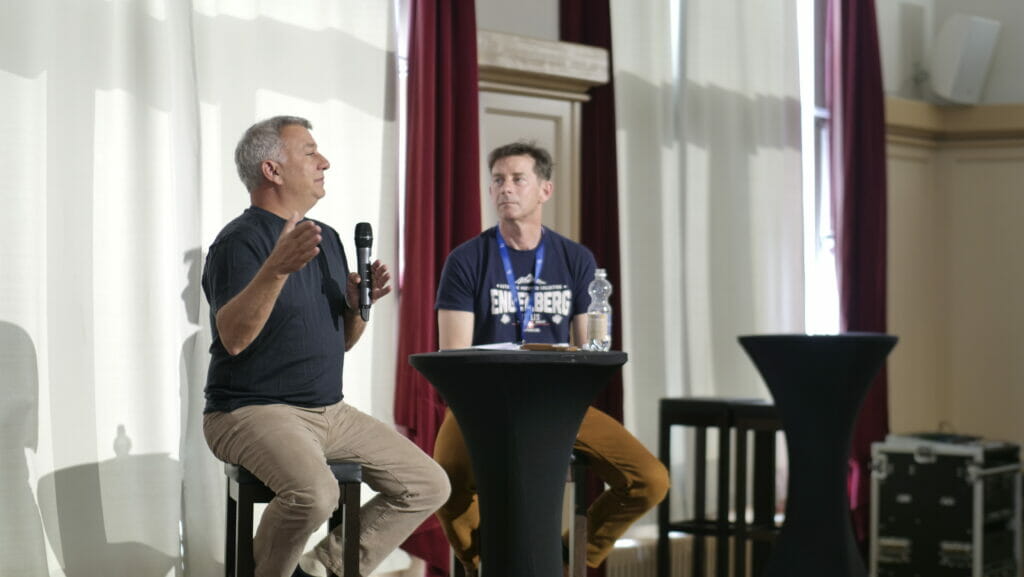
A founder in conversation
Watch Rawlings speaking with investor Rob Vinall in Engelberg in 2022 and the scale of the business sits alongside the informal way he describes it. He moves between the cigar-company beginning and questions about retention, economics and growth. The conversation gives the early adventures their proper proportion: memorable episodes within a much longer operating career.
His public leadership appearances also show a preference for bringing his personality to work. At a Seattle discussion alongside Brooks Running's Jim Weber and Zulily's Darrell Cavens, Rawlings argued against changing who you are upon entering the office. Asked about winning and losing, he described himself as eager to win and willing to risk losing. Those are his stated preferences, rather than a personality test administered from a distance.
His interests in subscription businesses extended beyond Trupanion. In April 2021, Naked Wines appointed him an independent non-executive director and announced that he would become chair that summer. The attraction was explicit: experience building a direct-to-consumer subscription company in the United States. He stepped down as chair in October 2022. It was a separate board assignment with its own beginning and end.
The job of choosing who comes next
For a founder, succession makes an unusually personal operating decision. The company carries years of your choices, yet its next leader needs room to make different ones. Rawlings began publicly setting out that transition before he actually left the CEO role.
In January 2023, he added chair of Trupanion's board to his responsibilities. Murray Low, the previous chair, became lead independent director. The announcement described a planned CEO succession in 2025 and Rawlings's wish to remain chair through 2035, subject to shareholder support. It was a statement of intention, with a condition attached, rather than a guaranteed tenure.
The handoff happened earlier. Margi Tooth became CEO on August 1, 2024. She had joined Trupanion in 2013 and progressed through marketing and revenue leadership before becoming president. The choice followed years of working together inside the company.
“There is no one I trust greater than Margi to lead Trupanion as CEO.”
Darryl Rawlings, May 2024
Tooth has described Rawlings as a mentor who encouraged her to think differently and trust her instincts. That adds a human dimension to the formal succession timetable. The person receiving the job had already spent years learning the business beside the person leaving it.
The transition also changed Rawlings's actual authority. He ceased being an officer and employee while continuing as a director and chair. Trupanion's 2026 proxy still identifies him as board chair. A visitor looking for the current CEO should find Tooth; a reader tracing the company's beginnings will keep finding Rawlings.
There is still room for dogs in the formal record. His 2026 board biography includes a picture with Murray and a recollection of the dog visiting an airplane cockpit. A corporate proxy has many duties; providing a small travel update about the chair's dog is a pleasant addition. Across all the changes in address and responsibility, canine company has remained part of Rawlings's public story.
The contrast with his first business is striking. Rawlings sold the cigar company and took the money into another venture. At Trupanion, he handed over the operating job while staying involved in governance. After so many years building, his next contribution depends partly on making space for someone else to lead. Monty's first policy belongs to the beginning. The company's future now has another person's signature.