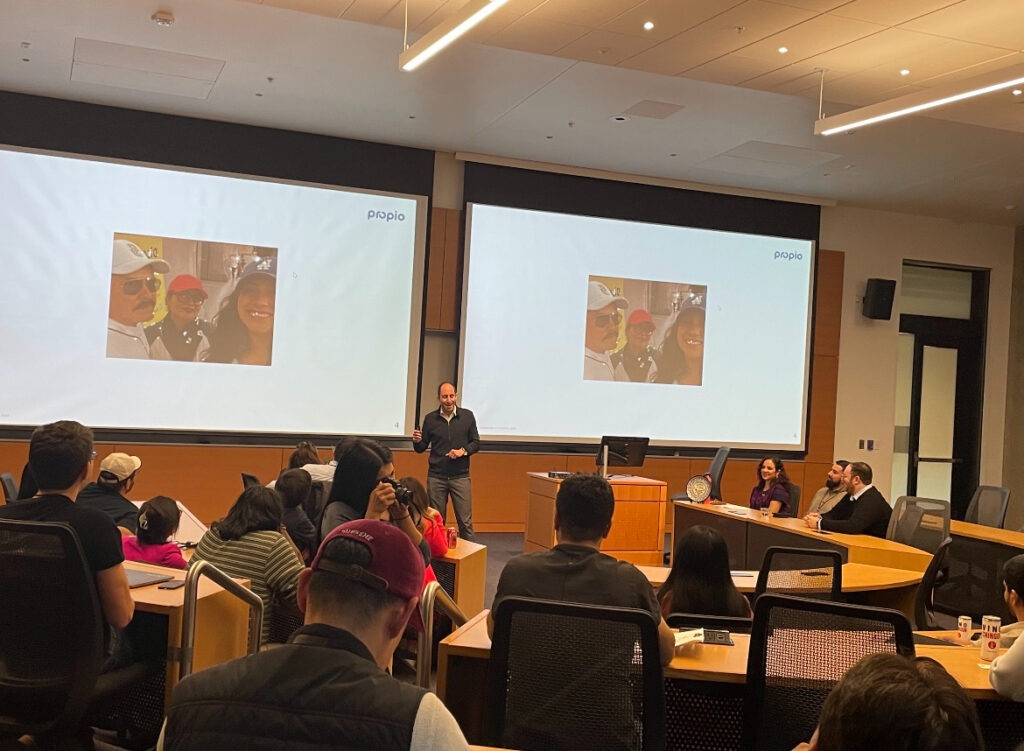
At a Seattle pitch competition in May 2024, Rodrigo Carriedo put a business owner named Araceli on the screen. She had immigrated from Mexico and built two businesses. Here was the sort of person an accounting company ought to understand: capable, busy, and working through obstacles that a tidy spreadsheet would never describe. Carriedo’s company, Propio, offered accounting help through WhatsApp. The audience awarded it $5,000.
- A tax-basis ledger puts the tax return’s structure inside the books.
- Patterns and vendor rules handle familiar transactions; AI tackles the rest.
- Client replies in three languages become context for the accountant.
That early presentation helps explain the company’s current ambition. Propio sells software to accounting firms, bookkeepers and tax preparers serving American small businesses, particularly firms working with Latino owners. Its question has grown more interesting than whether someone can get an accounting answer on their phone. Can the books become useful while there is still time to make a decision?
The answer starts with the filing
A ledger usually looks backward. Money arrived; money left; someone assigned categories. Propio makes a particular choice about those categories. Its general ledger is organized around tax forms, so the accounts already know where they belong when preparation season arrives. The product’s organizing idea is the destination of the information.
The details are pleasingly unglamorous. Its equity documentation explains how prior-year net income becomes retained earnings dynamically in the reporting layer. A correction to an earlier transaction changes the calculation without requiring a separate closing entry. Different business entities can share a familiar accounting structure while mapping their equity to different places on the return. This is where the company’s expertise shows: in the awkward seams between bookkeeping and filing.
Getting there takes care. Propio’s migration guide distinguishes a quick QuickBooks Online import of monthly journal summaries from a fuller CSV import with transaction-level history. These are different amounts of historical detail. Its setup also separates the date historical imports begin from the date Propio takes over the books. Switching software means deciding exactly where the old record ends and the new one begins.
The AI waits its turn
Read the categorization guide and the futuristic machine becomes a sequence of sensible chores. First come recognizable patterns: transfers, credit-card payments and payroll. Next come vendor rules. Only transactions that remain unfamiliar reach the AI models. Repeated work can become predictable work.
The software uses confidence signals to route the result. With auto-post enabled, suggestions at 90 percent confidence or above post automatically; less certain items go to review. Turn auto-post off and every suggestion waits for approval. That percentage describes the system’s confidence threshold, not an independently measured accuracy rate. The accountant still needs to know the client.

A correction can become a vendor rule for later imports. Propio’s setup guidance makes a related point: keep the chart of accounts lean. Every unnecessary subaccount gives the categorization engine another choice. The lesson travels well beyond accounting software. Before asking a machine to make better decisions, make the decisions less needlessly complicated.
A question belongs beside its transaction
Sometimes the missing input is sitting in somebody’s memory. Propio lets the firm select a transaction and ask the client about it through SMS or WhatsApp. The message includes the date, vendor and amount. Replies return to the transaction, instead of becoming another loose thread in another inbox.
Messages can use English, Spanish or Portuguese. A clear explanation gives the system context for another categorization attempt; an unclear one prompts a follow-up. If the client cannot answer, the software stops and escalates. Its badge is wonderfully plain: “AI gave up.” Someone at the firm takes over.
“Books are not the finish line. Live tax is.”
Rodrigo Carriedo, founder and CEO
A vendor case study from Retoolers describes building a hub for Propio that brought SMS, WhatsApp and email together. The current inbox documentation goes further into the bookkeeping mechanics: replies can be linked manually, and conversations sharing a phone number can be filtered by company. The work is as much about preserving context as producing answers.
The conversation gets closer to the money
Carriedo’s background includes financial inclusion work at Mexico’s finance ministry and service on the World Bank’s board. Propio passed through Techstars Seattle’s 2023 cohort. He later described meeting Alan Gonzalez at CoMotion, where coffee-machine conversations developed into a friendship. Gonzalez joined as co-founder and CTO in summer 2024.
The public pitch has evolved from conversational accounting help toward ongoing tax planning. Carriedo has described feedback from tax professionals about strategies being scattered and hard to trust quickly. His stated direction is to map accounts to tax lines, estimate tax as transactions arrive and make advice part of the regular relationship. That is a change in emphasis with a clear commercial logic: firms can sell advisory work alongside compliance.
Propio’s present website names Toro Taxes, MultiGLA and Tax Solutions & Bookkeeping in customer testimonials. It markets the platform as a QuickBooks replacement. Invoicing, payroll and a conversational assistant for clients remain labeled as coming soon. The distinction matters to a firm deciding which existing tools it can retire.
For a prospective buyer, the sensible cost calculation includes the changeover. How much staff time will mapping take? Which subscriptions can actually disappear? How many review items remain after the first month? A demo using a real client’s awkward transactions should make those questions concrete. A faster screen is useful only if the surrounding work gets shorter too.
Start with one complete client
The practical adoption lesson is in the onboarding details. Review the account mapping. Finish the first import. Correct recurring vendors. Check the available bank history before promising a complete historical ledger: Propio’s documentation says coverage varies by institution and account type. Check images, too, depend on what the bank actually supplies.
The documentation supplies an unusually specific example. A bank connection can deliver transactions without delivering statement PDFs containing check images. Some institutions need a client to change statement settings; others do not support that statement transfer. Software cannot extract the payee from an image it never receives. The setup conversation belongs inside the purchase decision.
Those conditions put boundaries around the promise. A firm needing unavailable modules, missing historical records or unattended professional judgment has more work to do. Propio’s privacy policy explicitly makes professionals responsible for verifying AI output. For an accounting practice prepared to do that work, the interesting possibility is straightforward: spend less of the client relationship reconstructing what happened, and more of it discussing what happens next.