The goose has a wisdom score of ten. This is a small, pleasing surprise in TotemBound, a browser game where animal spirits have strengths, affinities and a future that depends on somebody remembering to feed them. The owl scores twelve. The goose, apparently, has room to grow. So does the company behind it: Empires, a Seattle studio whose work stretches from creature collecting to custom AI applications.
- TotemBound is live on mobile and desktop browsers, with free core gameplay.
- Its family creators openly disclose AI-assisted artwork.
- Empires also builds custom business software; WastedRealms is its next game in development.
There is a useful way to read this combination. A game studio asks whether someone will care enough to return tomorrow. A software developer asks what happens when they do. Empires works on both questions. Its public materials become most interesting where those questions meet: repeated actions, a modest subscription, and the cost of keeping a world available.
The goose is the point
TotemBound puts the player in the role of a Keeper. You collect companions, feed and train them, complete challenges, and send teams on expeditions. Its codex lists twelve species, including bears, beavers, falcons and that thoughtful goose. Earth, Water and Air organize the starting collection. Strength, Agility and Wisdom give the animals different practical identities.
The appeal is cumulative. A newly acquired creature has somewhere to go: five growth stages, culminating in an elder. Care and experience make progress visible. A player deciding whom to train is also deciding which future abilities to cultivate. This is the territory of virtual pets and creature collectors, with browser access making the invitation easy to accept.
Collection also has a deliberate escape route from luck. At the Forge, three creatures of the same rarity can become one of the next tier. Keep the species identical and the result preserves it; mix species and the result is random. The animals you contribute are consumed. Suddenly, a duplicate has a job. Persistence becomes another way to pursue rarity.
Expeditions introduce a second scale of decision. You send three totems together, so an individual creature’s value depends partly on its companions. Challenges provide shorter activities; the codex and guides explain the surrounding rules. The world can grow through combinations of existing systems, giving a collection more uses than simply filling another slot.
A family’s skills gap
The game’s itch.io listing offers an unusually plain explanation of its production. TotemBound is a family passion project. Its creators have computer science and software development experience; professional art is outside their background. They use generative AI to help produce the graphics and visual assets that populate the game.
That disclosure makes the production choice understandable. A creature collector needs more than a working menu. It needs animals, stages of growth and places worth imagining. For these creators, generated imagery helps cover a capability gap. It also gives prospective players information they may care about before investing their time or money.
The copyable lesson is to identify the constraint precisely. Here, the team names a visual production problem and the tool it uses to address it. Nothing in that account establishes an automated game-making machine. The care systems, progression rules and software still have to work together. An attractive owl cannot repair a broken reward claim.
The price of coming back
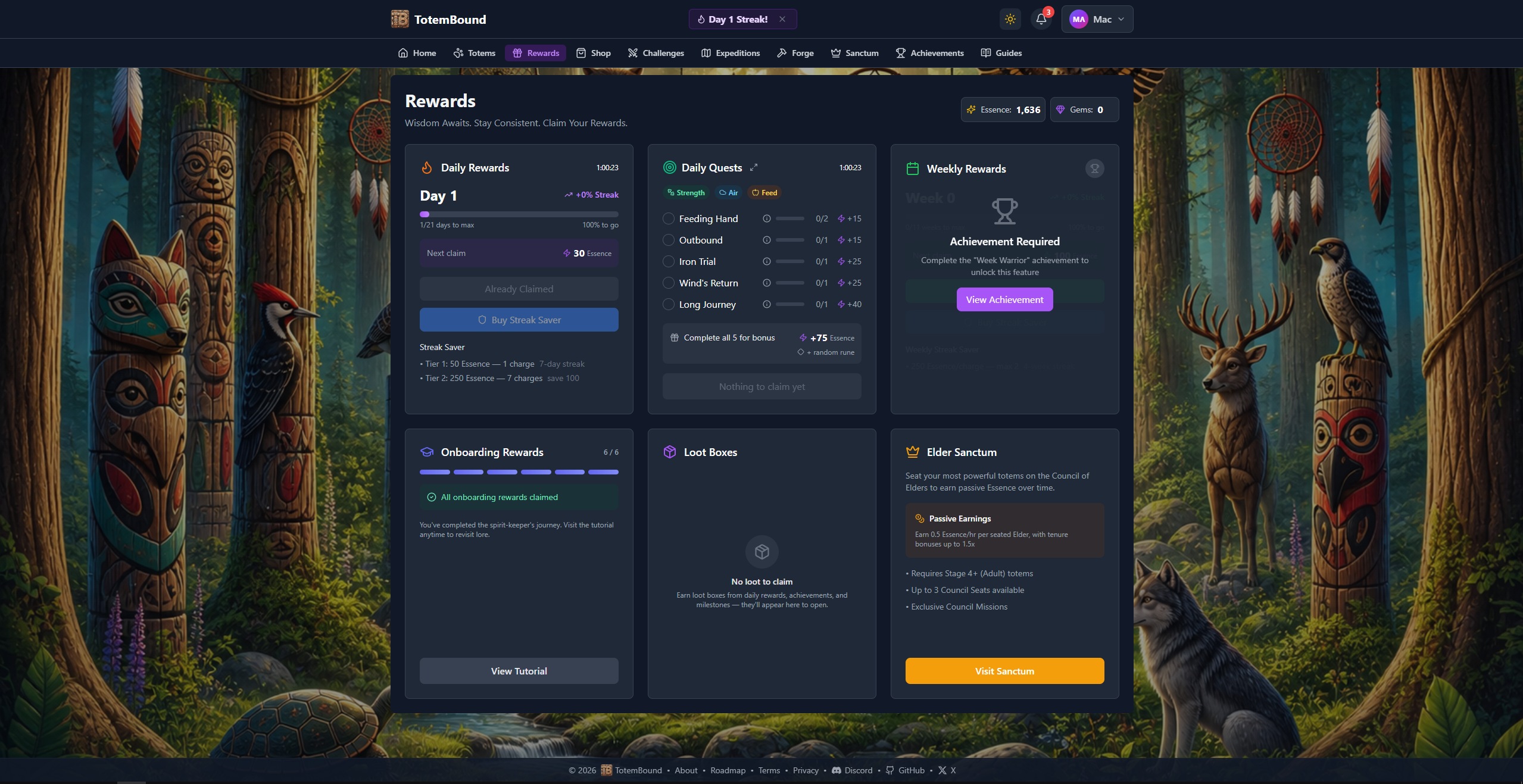
For players, the entry price is zero. TotemBound’s published Free plan includes collecting, training, evolution, challenges and expeditions. Premium costs $5 a month; VIP costs $15. Those prices were listed on October 23, 2026. Paid tiers add currency allowances, reward multipliers and exclusive companions, among other benefits.
The two currencies help explain the model. Essence is earned through play. Gems are the premium currency, with purchases processed through Stripe. The design offers a free routine, then asks whether extra rewards and collecting options are worth a recurring payment. Its natural audience is someone who enjoys returning to a growing collection and making incremental choices.
The request that never happens
Behind that routine sits a more prosaic discipline. The frontend documentation explains that repeated cloud requests have costs. Its stated approach avoids timer-based polling: refresh state after player actions, and use push notifications for real-time updates. A browser does not need to keep asking the same question simply because another few seconds have passed.
“Every API call costs money”
TotemBound frontend documentation
Seven static configuration files hold definitions such as species, challenges and rewards. They are delivered through CloudFront. Dynamic information, including balances, creature state and progress, comes from the API. Reading what an owl is should not require the same machinery as changing what a particular player owns.
Other builders can inspect this arrangement because TotemBound publishes its frontend and backend code. The distinction is useful for applications with stable reference information and occasional user changes. Continuous multiplayer action would impose different demands. The documented design offers a specific economy of effort, with its usefulness depending on the workload.
One studio, two kinds of customer
Empires connects this operating work to a second business: custom AI and LLM applications and business tools. Its proposition is that experience shipping its own products can inform client work. The technical footprint gives that proposition something concrete to examine. A prospective customer can look beyond the phrase “AI-ready” and ask how the studio handles identity, payments, deployment and changing data.
The backend documentation describes an AWS Lambda application, DynamoDB storage and Cognito authentication, with Stripe handling payments. These are ordinary services doing consequential jobs. For a business considering a development partner, the useful conversation starts with those responsibilities: what must stay secure, what changes frequently, and what the customer needs to operate after launch.
Its next consumer title, WastedRealms, points toward a different appetite. Empires describes an open-world RPG and strategy game built around exploring, governing a realm and competing for territory. It remains in development, with an art and gameplay reveal promised. TotemBound’s roadmap, meanwhile, separates its completed foundation from work in progress and future plans, including broader social competition.
For now, the most revealing object in this little portfolio may still be the goose. Someone has assigned it abilities, provided a path for its growth, built the system that remembers it, and attached a price to optional extras. Empires’ world-building happens through those small decisions. The creature gets wiser. The software has to keep up.