A bar napkin is a poor instrument for long-range planning. In 1997, Andrew Jassy and his wife agreed on one that they would spend a few years in Seattle, then return to New York. He had just joined Amazon. The arrangement had the appealing neatness of a temporary adventure: go west, learn something, come home.
By the time he recounted the agreement to employees in September 2024, he had been at Amazon for 27 years. He had helped build its cloud business and succeeded Jeff Bezos as chief executive. Seattle had acquired considerably more than a temporary resident. Somewhere along the way, the napkin had lost its authority.
Jassy, usually called Andy, presents an interesting problem for the tidy career story. He has two Harvard degrees and a job title that suggests a carefully plotted ascent. Yet his own account contains false starts, changes of mind, and a first day at Amazon when he did not know what his job would be. His record makes more sense as a succession of questions than as a ladder.
The microphone that never arrived
He grew up in Scarsdale, New York, played soccer and tennis, and graduated from Harvard College in 1990. He studied government and managed advertising for The Harvard Crimson. Those are useful credentials for several professions. Running computing infrastructure for other companies would have been an unusually specific prediction.
Sports had his attention first. After college, he wanted to become a sportscaster and sent a recording of his work to small television markets around the country. Two showed interest. He took a sports-production job at a major network instead, supplementing it with coaching his old high school soccer team and working in a golf shop. Eventually, a classmate persuaded him to interview at a consumer-products company.
Product management followed, then attempts at his own businesses, then brief spells in sales and investment banking. Business school came after the experiments. In May 1997, he finished his last graduate-school exam on a Friday and started at Amazon the following Monday. The weekend between the two was shorter than many people’s onboarding paperwork.
There is a useful distinction between having options and knowing what to do with them. Jassy had to test his. When he discussed his career with LinkedIn chief executive Ryan Roslansky in 2024, he emphasized attitude and the willingness to keep learning. It is advice with a fairly substantial paper trail: he had tried several futures before finding one worth extending.
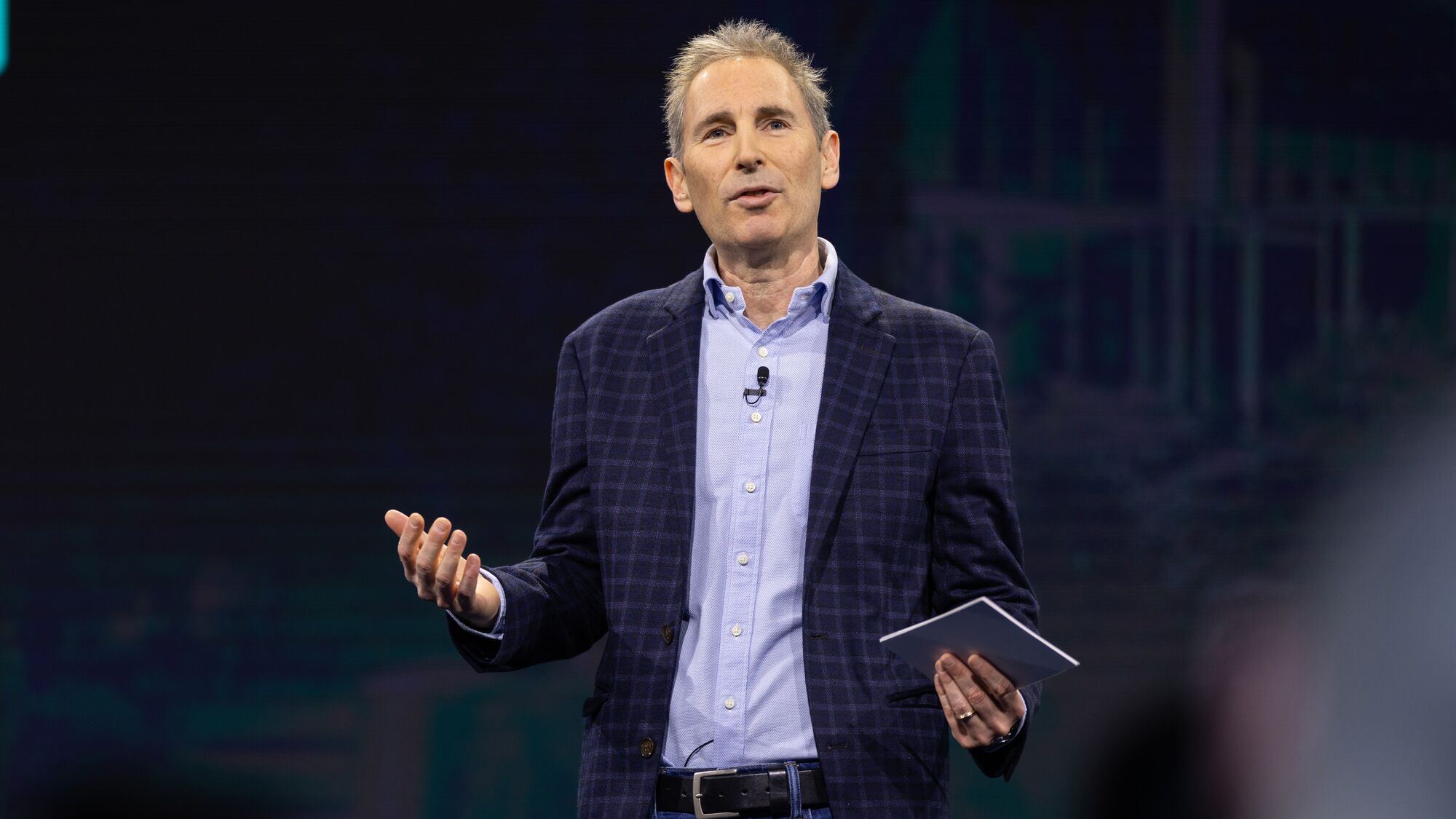
A bookstore discovers its plumbing
His early Amazon assignments included marketing and the compact-disc business. Later he became Bezos’s technical adviser, a role often described as the founder’s shadow. It put him close to decisions across the company, rather than inside one department’s view of the world. The future leader of AWS had arrived through the business side.
Amazon’s engineers had a familiar difficulty: too much effort went into the machinery required to build a service before anyone could concentrate on what made that service useful. Provisioning servers and managing infrastructure consumed money and attention. The retailer was learning an expensive lesson about the foundations of an internet business.
AWS turned that difficulty into a proposition for other developers. What if they could obtain storage and computing power as services, instead of assembling the whole apparatus themselves? In 2003, Bezos and Amazon’s senior leadership put Jassy in charge of the infrastructure-services effort. Engineer and evangelist Jeff Barr was among the colleagues preparing to explain it to developers.
That history matters because it resists the convenient picture of a lone executive receiving a thunderbolt. Jassy led an undertaking built by engineers, product teams, and early customers. His contribution was to help turn a set of capabilities into a business that people outside Amazon would choose to use.
Amazon S3 launched in March 2006, offering object storage. EC2 followed in August, providing computing capacity. Separately, the services could look oddly modest. Together, they suggested a different way to build software: rent the necessary pieces, combine them, and spend more time on the thing your customer actually wants.
In his 2023 shareholder letter, Jassy described these pieces as primitives. The word sounds suitably unglamorous. A primitive does one job well and leaves room for someone else’s invention. There is an appealing restraint to that ambition: provide something essential without pretending to know every use people will find for it.
A music fan with follow-up questions
The public Jassy can seem more comfortable in a detailed discussion than in the business-celebrity role his position supplies. Colleagues have described an analytical, competitive executive who notices the gap in a presentation. A meeting with him can require a more intimate acquaintance with the subject than the presenter had hoped to need.
Then there is the music fan. At the virtual AWS re:Invent conference in December 2020, he interviewed Brandi Carlile with the attention of someone who had done his listening. He recalled details of her work without notes and used a Foo Fighters lyric to frame a question about attempting something uncertain.
The conversation offered a small but revealing crossover. Here was a cloud executive thinking about business through a songwriter’s experience. Curiosity did not stop at the office door. Nor did competitiveness begin there: he has talked about youth tennis teaching him to take risks and move on after a point, whether it went well or badly.
Sports remain a visible part of his life. He belongs to the Seattle Kraken’s ownership group, and his public X biography advertises enthusiasm for sports, music, films, and buffalo wings. The wings receive a level of prominence that most executive biographies reserve for honorary degrees.
“be an incredibly ravenous learner”
Andy Jassy, in his 2024 conversation with Ryan Roslansky
When the shadow takes the chair
Jassy became Amazon’s president and chief executive on July 5, 2021. Bezos remained executive chairman. By then, Jassy had spent almost a quarter-century inside the company and had led AWS from its beginnings, receiving the AWS chief executive title in 2016. He inherited an institution whose habits he had helped establish.
The new job widened the consequences of his decisions. An AWS product choice affects developers and their customers. An Amazon-wide management choice reaches office teams, warehouses, delivery operations, entertainment, advertising, and retail. Familiarity with the culture could help him navigate that breadth. It could also make the culture itself the object of his attention.
His September 2024 employee memo attacked excessive layers of management and the meetings that accumulated around decisions. He asked senior organizations to increase the ratio of individual contributors to managers by at least 15 percent by the end of the first quarter of 2025. He also introduced a mailbox for reporting bureaucracy.
The same memo called employees back to the office five days a week from January 2025, subject to exceptions. Jassy argued that physical proximity helped collaboration, teaching, and the transmission of Amazon’s culture. Employees had already pushed back against the earlier three-day requirement. His prescription for speed made a substantial claim on how people organized their lives.
This is where the language of invention meets the responsibilities of being an employer. A flatter organization can promise more ownership while a stricter attendance policy reduces individual discretion. Both policies can follow from one executive’s theory of how teams work. The people doing that work still have to experience the promised improvement.
The question is getting more expensive
Jassy’s 2024 shareholder letter put a childhood habit at the center of his management philosophy. His father remembered a boy who kept asking why, sometimes excessively. The adult version asks why customers should accept an awkward experience, and why a technical or organizational constraint should be treated as permanent.
Applied to artificial intelligence, that habit has acquired a large capital budget. In July 2026, Amazon raised its expected capital spending for the year to $220 billion, covering technology and infrastructure including AI, chips, robots, and satellites. A belief about the next generation of computing now comes with construction schedules and very real bills.
AWS sales in Q2 2026
37% year-over-year growth, rounded as reported by Amazon. Quarterly sales, not annual revenue.
There is evidence of demand. AWS reported second-quarter 2026 sales of $42.2 billion, up 37 percent from a year earlier. There is also evidence of the strain of building ahead: Amazon’s trailing twelve-month free cash flow was negative $7.6 billion at the end of June. Growth and the cost of pursuing it appear on the same set of accounts.
The combination makes Jassy’s position more interesting than an uncomplicated success story. He has experience committing resources to a business whose early appeal was not universally obvious. That experience can inform a new investment. It cannot settle in advance how much customers will spend, how competition will develop, or what the eventual returns will be.
A few years, extended
Seattle also gave him commitments outside Amazon. He chairs Rainier Prep’s board and serves as a trustee of Rainier Scholars. Alongside the hockey investment, those education roles give the once-temporary move a civic dimension. His connection to the region has accumulated responsibilities as well as years.
In September 2026, visiting Amazon employees in Vancouver, he returned to the theme of learning and the uneven progress of ambitious work. The setting was apt: he had traveled with Bezos to Toronto for Amazon.ca’s launch in 2002. A business he had seen arrive in Canada now provided another audience for the lessons of staying.
The original agreement on the napkin remains a good way into Jassy’s story because it preserves the uncertainty that the job title tends to erase. He did not begin with a plan to spend decades in Seattle. He kept finding work that made departure less compelling. The short stay has required a surprising amount of patience.
More from Jassy’s world
- Amazon ↗Company website
- Andy Jassy on LinkedIn ↗Career updates and posts
- Andy Jassy on X ↗Public posts · @ajassy
- The letters to shareholders ↗Writing by Jassy and Bezos
- Watch: Jassy in conversation with Harvard Business Review ↗YouTube · May 2025
- The Vancouver conversation ↗AI, hockey, and learning · September 2026
- A closer look at the music fan ↗GeekWire profile · February 2021