A job application has a peculiar talent for making activity feel like progress. You fill in the boxes, press the button and receive a message confirming that the boxes have been filled. Somewhere, presumably, a person will read them. For someone seeking hourly work, that interval can be the whole problem. A vacancy exists. A worker exists. The conversation has yet to begin.
- JobGet puts nearby jobs, quick applications and employer conversations on a phone.
- It has bought hiring platforms including Snagajob, Seasoned and RippleMatch.
- The business now follows the applicant into screening, scheduling and recruiting-budget decisions.
JobGet’s original insight was to bring that conversation forward. A mobile profile, a nearby opening, a message to the hiring manager: the mechanics suited work that happens in stores, kitchens and warehouses. The interesting part of its story is what followed. Once applying becomes easy, a hiring business has to confront a less photogenic question. What happens to all those applications?
The waiting room in your pocket
JobGet launched in Massachusetts in 2019 with Tony Liu, Peter Lee and Billy Lan. Its 2020 funding announcement described three founders from first-generation immigrant families who had seen the difficulties of finding hourly work themselves and through relatives. That background offers a useful clue to the product’s priorities. An elaborate professional identity was less urgent than reaching somebody who could offer a shift.
The company began with eight employer partners. By its October 2020 seed announcement, it reported more than 5,000 employer locations. Its collaboration with MassHire Central during the pandemic gave the approach a public-service application: connect displaced workers with companies still recruiting. Initial access was free to job seekers and, for six months, employers. A phone could become the meeting place when ordinary meetings were suddenly difficult.

This is a distinctly practical corner of recruitment. Retail, hospitality, healthcare and transportation employers need people for particular places and particular schedules. A candidate can look suitable on paper and still be unavailable for the hours required. For this market, the conversation carries information that a polished cover letter may never supply.
A tap, a swipe, a conversation
Today, the free app offers one-tap applications, direct employer chat and a resume builder. JobGenie supplies daily job recommendations with swipe-to-apply. The attraction is easy to understand: use a small screen to move from discovery to action without making each vacancy a fresh administrative expedition.
There is also an unexpected neighbour in the app. GetCash rewards users for games, surveys and tasks. A person can be looking for a job and looking for extra money at the same time. Those activities have different economics; a game reward is hardly a replacement for a dependable wage. Their coexistence reveals how broadly JobGet wants to interpret the needs of its audience.
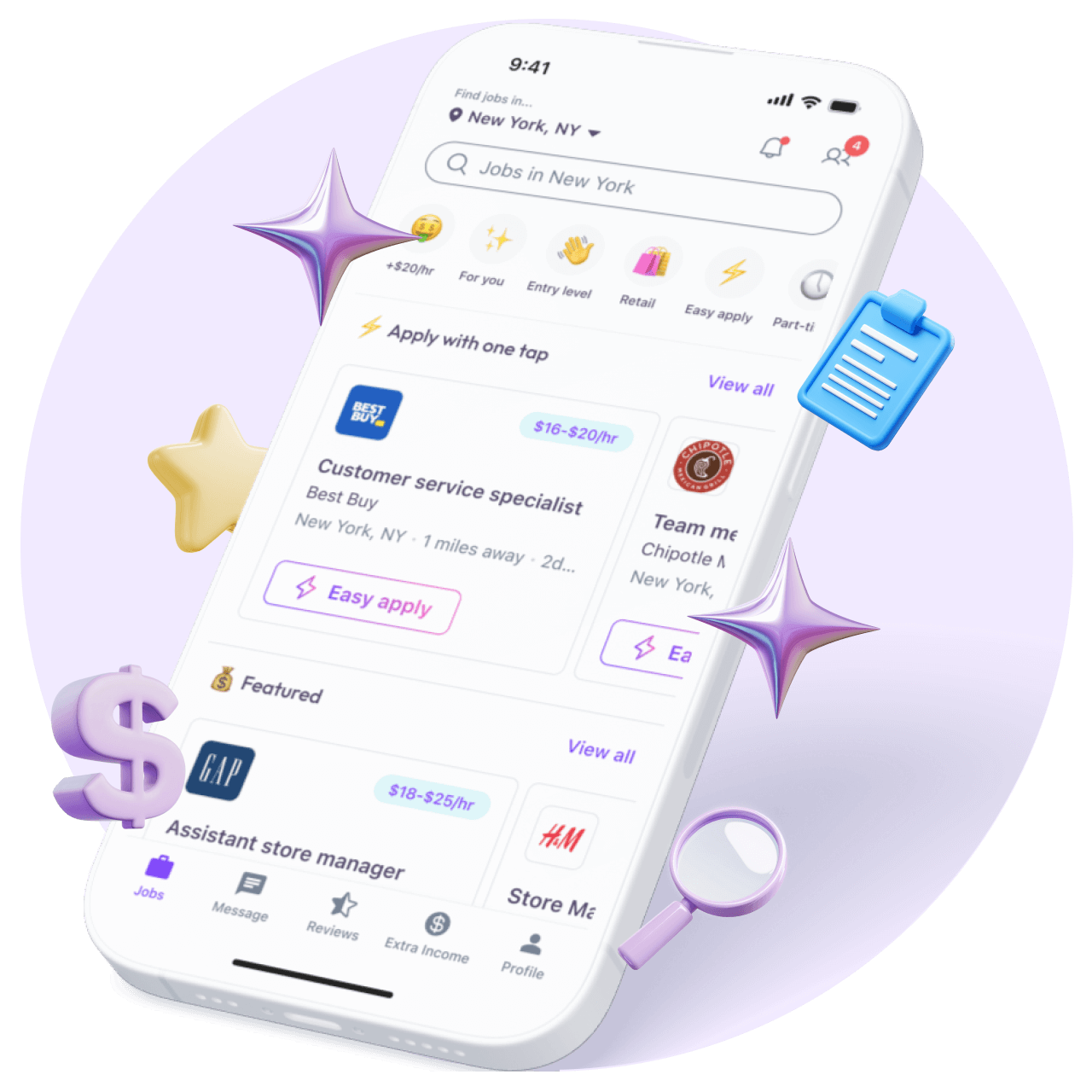
For employers, the product occupies territory between a job marketplace and recruiting software. Indeed and ZipRecruiter are familiar alternatives for finding applicants. JobGet’s pitch concentrates on the hourly worker and the mobile interaction, then extends into the machinery that employers use to process responses. Specialisation matters most when it improves the next step.
The $52 million fork in the road
In June 2022, JobGet announced $52 million in financing: $40 million of equity and $12 million of venture debt. JAZZ Venture Partners and Sanabil Investments co-led the round, with Pillar VC participating. The company reported nearly two million app downloads and more than 50,000 companies that had used it to post jobs.
“Our app is just the beginning.”Tony Liu · June 2022
Money created room for both product development and expansion. Acquisitions subsequently became a visible feature of the business. Heroes Jobs joined in 2023, bringing a social platform aimed at Gen Z. Wirkn followed in June 2024, with a network spanning malls, retail and restaurant locations. Snagajob arrived that November. The younger company was buying a name associated with an earlier generation of hourly job hunting.
Seasoned, announced in March 2025, added restaurant recruiting and automation. RippleMatch followed in May 2026, extending the portfolio into students and early-career candidates. JobGet called that its sixth acquisition. The pattern suggests a company assembling both audiences and the tools needed to serve them. Buying distribution is useful; making the resulting traffic productive is the harder assignment.
When the queue becomes the problem
The employer offering now has two revealing names. SpendSmart uses applicant-tracking-system signals to move recruiting spend between roles. HireReady handles screening, interview booking and reminders. One concerns where the next advertising dollar goes. The other concerns whether the person already found makes it into a conversation.
JobGet’s employer page reports that Potbelly cut hiring time from 11 days to 6.6 days within the first 60 days of working together. Treat that as a company-published customer result, with its own circumstances, rather than a universal forecast. It does, however, put the sales argument in useful units: days until a position is filled.
Days to hire · a reported 40% reduction
The homepage advertises employer access from $16 per day. That is a starting price, not the cost of an enterprise deployment. And the advertised network of more than 100 million workers describes reach. It should not be read as a count of people actively using the app. Large numbers become more helpful when their nouns remain attached.
Copy the handoff, not the headline
The transferable lesson is to inspect what follows every successful click. How long before a reply? Who books the interview? What happens when the candidate forgets? A manager can examine those transitions without buying another company or commissioning an AI assistant. Count completed conversations alongside incoming applications.
The approach needs responsive employers, credible vacancies and candidates who can use the mobile workflow. Matching cannot repair an unsuitable schedule or make an unappealing offer attractive. That is the useful tension in JobGet’s story: software can shorten the journey to a decision, while the decision still concerns an actual person and an actual job. The application receipt is only the opening line.