Five cents was enough to send people home. Early in his career at Dell, Tom Kieley supervised a boxing line on the second shift. A missing foam end cap, worth about a nickel, could interrupt production. The computer might be ready. The people might be ready. Without the packing material, readiness was an academic distinction.
He remembers shifts running from four in the afternoon to four in the morning, and the long stretches of work required to recover from supplier misses. A small absence on a purchase order became a large demand on somebody’s time. The imbalance stayed with him: the price of the missing item said remarkably little about the trouble it could cause.
Years later, Kieley would co-found SourceDay with Clint McRee, working on the communication between manufacturers and their suppliers. Their subject was purchase orders, a phrase unlikely to improve a dinner invitation. Their stakes were considerably more interesting: whether a business could keep its promises, and whether the people making its products would have what they needed.
A stopped production line.
A recollection from Kieley’s early work at Dell, rather than a company performance metric.
A buyer’s inbox can become a factory problem
Kieley graduated from Texas A&M in 2004. His background in engineering industrial distribution gave him an introduction to the movement of goods; Dell supplied the practical examination. Later came enterprise software roles at companies including Boomi, Asure and Pervasive. He had worked around both the physical product and the software sold to businesses.
That combination mattered. A factory’s internal planning system can record what it expects to receive. A supplier can have an entirely different understanding of the date, quantity or price. Between those two versions sits a buyer, often trying to settle the matter through email, spreadsheets and phone calls. An order placed is only the beginning of the conversation.
SourceDay addressed that interval. It connected supplier collaboration with enterprise resource planning systems, allowing changes to purchase orders to move through a shared process. Kieley’s emphasis was on the materials that become the finished product. A delivery service can do everything correctly and still have nothing to collect if production never gets its parts.
His description of buyers as “unsung heroes” gives this otherwise technical subject a human centre. They help make a sale deliverable. The public sees a product arrive; the buyer has been concerned with all the things whose failure could prevent that arrival. Kieley had supervised some of the people left waiting when those things failed.
Two founders, and an order that keeps changing
McRee brought his own manufacturing experience to the partnership. The pair shared an interest in the supplier problems they had encountered before becoming founders. Their company took shape through early experimentation and changes of direction, with the SourceDay launch they later celebrated dating to 2015. There was no elegant shortcut from recognising the problem to selling a workable answer.
Kieley had already co-founded RightGift, a platform associated with charitable wish lists and donations. Entrepreneurship preceded SourceDay, as did the experience of trying to make a new business work. RightGift also provides a useful connection to another part of his public life: his interest in giving employees a practical way to support community organisations.
By December 2020, he was telling business audiences to stop tolerating unreliable supplier performance. His argument went beyond finding a late shipment. Overbuying inventory to insure against surprises could consume cash and narrow margins. The apparently safe response to uncertainty carried its own cost. Better information and accountability were part of his proposed alternative.
In that period he described roughly 40 percent of purchase-order lines as subject to change. A 2022 account put the figure at half. These were descriptions of change within the customer environment, rather than a universal law of manufacturing. They explain why he kept returning to collaboration: an order could be correct when sent and become wrong before delivery.
The reward nobody cashed in
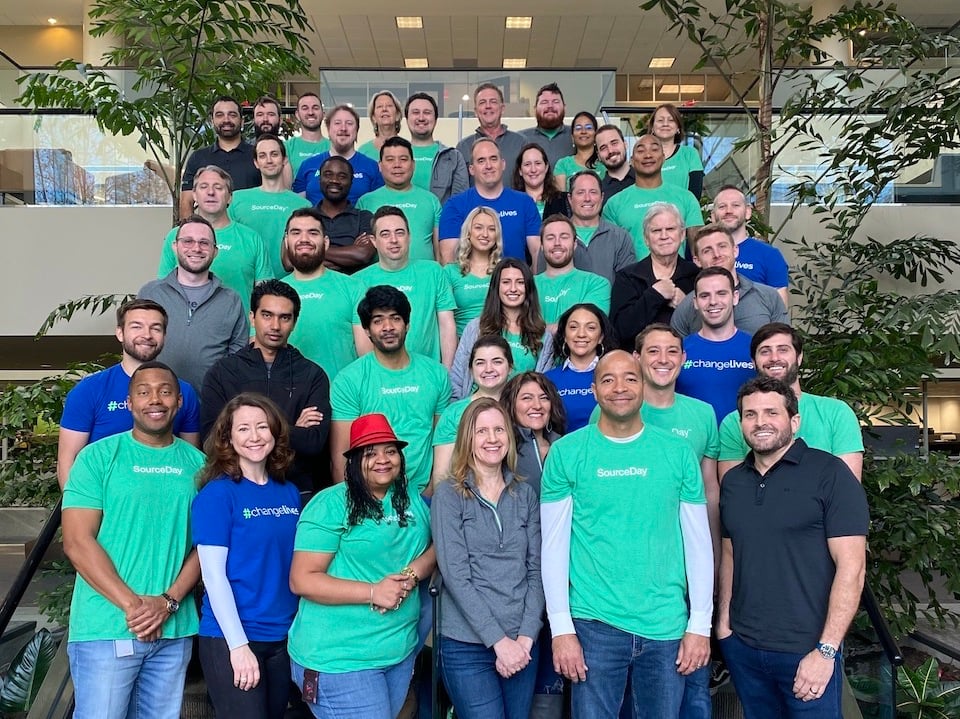
A company selling collaboration has a particularly awkward problem if its own employees cannot practise it. Kieley and McRee made workplace culture an early concern, and their approach eventually produced some revealing details. The most telling involved a reward scheme whose participants declined to behave quite as expected.
SourceDay introduced peer recognition through karma points. Colleagues could acknowledge help from one another, with rewards that had monetary value. In April 2020, Kieley reported that employees had directed every redeemed point to charitable organisations. The option of a personal treat existed. People chose somewhere else for the money to go.
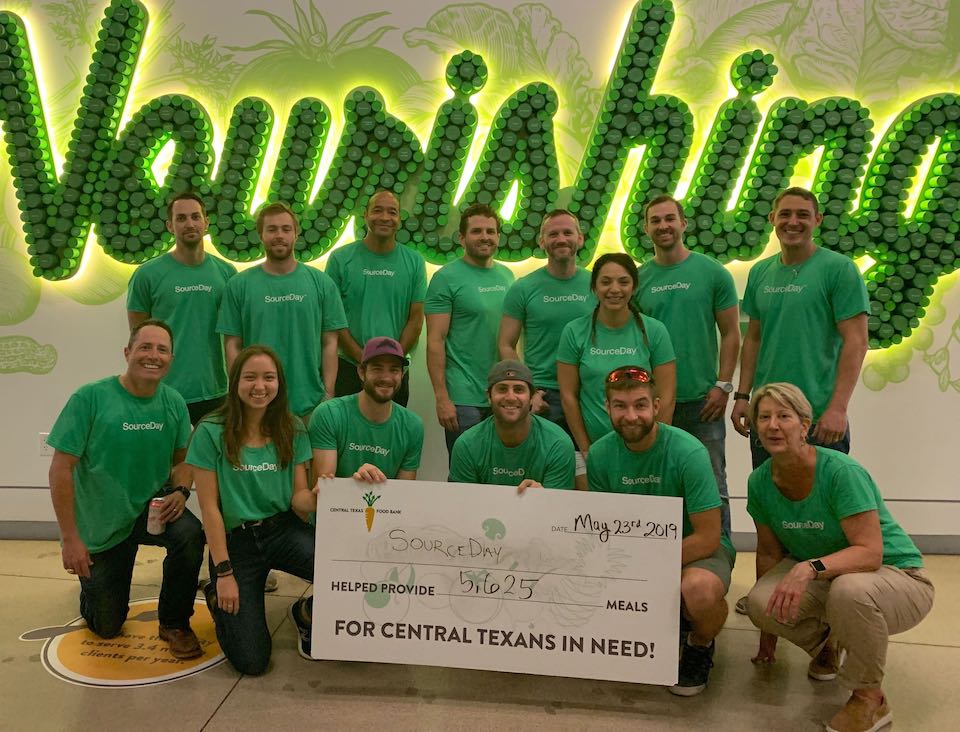
SourceDay Cares gave volunteering a place in the working calendar. The programme involved employees in choosing community projects, rather than leaving the entire decision to the executive office. A photograph from a Central Texas Food Bank visit catches the less abstract version of that idea: colleagues in green shirts, gathered behind a sign recording the meals their work helped provide.
His colleagues also had permission to be funny at his expense. An office scavenger hunt included video impersonations of the founders. There is a useful test of executive accessibility in whether people feel comfortable doing an impression of the boss. Here, it was an organised activity. Someone had put managerial mimicry on the itinerary.
Kieley’s willingness to give other people creative credit surfaced again when he praised marketing leader Sarah Scudder’s supply-chain podcast, What the DUCK?! He admired the name and its travelling mascot. “Someone like me would have called it something boring,” he wrote. The admission is a modest but useful executive skill: recognising that another person has supplied the better joke.
A lawn, a workshop, and the art of letting go
Delegation was a harder lesson. Kieley has credited his father, a CFO at early-stage companies, with helping him understand fundraising, financial operations and growth. The example he chose to explain delegation came from home. His father handed over the yard work, freeing time for woodworking. The yard was small, but it occupied a steep hill.
As a founder, Kieley recognised the same division of labour. Holding on to operational tasks could leave too little time for the strategic work the company needed from its chief executive. Trusting a team meant allowing other people to do important things. He described building out SourceDay’s executive team as a substantial focus during 2019.
The story has the advantage of being wonderfully unglamorous. Leadership literature tends to prefer a mountain summit. A lawn will do. Somebody still has to cut it, and the person holding the mower cannot spend the same hour in the workshop. A business makes the allocation harder, but hardly abolishes the arithmetic.
By February 2022, SourceDay had announced a $31.5 million Series C led by Norwest Venture Partners. Existing investors also participated, and Norwest’s Sean Jacobsohn joined the board. The company said the money would support recruiting and continued product investment, including plans to double its product and engineering teams. More people would need to take responsibility.
SourceDay’s Series C, led by Norwest Venture Partners, during Kieley’s tenure as CEO.
Writing the journey, then changing the job
In 2023, Kieley and McRee published Start-Up Lessons Learned Along the Way: Our SourceDay Journey. The book offered their respective accounts of building the company. Its lessons included finding a suitable partner, persistence, developing future leaders and recognising the link between culture and community. The two authors had plenty of shared material to work with.
Kieley favoured an aviation analogy: founders are assembling the aircraft while already in flight. It is an uncomfortable image, which may be why it works. Customers, employees and investors have joined the journey before every mechanism has been perfected. His advice placed value on people willing to build amid that uncertainty, rather than waiting for a finished blueprint.
“You gotta build it while you’re flying it.”
A startup saying Kieley uses in his book
On November 14, 2024, SourceDay announced Michael Miller as chief executive. Miller had been its chief operating officer. Kieley moved to a board role. After more than nine years leading the business, he was handing daily operations to someone already inside the company, while keeping a formal connection to what he and McRee had created.
His own announcement thanked his wife and children and made room for family, friends and travel. He also acknowledged that sitting still was unlikely to become a lasting occupation. Early in 2025, he publicly weighed three possibilities: joining an early startup, leading a more established software business, or building another company from scratch.
The next system has a light switch
Today, Bryte Light lists Kieley as its CEO. The company works on intelligent lighting, controls and low-voltage building infrastructure; its founder is Cory Brymer. Kieley’s remit has moved from supplier coordination to building systems. His public commentary now considers how commercial properties make decisions about infrastructure that may remain in use for years.
There is continuity in the questions he asks. Who has responsibility for the system? Are people choosing a familiar supplier because the arrangement still works, or because nobody has reconsidered it? What does an investment return in practice? The equipment has changed, but he remains interested in decisions that become expensive when left unattended.
Outside work, his interests include cars, boating and the outdoors. He is a father of three, an Aggie, and a repeat founder whose career has included factory supervision, enterprise sales, charitable giving software and supplier collaboration. The five-cent part belongs near the beginning of that career. The question it raised has travelled well: what small thing is everybody depending on?