The internet was ready to sell almost anything in 1999. Corporate purchasing departments were a more complicated proposition. Subhash Makhija and his three fellow founders started GEP that year with an idea about using technology to make procurement work better. Then they encountered a customer who rarely gets a starring role in entrepreneurial stories: the customer who needs something slightly different from the thing you have come to sell.
Large companies needed help with the work surrounding the technology. Processes had to change. Expertise had to be supplied. Somebody still had to run the operation. Makhija and his colleagues expanded GEP into consulting and outsourcing alongside software. A business that began with a technological proposition became a business willing to get involved in its customers’ working arrangements.
There is a pleasing inconvenience here for anyone who prefers a founder’s biography to proceed in a straight line. GEP’s beginnings suggest that being right about the future and being useful in the present are separate accomplishments. The company had to find a way to do both.
The customers arrived with a different problem
Makhija founded GEP with Roopa Gandhi, Neha Desai Shah and Jagadish Turimella. He brought experience from Accenture, where he had led assignments spanning strategy, procurement, supply chains and outsourcing. He knew the corporate buying world before setting out to sell it a new approach.
The adjustment in GEP’s early years is easy to underestimate. Consulting, software and managed operations ask different things of a company. One diagnoses and redesigns work; another builds the system; another takes responsibility for doing the work repeatedly. Bringing them together means accepting a customer’s untidy combination of needs.
That combination also helps explain the founder’s endurance in this particular field. Procurement offers few opportunities for a glamorous reveal. A supplier gets paid. A contract becomes easier to manage. A buyer can find information before entering a negotiation. The achievement is often measured in the absence of a familiar irritation. Nobody throws a launch party because an approval finally went to the right person.
A schematic of GEP’s business model, not a revenue breakdown.
An engineer learns to listen
His formal preparation started in chemical engineering, with an undergraduate degree at Mumbai’s University Department of Chemical Technology. A master’s at the University of Rhode Island and a doctorate at Polytechnic University followed. He also earned an MBA at Chicago Booth in 1996. The educational itinerary crosses disciplines as well as countries.
Engineering and procurement make an interesting pair. Both require attention to what passes through a system, where constraints appear and what happens when an input changes. That is a way to read the relationship between his training and his career, rather than a claim that a doctorate supplied a ready-made business plan.
The consulting experience supplied another kind of preparation: exposure to how organizations actually make decisions. A technically sound proposal must still pass through budgets, responsibilities and the habits of people who have other work to do. GEP’s early change of course makes sense against that background. The machinery of adoption deserved as much attention as the machinery of software.
“Bring in amazing talent who will delight our customers.”
Subhash Makhija
The name on the patent page
For a CEO whose public language often returns to people, Makhija has a surprisingly literal presence in the technical record. He is a named co-inventor on a patent for data processing in an enterprise application, granted in June 2023. The invention concerns processing supply-chain information, including grouping data through graph-based analysis.
It is a small but useful correction to the usual division of labor in a founder profile. Here, the executive speaking about customer relationships also appears alongside collaborators on the paperwork for the systems underneath them. The patent credits multiple inventors. Its significance is collaborative technical work, rather than the romance of a solitary inventor.
A March 2026 application publication names him among the inventors of a system for AI-agent data processing in enterprise applications built using a codeless platform. An application is a proposal seeking patent protection, distinct from a granted patent. Even with that distinction, the subject matter is revealing: conversational input, agents and the execution of business tasks. The work reaches into how enterprise software might be operated, as well as what it displays.
Buying earns a seat at the board table
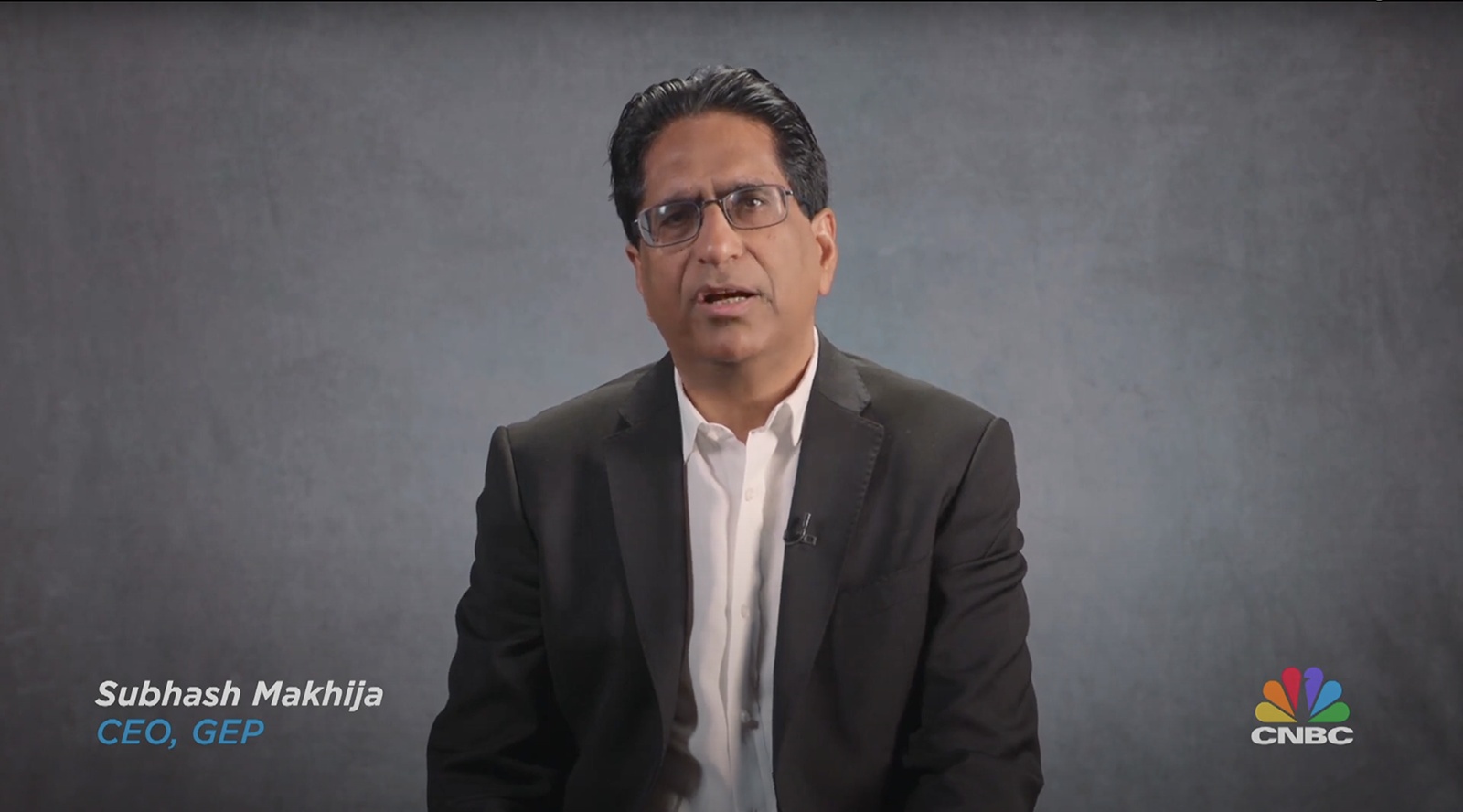
Makhija’s public career has followed procurement’s widening remit. In February 2023, he joined the CNBC CEO Council, bringing supply-chain questions into a community of chief executives from different industries. The subject travels well because almost every corporate promise eventually depends on somebody else delivering something.
In March 2026, he and veteran executive Raj Gupta set out a board-level argument: directors need to understand dependencies beyond their immediate suppliers. A company may diversify the businesses it buys from while those businesses continue buying critical materials from the same place. The organization chart changes; the underlying exposure can remain.
Their proposed response includes mapping the wider network, testing disruption scenarios, investing in resilience and giving supply-chain oversight dedicated attention. It is an argument about responsibility as much as information. A risk that crosses purchasing, operations and finance can become very good at belonging to nobody.
This is where Makhija’s field becomes more interesting than its reputation. Procurement determines which relationships a business can rely on under pressure. A lower purchase price has value. So does the ability to keep a commitment when an upstream dependency fails. The hard work is deciding how to account for both before the emergency arrives.
Davos, with the packaging included
His interests also extend to the environmental consequences of purchasing decisions. After Davos in 2023, Makhija wrote about energy transition, the reorganization of supply chains and AI. He described practical measures such as cleaner energy, changes to packaging and tracking emissions associated with suppliers.
These are subjects with a wonderfully unromantic vocabulary. Packaging specifications and common measurement standards seldom set a room alight. Yet they are among the places where an environmental ambition acquires a purchase order, a delivery schedule and somebody responsible for checking the result.
GEP’s work around the World Economic Forum has included a roundtable on sustainable supply chains and participation in a task force concerned with the responsible procurement of AI. Those two conversations belong near each other. Buying new technology also means making decisions about its risks, its suppliers and the standards by which it should be judged. A company that purchases AI still needs to exercise judgment about the purchase.
A thousand people unlock a gift
Makhija’s relationship with education continued after his own degrees. In June 2020, he and fellow Booth alumnus Ashish Kishore put forward a $100,000 challenge grant. The money would be unlocked if at least 1,000 donors gave during the month. The response reached 1,236.
Including the sponsors’ grant, the effort raised $1,418,960 for the school’s Annual Fund. The design matters almost as much as the amount. It turned participation into a condition for a collective result. A modest contribution counted toward a threshold that made another contribution possible.
$100,000 joint challenge grant from Makhija and Ashish Kishore. More than $1.4 million raised in total.
There is a broader personal commitment behind the fundraising detail. Makhija and his wife, Roopa, have focused their philanthropy on child poverty, education and women-related causes. These commitments sit alongside their roles in building GEP, rather than waiting for a later chapter after business life is finished.
A book for the long flight
During GEP’s 25th-anniversary year, Makhija described traveling to meet colleagues in Germany, London and Mumbai. He also mentioned finishing a book about Jamsetji Tata during the long flights. His reflection connected the history of another company with the kind of future he wanted for his own.
The aspiration was unusually patient: for GEP’s values to pass to future generations and for the company to keep serving its stakeholders 150 years into the future. It is a revealing timescale for someone working in an industry where product terminology can become elderly before the office furniture does.
Reading about Tata does not make two companies equivalent. It does give a more human shape to Makhija’s ambition. Between meetings and flights, the question on his mind was what might survive the founders. The people eventually running the company would need something worth inheriting.
Back to school, thirty years later
In July 2026, Chicago Booth announced the GEP Center for Supply Chain Innovation and Applied Technologies. Three decades after Makhija’s MBA, his company was supporting a place for research and education in the field that had become his working life. Roopa and Turimella are Booth MBA graduates too.
The center will connect faculty, students and industry around supply chains and emerging technologies. For Makhija, who serves on the Council on Chicago Booth, it extends an existing institutional relationship. For the story of GEP, it adds a return journey: from a school that helped educate its founders to a company helping support the next round of inquiry.
His present argument about AI retains the practical concern visible in GEP’s beginnings. In a recent interview, he urged executives to invest in employees’ skills and rethink their responsibilities as software agents take on transactional tasks. The original difficulty remains recognizable. A powerful tool needs people and processes capable of making it useful.
In 1999, the buying department required more help than the original proposition allowed. Makhija and his co-founders adjusted. Decades later, his work still circles that encounter between an ambitious technology and the organization expected to use it. The future may arrive promptly. Getting everyone ready takes rather longer.