A factory can be a kingdom undone by a part small enough to lose beneath a thumbnail. One chip fails to arrive, one resin changes price, one supplier slips a date, and an expensive production line develops the stillness of a museum. Keith Hartley has spent much of his career asking why the people responsible for preventing that silence are so often armed with yesterday's prices, crowded inboxes, and spreadsheets whose logic vanished with a former employee.
It is a question with roots deeper than the current appetite for artificial intelligence. Hartley grew up in a small Wisconsin town in a blue-collar manufacturing family. His father managed a canning and manufacturing facility in food and beverage. Factories were not abstract nodes on a consultant's slide. They were workplaces, complicated systems, and a family language.
He saw how important supply-chain workers were and how lightly software had served them. Later, he studied computer engineering at California State University and earned an MBA from London Business School, where he chaired the Entrepreneur Club. The career that followed would move through Red Hat, Oracle, ServiceMax, Blue Yonder, and Ivalua. The recurring assignment was to take sophisticated enterprise technology into markets where useful tools had arrived late.
A party of one, briefly
One episode interrupts the tidy executive biography. Early in his career, Hartley left what he described as his dream job and founded Silicon Valley Venture Advisors, working independently with technology CEOs. He expected autonomy and found isolation. He later called it the worst job he had ever had.
The admission is funny because it violates the usual grammar of founder mythology. The venture did not reveal a secret market or turn hardship into a unicorn. It gave him something smaller and more useful: a specification for himself. He did not want to be a party of one. He wanted to work with a team and lead it.
Failure is fine and inevitable, but the lessons learned are priceless.Keith Hartley
There is a practical modesty in that lesson. A career experiment can succeed by proving that its premise was wrong. Hartley returned to company building with sharper self-knowledge, taking on sales, general management, and strategy roles across enterprise software. At Blue Yonder, he led manufacturing sales and helped organize the Americas go-to-market effort around industries. At Ivalua, he served as senior vice president of sales. In November 2022, LevaData appointed him CEO and added him to its board.
Computer engineering, then an MBA at London Business School.
Roles across Red Hat, Oracle, ServiceMax, Blue Yonder, and Ivalua.
Named LevaData CEO and joins the board of directors.
Receives a Pros to Know Lifetime Achievement Award.
Publishes Conquering the Decision Abyss.
Two questions beneath all the ceremony
Hartley's view of procurement begins by clearing the desk. Beneath the workflows, datasets, approvals, and supplier rituals, he argues that direct-material sourcing has two foundational questions. Is the company getting a competitive price in the market now? Can it get the part in time to refine, assemble, or manufacture the product?
The word now does a great deal of work. Comparing this year's quote with last year's purchase price may feel rigorous while missing the active market entirely. A cheaper part can also become spectacularly expensive if its lead time delays a launch. First-principles thinking exposes the tradeoff; design thinking then asks how real people should work with the answer.
Hartley recommends questioning assumptions, looking for alternate parts, testing supplier risk with evidence, and using the five whys to reach the cause beneath a process. This is the engineer peeking through the executive. Reduce the system, find the load-bearing facts, then rebuild the work around the people doing it.
Crossing the decision abyss
Hartley calls the distance between abundant data and confident action the decision abyss. It opens when planning cannot see the parts inside a product, sourcing cannot see current market context, and teams use different systems and language. Information exists everywhere. Meaning arrives late.
His favorite villain is not dramatic. It is the spreadsheet, multiplied until it becomes an informal operating system. Hartley once spoke with a company managing procurement through roughly 200 of them. The problem was not the file format itself. It was the manual effort, the opportunity for error, and the tribal knowledge trapped in cells and email threads.
A useful decision needs more than price
Conceptual map, not measured performance. The point is combination: isolated signals become useful when they meet at the part and the decision.
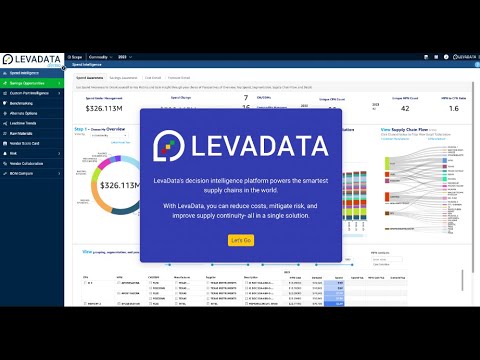
LevaData's answer is to aggregate internal, market, and community data, then contextualize it at the part level. Cost, lead time, inventory, alternatives, lifecycle, and supplier conditions become signals that teams can use before a disruption reaches production. The unit matters. Product-level comfort can hide the one component capable of stopping the whole product.
Direct materials make this especially awkward. These are not the office supplies and subscriptions that can be swapped with a click. They are the chips, fasteners, displays, metals, and assemblies designed into the object a manufacturer intends to sell. Engineering may have chosen them months before sourcing discovers the market consequence. Once a design freezes, an alternate can require testing, redesign, or certification. A buying decision is therefore also a product decision, a schedule decision, and occasionally a very expensive lesson in organizational geography.
Hartley has repeatedly argued for closer collaboration between procurement and engineering. In conversations with Art of Procurement's Philip Ideson and ProcureTech's Lance Younger, and in a LevaData video with product leader Brian York, he has returned to the value of shared visibility. The connection is practical: engineers understand function, sourcing understands the supplier market, and finance understands the economic constraint. None sees the whole problem alone.
AI gets a desk, not the corner office
Hartley has been consistent about AI's place in this system. He expects it to augment procurement teams, not replace them. Software can monitor events, classify data, expose a risk, or surface a negotiation opportunity. People still handle supplier relationships, cross-functional judgment, and the uncomfortable conversation when evidence challenges an established plan.
He has described AI as a future digital colleague, a phrase that is more revealing than the usual automation vocabulary. A colleague brings information into the work. It does not absolve anyone of deciding. Hartley's more recent writing has pressed the same theme from another direction: weak data and inherited workflows do not become wise merely because AI has been placed on top of them.
There is also a job-design argument here. When analysts spend their days collecting, cleaning, and reconciling data, their scarce judgment is consumed before a negotiation begins. Automating the clerical hunt can move their attention toward supplier strategy, scenario planning, and the exceptions that deserve a human eye. Hartley calls for starting with limited projects, proving the value, and expanding as teams learn a common language. The order is sensible. Culture rarely accepts a grand transformation merely because the presentation had tasteful gradients.
This view also raises procurement's status. If clean, contextual data lets sourcing explain both cost and continuity, the function becomes more than a savings department. Hartley calls good data a lighthouse. It can help finance, engineering, product, and supply-chain teams orient around the same evidence.
Soon we'll come to think of AI as a digital colleague that we interact with to make better decisions faster.Keith Hartley
The operator becomes an author
In 2025, Hartley received a Lifetime Achievement Award in Supply & Demand Chain Executive's Pros to Know program. That September, he published Conquering the Decision Abyss, giving a title to the problem he had been discussing in interviews, webinars, and company writing since shortly after arriving at LevaData.
His arrival had also been a handoff. LevaData founder Rajesh Kalidindi stayed on the board, while chairman Angel Mendez described Hartley's customer focus and record of execution as the fit for the company's next phase. Hartley inherited a platform built around direct-material sourcing and a market newly alert to supply continuity. The pandemic had made shortages ordinary dinner-table conversation; inflation and geopolitical shocks kept the subject in boardrooms. He entered with the operator's less cinematic task: turn urgency into repeatable work.
His current public work keeps returning to the bill of materials, the list of components that turns design into a buildable thing. He writes about tariffs, supplier concentration, alternate sourcing, new-product introduction, and the conditions that make procurement genuinely ready for AI. The subjects change with the market. The method does not: find the decision, assemble trustworthy evidence, and move while the answer is still useful.
The career arc makes this obsession less surprising. Hartley began near factories, learned the structure of computers, spent decades carrying software into complex organizations, and discovered during one lonely professional detour that he wanted to do the work with a team. His argument for procurement contains all four experiences. Systems matter. Parts matter. People matter. Timing matters most when the line is waiting.
There is no romance in a component arriving exactly when promised. Nobody films a documentary about a purchase order that required no emergency meeting. Yet competence often looks like the disaster that never happened. Hartley's project is to make that quiet success easier to repeat, and to give the people responsible for it something better than a heroic relationship with Excel.