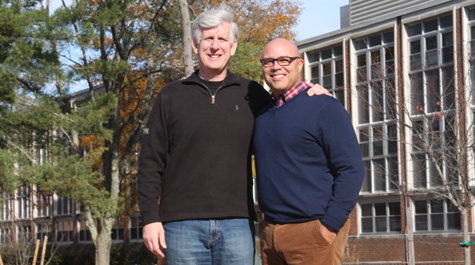
Michael Powell arrived at William & Mary in August 1981 with a powder-blue Ford Pinto and a trunk that presented an immediate logistical problem. His new room was on the third floor of Yates Hall. His new roommate, Todd Stottlemyer, played offensive line. Powell took one look and concluded that the trunk had found its solution. Before there were boards to chair, there were stairs.
It is a useful opening to Stottlemyer’s story because the friendship lasted. Both students graduated in 1985. Both eventually served as rector, the chair of the university’s Board of Visitors. A housing assignment acquired an unusually long afterlife. Decades later, when Stottlemyer took on that responsibility, his former roommate was someone he could call for advice. The room had been temporary. The relationship proved rather more durable.
Today Stottlemyer leads Acentra Health and sits on its board. His earlier jobs include corporate finance, consulting, entrepreneurship and the leadership of a national business association. Read straight through, those appointments can look like a career conducted entirely in conference rooms. Look more closely and people keep entering the picture: a campaign colleague, an early boss, a mentor, a friend from college. His path becomes easier to understand when the names receive as much attention as the titles.
Thirteen years of learning the business
Stottlemyer was born in Pittsburgh and grew up outside New York City before his family moved to Northern Virginia. His father’s Foreign Service work brought international affairs into everyday life. Government became his subject at William & Mary; football supplied another education, one organized around teammates, assignments and the consequences of failing to do your part.
He finished his bachelor’s degree in 1985. A Virginia gubernatorial campaign gave him an early professional assignment and responsibilities that arrived before a long résumé could possibly have done. Campaigns have a way of compressing an apprenticeship: deadlines come quickly, people have opinions, and the calendar shows little interest in whether the junior staff member feels ready.
A connection from his work with Judy Peachee led to an interview at BDM International. He entered the technology company in 1985 and stayed for thirteen years, progressing to corporate vice president and the senior executive team. While working there, he also studied at Georgetown University Law Center from 1987 to 1991. He chose business-related courses, using a legal education to deepen his understanding of how companies work.
BDM exposed him to changes in ownership, international business and acquisitions. It was an education with moving parts. The same organization could have a different set of owners and still require someone to make a decision on Monday morning. For an aspiring executive, such experience gives the abstract language of corporate strategy a practical setting: people, transactions, obligations and work that continues through the change.
His first business job became a long apprenticeship, from an entry-level role to the executive team.
In 1998 he moved to BTG as an executive vice president and chief financial and administrative officer. Later came leadership at McGuireWoods Consulting, Apogen Technologies and the National Federation of Independent Business. Acentia and Inova followed before CNSI. The variety matters. Finance, a trade association and an operating company ask different things of a leader. Moving between them meant learning a new organization’s language without discarding what the previous one had taught him.
A board without a boardroom
George Newman, an early BDM mentor, suggested that Stottlemyer assemble a personal board of directors. He followed the advice. Over time, his circle included Earle Williams, Phil Odeen, Ed Bersoff, Mike Daniels, Milt Peterson, Frank Atkinson, Bill Mims, Bill Conway and Donna Morea. Their backgrounds crossed company leadership, investment and law.
The phrase is memorable because it borrows the machinery of corporate governance for a more ordinary human need. A person benefits from advice, too. A title can increase the number of people willing to listen while doing surprisingly little to increase the number willing to challenge a decision. Keeping advisers close gives ambition some useful company. It also makes the solitary-genius version of a business career look a little underfurnished.
Stottlemyer has returned to those relationships in his own writing. In a 2016 remembrance of Earle Williams, he described three connected roles: an industry pioneer, a community builder and a servant leader. Williams’s example linked the responsibilities of running a company with the responsibilities of living in the place where it operates. An executive’s work extended beyond shareholder returns.
That is a demanding idea precisely because it sounds so agreeable. Almost everyone can endorse community service in principle. Finding the time, accepting the assignment and doing the unglamorous committee work require something more. Stottlemyer’s reading of Williams places civic activity inside the job of leadership, where it competes with real demands and has to survive them.
“How have you helped someone else be successful?”
Todd Stottlemyer
His 2025 tribute to Mike Daniels is more personal. Daniels had served on two of his company boards and helped him as a first-time CEO. Stottlemyer remembered the value of constructive feedback, then described how their conversations changed after he became a grandfather. Two technology executives found themselves discussing grandchildren. The calls ended with a simple expression of affection: “I love you, my friend.”
That detail supplies a different measure of a professional relationship. The business advice mattered. So did the friendship that continued when business ceased to be the most interesting subject on the telephone. The people in his career were allowed to become people in his life.
Giving an old place a future
At William & Mary, Stottlemyer’s alumni connection grew into a governing responsibility. He joined the Board of Visitors in 2011 and served as rector from 2013 to 2018. During that tenure, the university enacted the W&M Promise tuition guarantee, launched the For the Bold campaign and selected Katherine Rowe as its president.
Those are institutional decisions with consequences that extend beyond the term of any board chair. Tuition affects a family’s plans. A fundraising campaign influences what a university can afford to attempt. Choosing a president shapes the work of people who may never know the names around the appointment table. Nostalgia can bring an alumnus back to campus; governance requires thinking about students who have yet to arrive.
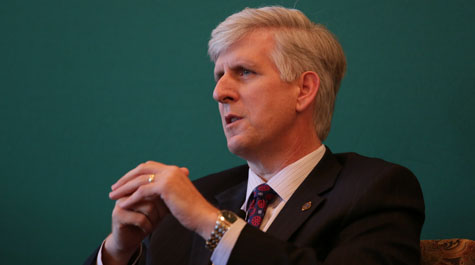
He and his wife, Elaine, have supported the Stottlemyer-Coyne Football Scholarship, the Powell Leadership Scholarship and the Global Research Institute. Their giving also helped the Reveley Garden and Hearth: Memorial to the Enslaved. The range places athletics alongside research and the university’s engagement with its own history. A place can hold fond memories and still need serious work.
William & Mary awarded him its Alumni Medallion in 2024 and an honorary Doctor of Public Service degree in 2025. In accepting the latter, he spoke with enthusiasm about the university’s new School of Computing, Data Sciences & Physics and its efforts to encourage civil discourse. The former government student remained interested in how education prepares people for public responsibility.
His board work reaches beyond campus. It includes the Wolf Trap Foundation for the Performing Arts, the Northern Virginia Technology Council and corporate boards including LMI, Serco North America and the Peterson Companies. These organizations have different purposes. Together they show how much of his working life sits in the space where businesses and their surrounding communities meet.
A new name, a familiar task
Stottlemyer became CNSI’s CEO in 2018. When CNSI and Kepro announced their merger agreement in November 2022, he was selected to lead the combined company. The transaction closed that December. In June 2023, the organization adopted the name Acentra Health.
A merger supplies plenty of visible milestones: the agreement, the closing, the name. The less visible work belongs to the people who have to make the combined organization function. Established teams arrive with established habits. The executive’s assignment is to give their work a common direction while understanding what each group brings.
By 2026, Virginia Business described a company with approximately 3,400 employees in the United States and India. It also reported Stottlemyer’s service on Governor Abigail Spanberger’s transition committee and his appointment to the Virginia Commission on Higher Education Board Appointments. The corporate and civic strands of his career were still running together.
A little room for the forecast
There is one more interest to put beside the boards and companies. Stottlemyer is an amateur meteorologist, fascinated by weather since childhood. He subscribes to a professional weather service and studies American, European and Canadian forecasting models. Apparently, one forecast leaves too many interesting questions unanswered.
It is tempting to turn every hobby into a leadership lesson. Weather deserves to remain weather for a moment: a subject he enjoys, a set of models to compare, something outside the next meeting. Alongside reading, hiking and skiing, it gives the executive biography room to breathe.
The relationships provide the stronger thread. A campaign colleague helped him enter business. Experienced leaders continued to advise him. A college roommate became a fellow rector and a lasting friend. In Stottlemyer’s story, advancement does not erase the earlier chapters. The people from them keep appearing, sometimes with advice, sometimes with memories, sometimes with grandchildren to discuss. The company he keeps has a longer history than the company he leads.