Dass Ramadass arrived in Hawaii with another destination in mind. London was supposed to follow. Law was supposed to be the profession. Hawaii Pacific University would occupy a summer, and then the original itinerary could resume. Instead, he stayed. The summer acquired semesters; the student acquired an internship; the internship acquired a future. By the time he was writing about the experience in 2008, he was president of Hawaiian Properties, explaining to other interns that the distance between their position and his could be crossed.
He gave that explanation a very short punch line: “I did.” There is a certain economy to it. A career that had taken two decades to unfold could fit into two words. The interesting part, though, lies in the unfolding: how an occupation becomes compelling enough to replace an earlier ambition, and how someone learns a business before being asked to lead it.
London could wait
Before Hawaii, there had been a less conventional detour. Ramadass studied pre-university law in Kuala Lumpur, became interested in racehorse training, and spent time pursuing it before returning to education. His parents were unenthusiastic about the horses. Later, an experienced commercial property manager helped make a different occupation interesting to him. These episodes supply the beginnings of a career without making it look inevitable. A barrister’s future and a property manager’s working day make rather different demands on a calendar.
His education and early employment overlapped. HPU identifies him as a member of its class of 1985 and as an MBA alumnus. In 1986, he joined National Mortgage and Finance Company as an intern. The name on the door would eventually change; the connection endured. Twenty years after that beginning, he became president in 2006, the year the business adopted the Hawaiian Properties name.
An internship is an appealing starting point for this particular story. Property management concerns the things that must actually happen after a decision has been made. Someone has to arrange, explain, check, and follow up. Beginning with small assignments puts a person close to that machinery. The later title gives the beginning its surprise, but the beginning gives the title some substance.
A business inherited, then learned
The company had a history long before its future president arrived. Its predecessor was established in 1929 by Masayuki Tokioka to provide financing to people who struggled to obtain conventional loans. Property management developed as clients’ circumstances changed. Ramadass entered an existing enterprise with an existing account of why relationships mattered. He was taking his place in a business lineage rather than inventing one for a launch announcement.
In his 2008 account, he put the managed portfolio at 1,000 units when he started and 16,000 properties by the time he wrote. He also described training that allowed experienced staff to pass knowledge to newer colleagues. The combination matters. A larger portfolio creates more work; shared knowledge helps more people do it. Growth, viewed from inside an office, has a staffing problem attached.
His own early experience with a mentor gave that emphasis a personal foundation. Learning a profession from someone who knows its practical complications is different from admiring it at a distance. There are questions a newcomer does not yet know to ask. An experienced colleague can make those questions visible. Ramadass later urged people entering property management to seek that kind of guidance.
A longer client list also means a longer list of promises to keep.
An observation on the work
The Ilikai test: keep the day running
A concrete example arrived in 2010. Hawaiian Properties was appointed manager of the Ilikai Hotel and Condos, taking over on May 1. The mixed-use property contained 1,025 residential and commercial units. It brought together businesses, residents, and visitors in one building, an arrangement with plenty of scope for competing expectations. A management appointment at that scale is a date on a contract and a change in many people’s daily arrangements.
Ramadass’s public comments at the time emphasized continuity. The company had contacted owners and assured them that services would continue through the change. That is an unshowy promise with a large practical burden. For an owner, the introduction of a new manager becomes meaningful when a request reaches the right person and an outstanding matter receives attention. The welcome announcement is only the introduction.
The company’s portfolio then also included Harbor Court, Villa on Eaton Square, the Japanese Cultural Center of Hawaii, and the Hawaii Kai Marina Master Association. Those names give some texture to the job. Managing property could involve a residential building, a cultural institution, or a community with a marina. The common requirement was the ability to make an organization useful to people with particular needs.
Across the water, the same obligation
In 2017, Hawaiian Properties acquired Augustine Realty, extending its presence to Hawaii Island. The acquired business had spent 26 years serving the Kailua-Kona and Kohala Coast areas. Kathy Cooley and Christy Hinds joined the expanded team in senior property management roles. An acquisition could enlarge a map immediately. Establishing working relationships in the enlarged territory remained a more personal undertaking.
The following year, the company described a client base of 235 across Oahu and Kona. Its staffing figures offered a useful glimpse behind the management label: 31 property managers, supported by 16 administrative and 33 accounting personnel. The accounting and administrative work occupied a substantial part of the picture. Buildings may be the visible assets, but a management business also runs on records, reports, and the people who keep them in order.
By summer 2023, the company was describing a team of 50 property managers and 72 administrative and accounting personnel. That year Ramadass also appeared with colleagues at the Hawaii Buildings, Facilities & Property Management Expo. There is something fitting about finding a company president in a group photograph at a trade booth. In a service business, the people beside the president are part of the explanation.
The present-day company describes association management through budgets, financial reporting, maintenance planning, and support for boards. Its client testimonials dwell on such matters as timely answers and orderly meetings. The details identify the experiences the business chooses to put on display. A meeting that finishes efficiently is unlikely to inspire a monument. Anyone who has endured the opposite may consider it a respectable achievement. The administrative figures help explain why such ordinary outcomes require people behind the scenes. A client may see a single point of contact, while an answer depends on several desks doing their part. The visible exchange carries the work of a team.
The return visit to campus
Another group photograph places him at HPU, this time on the giving side of a university occasion. In November 2021, Ramadass and Hawaiian Properties board member Frank Tokioka visited campus to present a donation to university president John Gotanda. The oversized check made the occasion easy to photograph. The destination of the support made it more interesting: the College of Business Dean’s Fund.
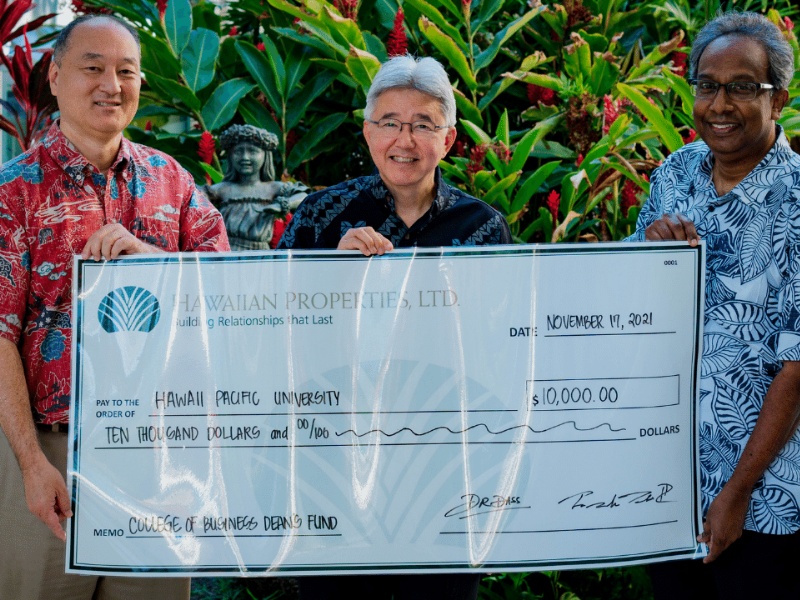
The university described the company’s support as enabling special programming, speaking engagements, and project-based experiences for undergraduates. These are opportunities to encounter business beyond the course outline. For someone whose own career changed during an internship, participation in that kind of support has a pleasing continuity. The former student returned with something that could help current students explore the world he had entered.
His connection to organized giving also appears in NMF Foundation filings, which list him as treasurer and secretary alongside members of the Tokioka family. That is a distinct responsibility from running a property management company. It puts his name in the administrative work of a charitable foundation, another setting in which stewardship depends on attention to details that rarely make a photograph.
A handover belongs in the story
In spring 2025, Hawaiian Properties announced that Ramadass would retire from the presidency on April 30 after 19 years in the role. Its account placed the workforce at 140 and the managed portfolio at nearly 50,000 units. Jarrett Walters, previously president and CEO of Hawaiian Building Maintenance, had joined in January and was appointed president. The announcement planned for Ramadass to assist as a consultant through the end of the year.
Those details give the departure a practical shape. A successor had arrived. A period of continuing assistance was planned. Knowledge could be passed on while the work continued. For a career that began with learning from experienced colleagues, a transition allowing time for assistance makes a fitting final professional chapter.
His retirement comments returned to client trust and the quality of service. Elsewhere, in a testimonial for a roofing contractor, he had praised responsiveness, reasonable pricing, and help given to his property managers. It is a revealing set of things to notice in another business: the availability of help, its usefulness, and the people who receive it. A roof may bring the matter to everyone’s attention; a reliable working relationship determines what follows.
The horses, the proposed law studies, and the extended stay in Hawaii make the beginning memorable. The quieter work explains the years that followed. Ramadass had once set out to pass through. He found an occupation worth learning, an organization in which to advance, and clients whose expectations would keep the job specific. London remained in the opening paragraph. Hawaii supplied the rest of the career.