The revealing moment in a software project often arrives after people start using it. Hawaii’s Department of Education wanted a better way to track school construction money. DataHouse helped build a first version using inexpensive, low-code tools. People adopted it. They requested more. Eventually, the platform could no longer comfortably accommodate the demand. Success had exposed the next problem.
- DataHouse connects old systems, new applications, and the people who depend on both.
- Its customers include schools, banks, government agencies, and hospitals.
- The recurring method: understand the workflow, deliver in stages, and prepare for what adoption brings.
That sequence offers a useful introduction to the company. DataHouse sells technology consulting and development, but its work repeatedly concerns the awkward interval between an institution’s existing habits and its next operating system. A school still needs its budget records. A bank still needs its staff ready. The upgrade has to coexist with Tuesday.
A good prototype earns a harder job
The construction tracker’s first version established demand. For version 2.0, DataHouse moved to VizPlatform, its pre-engineered foundation built on Amazon Web Services. The assignment joined budgeting, procurement, project reporting, and construction management, including an integration with Procore. The company reports that it migrated the earlier data and established a data lake and self-service reporting.
The lesson is easy to borrow: treat an early tool as an experiment with an eventual exit route. Adoption tells you which capabilities deserve investment. It also creates obligations to users and their records. A cheap beginning can be sensible, provided someone has thought about the next platform before the first becomes indispensable.
- 01 / ProveStart with a usable workflow
- 02 / ConnectBring records and systems together
- 03 / ExtendExpand capacity and reporting
The person was worth keeping
Dan Arita founded DataHouse in November 1975 with a distinctly local ambition. Software could create skilled work in Hawaii, giving people a reason to build careers there. “And providing high tech jobs here would help stop the brain drain,” he recalled in the company’s history. Geography was part of the business problem from the beginning.
Later, a valued developer moved to another state for family reasons. DataHouse says it worked out how to keep him contributing through dial-up connections and modems. Its account gives no grand launch date for remote work. There was a person to retain and a connection to make. The working arrangement grew from that practical decision.
“And providing high tech jobs here would help stop the brain drain.”Dan Arita, founder
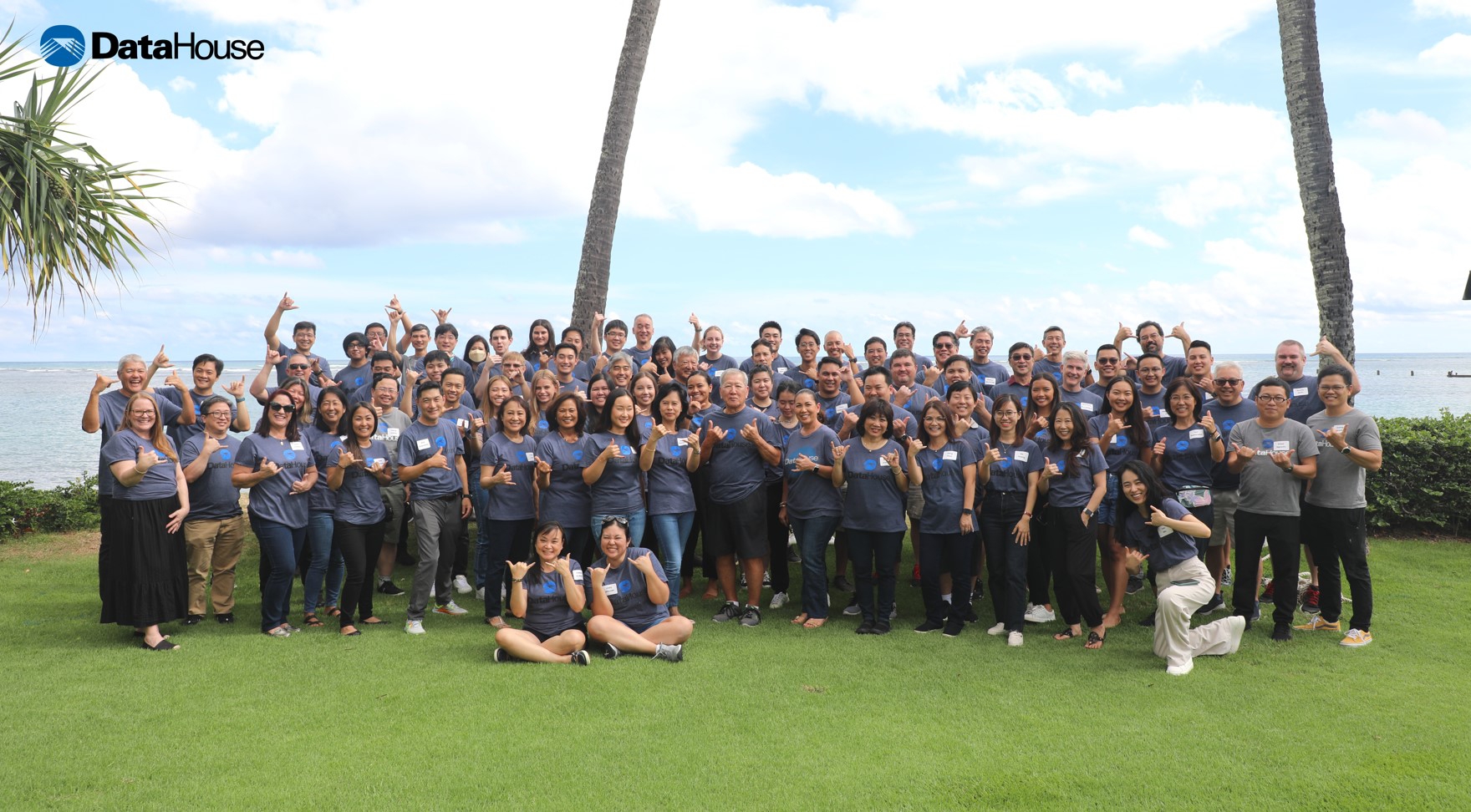
The present company combines that local identity with international delivery. Its 2023 service catalog described more than 300 employees across Hawaii, several mainland states, American Samoa, and Vietnam. It is also the founding member of the ‘ike family of companies. Those connections widen the pool of engineering knowledge available to a client whose problem begins close to home.
The patient has already arrived
Healthcare makes the integration problem unusually concrete. A patient may move through registration, consultation, a laboratory, pharmacy, and billing. Each stop can generate a separate record. VizHIS, DataHouse’s hospital information system, offers modules spanning those activities, alongside inpatient care, emergency care, reporting, and a patient portal. Its proposition rests on giving departments access to connected information.
At Makati Life Medical Center in the Philippines, DataHouse describes deploying VizHIS with VizERP, the operational and back-office platform, on AWS infrastructure. Implementation proceeded in phases: registration, consultation, and medical records first, then billing, pharmacy, and inventory. Staff training accompanied the rollout. Clinical and administrative change shared a timetable.
That order matters. A hospital platform has to become useful to the people who receive patients, handle medicines, and reconcile payments. Configurable workflows and role-based access are part of that work. The company reports improved coordination and throughput at Makati Life; the interesting detail is the sequence of implementation rather than a dramatic savings claim.
The quiet work behind the software
First Hawaiian Bank illustrates another side of the offering. DataHouse’s published core-banking case describes project management, business analysis, quality assurance, and training. Consultants worked inside the bank’s existing project structures, clarifying requirements and acceptance criteria, coordinating schedules, tracking defects, and preparing employees. Much of the deliverable was organizational readiness.
This places DataHouse in the market for systems integration and institutional change, with its own software platforms available when suitable. A buyer can consider a packaged application, an internal engineering team, or another consultancy. DataHouse’s particular combination is industry familiarity, implementation staff, reusable technology, and continuing support. The value depends on how well those pieces fit the assignment.
The commercial relationship can include consulting, development, hosting, infrastructure, and ongoing assistance. Cost deserves careful boundaries. In the historical eCSSS school-support project, ‘ike reported a zero-cost license for TeamPraxis technology. That describes the license. Building, migrating, training, and maintaining an institutional system are separate tasks. Buyers should ask for those costs separately, together with the costs of future integrations.

Start where the work happens
During the pandemic, DataHouse analysts visited an airport testing site while developing a solution for the National Kidney Foundation of Hawaii. They observed travelers, mapped their journeys, and configured the LumiSight platform around the actual process. The company reports a launch within weeks and adoption exceeding a thousand users daily. Observation preceded configuration.
There are limits to copying that approach. A phased migration needs usable interfaces, reliable records, and people authorized to settle competing requirements. Connecting systems will not by itself resolve conflicting definitions or unclear ownership. DataHouse’s September 2026 guidance on AI makes a related argument: establish trustworthy, traceable data before expecting sophisticated tools to produce dependable answers.
The company’s next chapter includes healthcare products and cloud advisory work. It announced AWS Well-Architected Partner status in September 2025 and Sao Khue recognition for VizHIS in June 2026. Its March 2026 anniversary account emphasized long relationships. Across those activities runs a consistent question for any buyer: can the new system carry the work people already need to do?
DataHouse website ↗ · Explore VizHIS ↗ · Customer projects ↗ · Data health and AI ↗
LinkedIn ↗ · X ↗ · Facebook ↗