Tim Zheng had a company that helped people sell things. Selling that company’s own software was becoming an expensive problem. By 2019, Apollo’s early momentum had stalled. Cash was disappearing. Employees were leaving. In Zheng’s later telling, less than six months of runway remained. The business had found customers, which is usually the encouraging part of a startup story. It had also found a way to spend too much money acquiring them.
The price seemed respectable: annual contracts around $10,000. Respectability, however, did not pay the bills. Small businesses found the commitment expensive, while the sales operation needed to win those contracts carried its own costs. Apollo occupied an awkward middle ground. It was asking smaller buyers to endure a buying process whose economics did not work particularly well for the seller either.
Zheng’s eventual answer was to make the software cheaper and let customers buy it themselves. It was a substantial change for a founder who had already spent years building the company. Much of what followed depended on accepting that the machinery around a useful product could be wrong.
Six months to change the arithmetic
Apollo had started in 2015. Its first years produced real revenue, followed by a period when progress became harder to sustain. In his account of the crisis, Zheng described a market crowded with competitors, each adding features while Apollo’s resources dwindled. The company had roughly 50 employees. It also had a shrinking margin for experiments that failed.
He recalled getting into a conference room with his co-founders and a venture partner for several days. The immediate objective was survival through positive cash flow. The longer project was rebuilding the company around a business model the remaining team could execute. A strategy conversation is rather more bracing when the bank balance has appointed itself meeting chair.
The reset involved reducing the team to about ten people and founders temporarily going without salaries. Those decisions gave the business time to change. They also carried consequences for the people whose jobs disappeared. The tidy phrase “product-led growth” leaves out that part of the work.
The insight Zheng drew from this period went beyond product-market fit. Customers could want Apollo while its pricing and distribution still worked against them. He began talking about product, market, model, and channel fitting together. A good tool needed an equally coherent route into a customer’s working day.
Before the salespeople, the schoolteachers
His original problem had been more modest. Before Apollo, Zheng built BrainGenie, an education startup. He had studied at MIT and wanted to make useful software. Then came the familiar second assignment: persuade someone to use it. The available prospecting and outreach tools gave him poor data and awkward workflows, so he built an internal alternative.
That system paired information about teachers and principals with targeted email campaigns. Zheng later said the effort helped grow the education product from 5,000 users to 150,000 in about six weeks. Other businesspeople saw the result and wanted similar tools. The internal project had acquired an audience beyond the company that needed it.
Apollo grew from that experience. Its proposition connected finding potential customers with contacting them. A seller could use data and outreach tools in the same environment, rather than assemble every step separately. The founder had arrived at sales software by trying to get another piece of software into people’s hands.
That origin gives the later pricing decision a certain symmetry. Zheng had experienced the irritation of tools that made a small company’s work harder. Years later, he had to examine the obstacles his own company placed between those customers and its product. Being useful was the beginning of the obligation.
A cheaper product needs a different company
On a June 2025 podcast, Zheng discussed the shift from roughly $10,000 annual contracts toward $99-a-month software. The price was only the visible edge of the change. A customer buying without a salesperson needs to understand the product, get something done, and decide whether to pay. Each of those steps becomes part of the company’s commercial work.
Consider what that asks of an engineer. A confusing screen can lose a customer before anyone has a chance to explain it. An upgrade needs to make sense at the moment someone encounters it. A free account has to demonstrate enough value to earn a return visit. The product is carrying conversations that employees once conducted.
In Zheng’s later discussions, the problem extends to finding leaders who can operate at successive stages of growth. A company that has learned to survive still has to learn to expand. Improving the economics creates another set of responsibilities; it does not retire the founder from making difficult decisions.
The broader question is how much effort a company requires from someone who wants to become its customer. Apollo’s new approach placed a bet on people discovering enough value to act for themselves. For Zheng, serving smaller companies meant redesigning both the software and the organization around that behavior.
Please leave the engineer at his desk
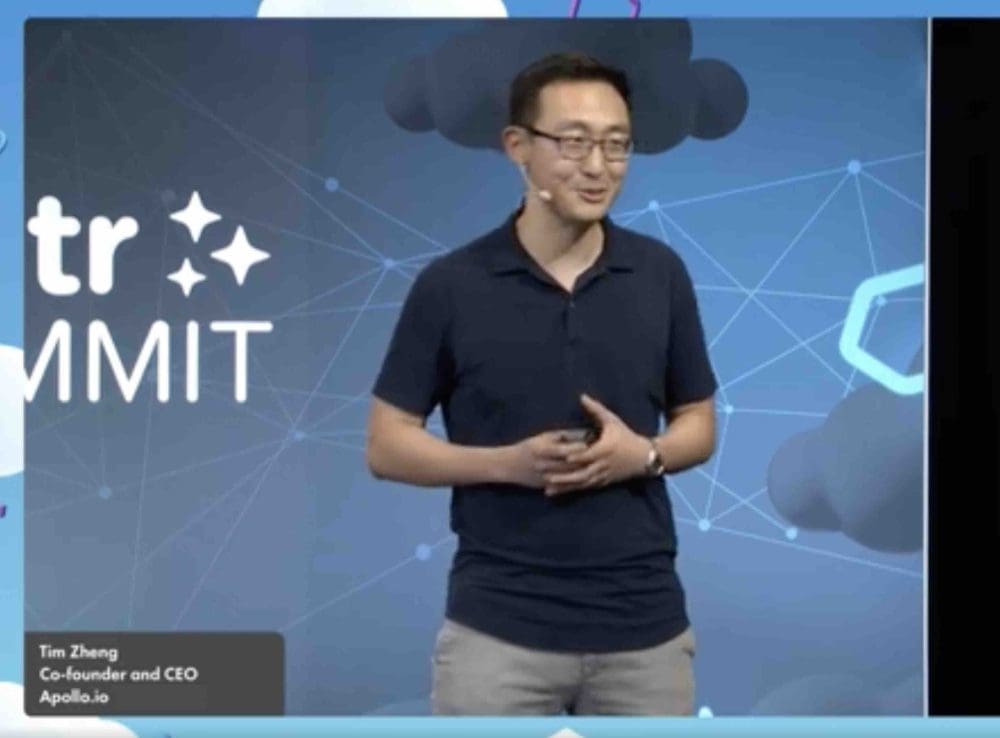
There is a small, revealing episode in Zheng’s public account of building Apollo. When the company prepared its Olympus event, he wrote that the marketing team was insisting he give a keynote. His own preference was to keep building. A software founder may sell automation all day and still discover that public speaking cannot be delegated to the product.
“Engineer by trade, normally I’d stay focused on building….”
Tim Zheng, on preparing for Olympus
He made the appearance part of a wider ambition: share what Apollo had learned and make useful resources available to people working in sales and marketing. There is a practical connection between teaching customers and letting them buy software themselves. Both require translating the company’s expertise into something another person can use without a lengthy introduction.
The anecdote supplies a human scale to a business usually described in revenue multiples. Here is an engineer with a product to build and a marketing team with other plans for his calendar. His explanations of Apollo’s strategy often have the same practical emphasis: what costs too much, what takes too many steps, and what needs to change.
One wave pays for the next
By August 2023, the company was raising a different kind of money. Apollo announced a $100 million Series D led by Bain Capital Ventures, with participation from Sequoia Capital, Tribe Capital, and Nexus Venture Partners. The round valued the company at $1.6 billion. Apollo also reported that revenue had grown ninefold over the preceding two years.
The financing connected Zheng with investors who would also become public conversation partners. Bain Capital Ventures partner Merritt Hummer discussed Apollo with him at Slush in 2025. Sequoia’s Sonya Huang was another investor associated with the company’s expansion. What had once been an internal tool now needed a substantial organization around it.
- August 2023$100M
Series D raised at a $1.6B valuation
- May 2025$150M
Annual recurring revenue reached
- February 2026~100k
Paying customers approached
At Slush, Zheng described growth through successive product curves. Apollo began with data, added engagement capabilities, and moved toward AI agents. Hummer’s account of the discussion described a proposed allocation of 70 percent of effort to the core and 30 percent to the next innovation. The existing business would support the next experiment.
The idea suits a founder who has already learned the limits of simply adding more features. Each new product has to draw on something customers already trust. Distribution matters again: the next tool arrives inside a relationship the earlier one helped establish.
In 2025, Apollo announced $150 million in annual recurring revenue. Zheng linked that milestone to rebuilding the product and the company’s approach to reaching customers. He also described AI as a way to make research and prospecting less laborious. The ambition remained recognizable from BrainGenie: help a team reach people without spending its working life assembling the process.
A different chair at the same table
On February 3, 2026, Apollo announced Matt Curl as CEO. Zheng continued as chairman. Curl had worked closely with the business for years, first as an adviser and later as chief operating officer. The company said it was approaching $200 million in annual recurring revenue and nearly 100,000 paying customers.
Zheng’s own explanation emphasized how much of the operating job Curl was already doing. In his public transition post, he credited Curl with changes across operations, culture, sales, and product. He described the promotion as bringing the title into line with the work, and his own future contribution as an advisory, supporting role.
It is an interesting decision for someone whose company began as his answer to a personal problem. Founders can become closely identified with the remedy they invented. Zheng was publicly recognizing that another person should lead the next stage. The company’s announcement described his continued involvement in supporting Curl and the leadership team.
The pattern across his career is a willingness to revisit the arrangement around the work. First he built tools because the available ones frustrated him. Then he changed how Apollo sold them because the economics frustrated the company’s progress. Finally, he changed his own role when he believed the operating leadership was already in place.
Apollo’s cheaper entry point once asked Zheng to trust customers with more of the buying process. The handoff asked him to trust someone else with more of the company. He remains at the table, in a different chair, with a business that has already required him to rearrange the furniture.