- Sprouts.ai combines prospect discovery, enrichment, intent, prediction and outreach in one enterprise platform.
- Its defensible bet is the data layer: more than 400 million records from 40-plus sources, refreshed weekly.
- The company raised $9 million in May 2026, taking reported funding to $14 million.
- The transferable lesson is simple: clean and join the data before asking an agent to act.
There is a particular sort of modern office mystery: the company with more sales software than sales certainty. One system knows who visited the website. Another knows where they work. A third claims to know whether they are shopping. The CRM knows something too, although nobody is entirely sure when it last learned it. Then a rep opens a spreadsheet.
Sprouts.ai starts with the suspicion that the spreadsheet is not the embarrassing part. The stack is. Founded in 2022 by Karan Chaudhry, Kapil Chaudhry and Avinash Nagla, the company sells an AI-native go-to-market platform for B2B enterprises. It discovers promising accounts, enriches contact records, reads intent signals, predicts who may buy and conducts outreach across email, LinkedIn and phone. Its newer name for the autonomous pieces is “Revenue Agents.”
That phrase lands neatly in 2026. But the interesting part is not that an agent can draft an email. Half the internet can draft an email. The interesting part is whether the agent understands the account, the buyer committee, the relationship graph and the moment well enough to send one worth reading.
The database is the product wearing work clothes
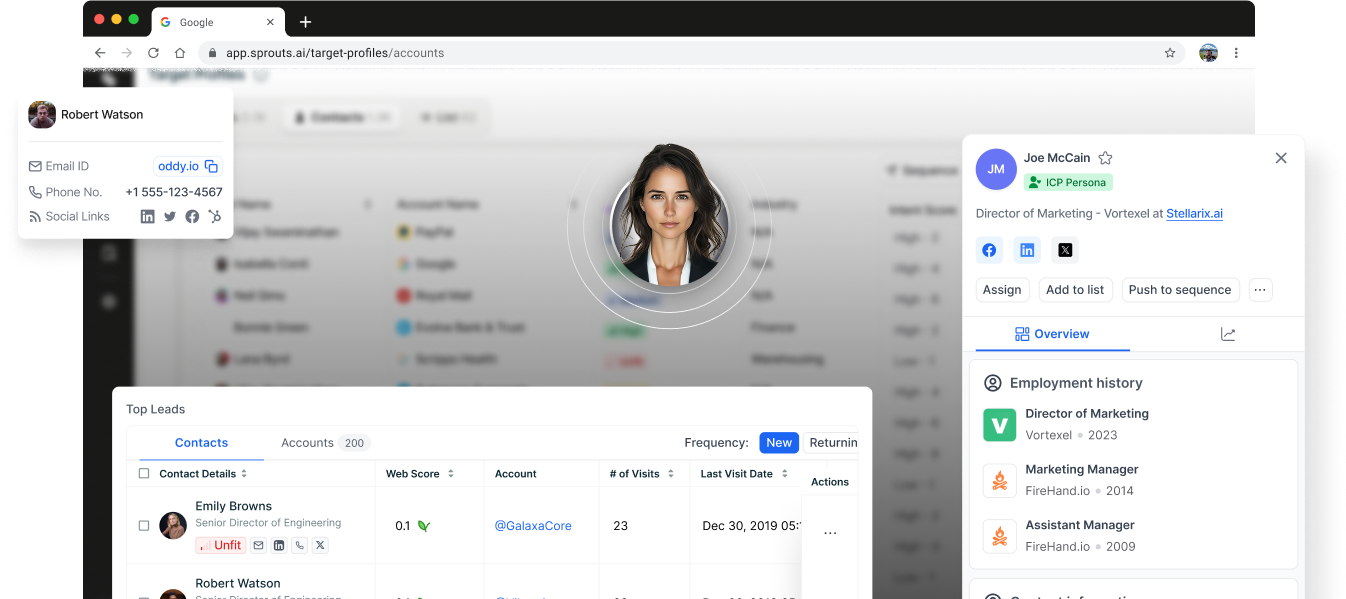
Sprouts.ai’s system processes more than 400 million records pulled from over 40 sources and refreshed every week. It turns that mass into complex searches, product-usage heatmaps, buyer-committee maps and recommended next actions. The output can appear inside Salesforce or Microsoft Dynamics, or through tools such as Claude and Microsoft Copilot. In theory, the rep does not have to pilgrimage to another dashboard.
This is where Sprouts.ai sits in the market. ZoomInfo and Apollo are obvious alternatives for data and prospecting. Clay offers flexible enrichment and workflow construction. 6sense and Demandbase occupy intent and account-based territory. Outreach and Salesloft orchestrate engagement. The large CRMs are adding their own agents. Sprouts.ai’s argument is not that these jobs are new. It is that splitting them among vendors creates a tax - duplicated contracts, mismatched fields, aging records and an assembly line of handoffs.
The first thing to fail was search
The tidy product diagram hides a less tidy engineering lesson. According to co-founder and CTO Kapil Chaudhry, the team’s earlier attempt at sophisticated, performant search across its dataset was “nearly impossible.” Hundreds of millions of changing records are not a clever prompt. They are an indexing problem, a latency problem and, once an agent begins acting on them, a trust problem.
The team made Elasticsearch its primary data store and vector database. Elastic’s Model Context Protocol server lets agents construct and execute retrieval tasks in real time; technology from Tumeryk supplies guardrails intended to reduce hallucinations and data leakage. Sprouts.ai also pushed recommendations into Salesforce, where a human seller can see prioritized accounts, suggested messages and the next recommended action.
“Before Elasticsearch, achieving sophisticated, performant search on our massive dataset was nearly impossible.”Kapil Chaudhry, co-founder and CTO
What changed their mind was not fashion. It was scale colliding with response time. Search had to become infrastructure rather than a feature. That decision is worth copying because it runs against the usual AI-demo sequence. The demo begins with the talking agent; the durable system begins with retrieval, permissions, validation and a place for the answer to land.
A $14 million argument against more tabs
In May 2026, True Global Ventures and Accel led a $9 million pre-Series A, taking Sprouts.ai’s reported total funding to $14 million. That is the clearest public answer to what the build has cost in capital. For customers, Sprouts.ai does not publish a menu price. It sells through demos and enterprise contracts, where the relevant comparison is not one subscription against another but one platform against a bundle of data, intent, enrichment and engagement tools.
$9 million arrived in the 2026 pre-Series A. The customer-side equation is consolidation: software cost saved, implementation cost added, and the harder-to-price value of reps working from fewer contradictory records.
The company reports that customers have seen three times more ICP-qualified leads, a 25 percent lift in sales-qualified leads, three times higher response rates and a 35 percent reduction in go-to-market tooling costs. Elastic’s published customer study offers a second set of company results: a 50 to 60 percent increase in qualified pipeline for Sprouts.ai’s own sales work and a 50 percent increase in client sales efficiency. These are vendor and partner case-study numbers, useful as evidence of possibility rather than a universal forecast.
The named customer list gives the claim some weight: Hewlett Packard, Razorpay, HighRadius and Udemy appeared in the funding announcement. Sprouts.ai’s site also displays brands including Aon, BrowserStack, Capillary, Hevo Data, SmartKargo, Tekmetric, Wingify and Xelix. These are organizations with enough accounts, contacts and internal systems for fragmentation to become expensive.

What the buyer is really buying
The customer is not buying a substitute for a salesperson. Sprouts.ai’s current value is the work around the salesperson: finding the right account, filling gaps in the record, noticing a behavioral change, deciding what deserves attention and preparing a relevant approach. CROs get pipeline visibility; RevOps teams get cleaner orchestration; marketers get sharper segments; SDRs get a shorter research ritual.
Large contact sets and enrichment, but often another source to reconcile.
Signals that suggest interest, with execution handed to a different system.
Sequences and rep workflows that depend on the quality of imported data.
One data layer joining discovery, intent, prediction and execution.
The model has conditions. It makes the most sense where the sales cycle is complex, the addressable market is large, buying committees matter and data decays faster than humans can repair it. A small business with a few dozen target accounts may gain more from disciplined CRM habits than from an autonomous platform. A company without clear ownership of data definitions can also automate disagreement at impressive speed.
And consolidation always has a mirror-image risk: dependence. If one layer discovers the account, scores it and sends the message, errors can travel farther before someone notices. Buyers should test data provenance, false positives, opt-out handling, permission boundaries and rollback controls. They should ask what happens when a source changes, a contact moves jobs or a model produces a confident absurdity. “All in one” is a benefit only while the one thing remains inspectable.
The play worth stealing
Sprouts.ai’s most portable idea has nothing to do with calling software an agent. Start with the decision you want a person to make. Work backward to the records required. Join and refresh those records. Put the recommendation inside the tool where the person already works. Automate the action only after the retrieval path and permission boundary can be inspected.
That sequence is less theatrical than a chatbot typing at cinematic speed. It is also how a product survives contact with an enterprise. Sprouts.ai has turned the sales stack’s least glamorous problem - keeping the underlying facts straight - into its central bet. The agent gets the name. The plumbing may decide whether it works.