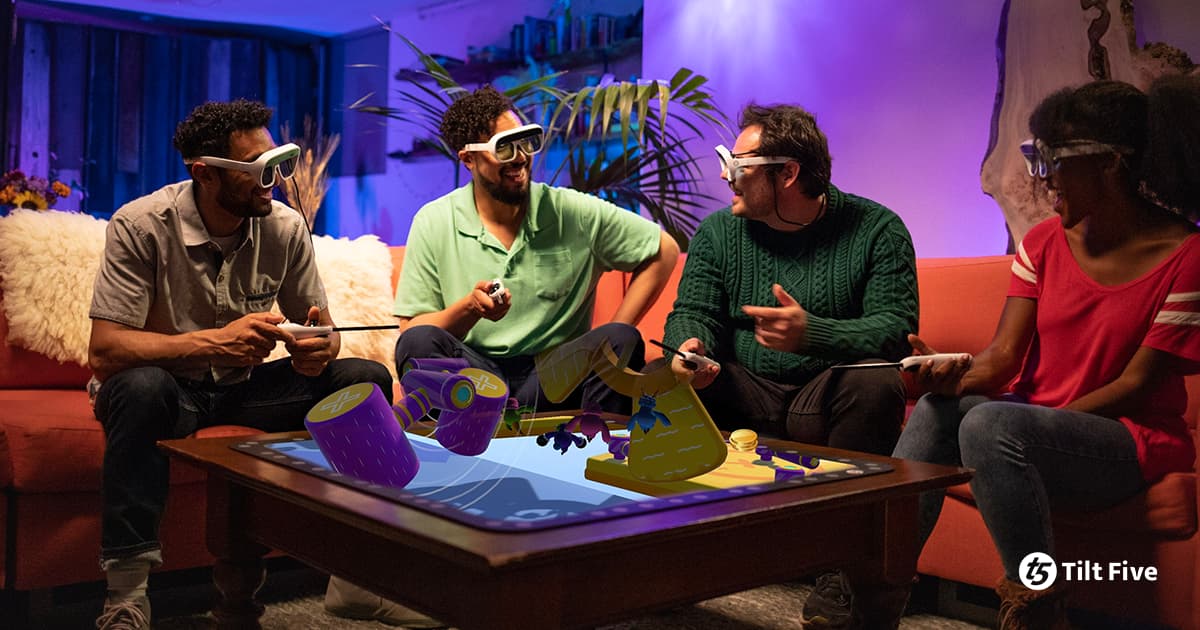
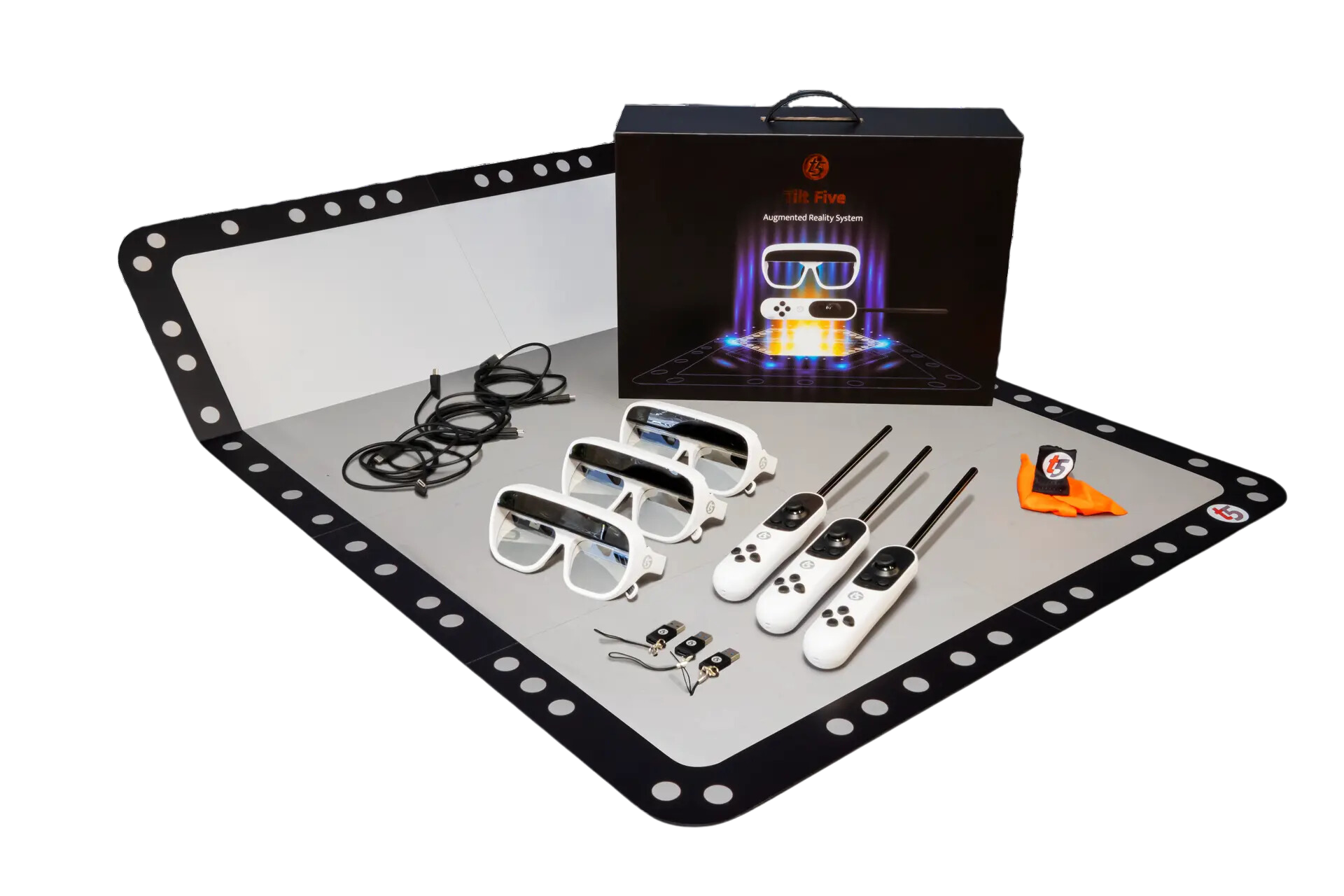
The first thing Tilt Five asks you to do is wonderfully unfuturistic: unfold a mat on a table. Plug a pair of white glasses into a Windows PC or compatible Android device. Add two AA batteries to a wand. Then look down. A dungeon, racetrack or island rises from a surface that appeared blank a moment earlier. The person across from you remains visible, including the small twitch that says they are absolutely hoarding sheep cards.
This is augmented reality with manners. It does not take over the room or place a screen between players and their surroundings. Tilt Five confines the spectacle to a retroreflective gameboard and uses lightweight projection glasses to send a separate stereoscopic image to every wearer. People can share one physical table while seeing different camera angles, hidden information or private hands.
The limitation is the point. Meta, Apple and other platform companies have spent heavily on headsets that try to understand and redraw the world. Tilt Five picked one dependable patch of it. The startup moved optical complexity into the board, focused on near-field imagery and made a product around a stubborn human ritual: sitting down together.
01 / The trickMillions of tiny mirrors and one big constraint
Each lens contains a tiny projector. Light travels away from the player's face, strikes the board's coating of microscopic glass spheres and returns toward that same player. The glasses provide a slightly different image to each eye, creating depth. Head tracking adjusts the scene as the wearer moves, while the six-degree-of-freedom wand lets a player point, grab and steer inside it.
How the tabletop illusion makes the round trip
That round trip explains the product's unusual balance. Tilt Five has cited a 110-degree field of view for content close to the board, and its glasses weigh under 95 grams. Because the imagery is focused at the physical surface rather than floating at an arbitrary distance, the system is designed for natural near-work. Clear lenses preserve the room, the snacks and everyone else's face.
It also explains what Tilt Five cannot do. The holograms do not follow you into the kitchen. Sunlight, board placement, USB bandwidth, host-computer performance and game compatibility all matter. This is not a universal computer worn on the face. It is a peripheral with a very good party trick and a growing set of serious side jobs.
“My biggest mistake was to not believe in my ability to be CEO.”Jeri Ellsworth, reflecting on castAR
02 / The scar tissueThe first version failed before the technology did
Tilt Five's origin is not a clean garage myth. Ellsworth found the optical idea while leading hardware research at Valve, after a beam splitter rotated and threw a high-contrast image onto retroreflective material across the room. She and Rick Johnson later formed castAR around the approach. That company raised more than $1 million on Kickstarter and roughly $15 million in venture capital, but closed in 2017 before delivering consumer hardware. Crowdfunding money was returned.
What failed first was organizational focus. Ellsworth has said she lacked confidence in taking the CEO role, while later interviews describe a company pulled away from the simple consumer target. The technology remained compelling; the company around it ran out of alignment and runway. Mentors then pointed out an option she had not considered: buy the intellectual property out of the bankruptcy process and try again.
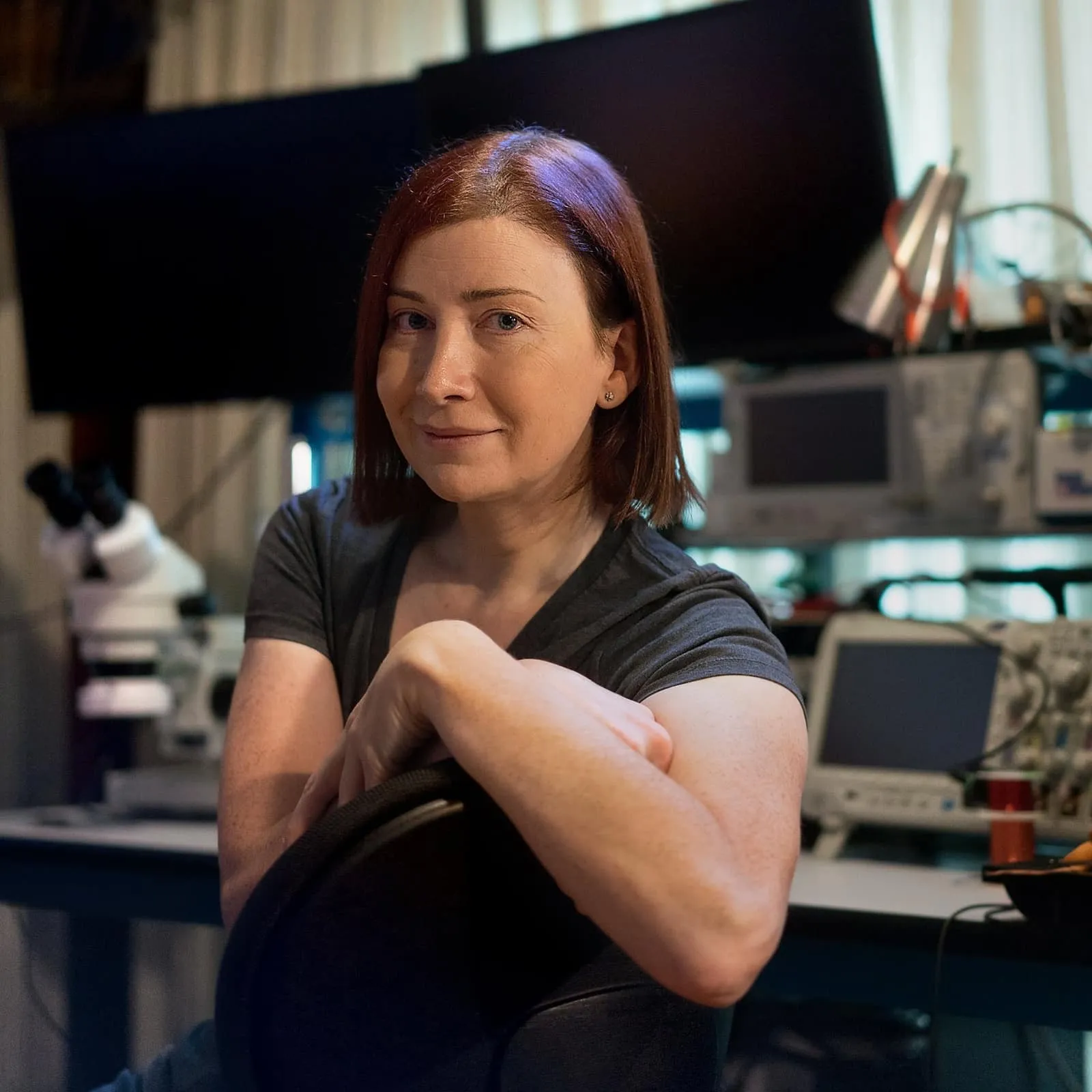
Ellsworth, software engineer Jamie Gennis and colleagues pooled money, recovered the technology and founded Tilt Five in 2017. This time Ellsworth led. The thesis became narrower: deliver great AR in one setting rather than adequate AR everywhere. In 2019, the team returned to Kickstarter with working prototypes and a $299 pledge level. The campaign passed its $450,000 goal in less than a day and finished above $1.7 million with more than 3,000 backers.
Then hardware did what hardware does. The campaign aimed for mid-2020 delivery. COVID-19 disrupted manufacturing, travel and supply chains. Tilt Five sent beta kits slowly in 2021, using weekly conversations with testers to find problems in the hardware, SDK and support process. Production drivers and the Unity plug-in reached version 1.0 in March 2022. By early 2023, the company said nearly all responsive backers had received their rewards.
The price changed too. A one-player retail system was later listed at $359. Two-player and three-player bundles were eventually advertised at $499 and $699, discounted from $659 and $959. Those numbers expose the awkward economics of social hardware: the experience becomes more distinctive as more people put on glasses, but every seat adds electronics. Tilt Five's store now marks the consumer systems out of stock and directs partners and institutions to contact the company.
The price of putting more eyes around the table
Last advertised prices, not current offers. The shop currently lists systems as out of stock.
03 / The ecosystemA hardware platform needs something to play
Tilt Five sells a system, not a sealed console. Games can remain in familiar stores such as Steam, Epic, itch.io and Google Play. Developers add a Tilt Five mode to an existing title, then decide how a flat interface should live in world space and whether the wand improves interaction. The public toolchain includes Unity and Unreal plug-ins, native C APIs and community work for Godot.
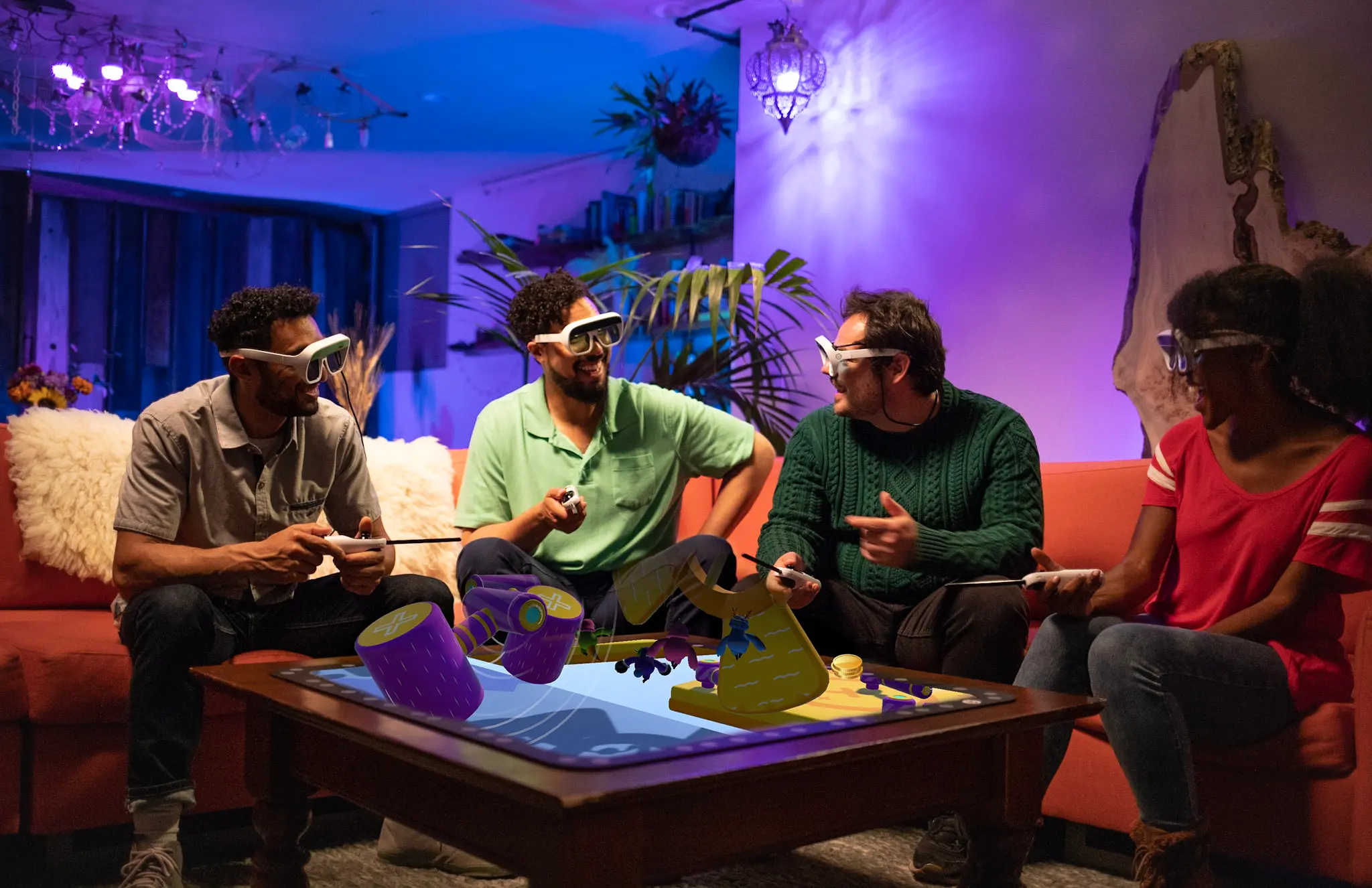
The developer strategy is practical. Tilt Five has sought finished or nearly finished 3D games with top-down or “god view” cameras, because those adapt well to the board. It offered selected studios hardware, technical help and promotion. Software releases carry fantasy-creature names - Frenetic Flumph, Huggable Hellhound, Inquisitive Imps - which is a small but telling sign that the people building the plumbing remember it is supposed to lead to game night.
Partners have ranged from Tabletopia and mixed-reality broadcaster MixCast to CATAN GmbH, CATAN Studio, Twin Sails Interactive and Blazing Griffin, which announced a holographic CATAN adaptation in 2022. The promise is almost suspiciously well matched: a familiar board, private information, animated terrain and players still able to negotiate face to face. Tilt Five has also promoted titles including Wartile, Figmin and The RPG Engine.
Beyond games, the same shared view can display architecture, engineering models, anatomy, training simulations and three-dimensional data. Tilt Five attended EdTech Taiwan in 2024 after conversations with schools and educators. The company now explicitly invites partners and institutions to discuss products and services. That does not prove an enterprise pivot, but it shows where specialized hardware often finds oxygen when the consumer shelf gets tight.
04 / The stealHow to compete with a giant without impersonating one
The most copyable part of Tilt Five is not the projector. It is the decision to make the battlefield smaller. A startup cannot match the budget, distribution or silicon of an Apple or Meta. It can choose a job where those advantages matter less. Tilt Five optimized for close-up shared 3D, not walking directions, floating browser windows or an all-day wearable.
The concentrated-product playbook
- Start with a recurring social behavior, not a technology demo. Here, it is people gathering around games and models.
- Move complexity into the environment when it makes the wearable cheaper, lighter or easier to understand.
- Expose the constraint early. “Tabletop only” sets a cleaner expectation than pretending the device is universal.
- Meet creators in tools and stores they already use. A mode inside an existing game is a smaller ask than a new catalog from scratch.
- Use the failed attempt as operating data. Leadership, investor alignment, manufacturing and support belong in the product plan.
The market position is equally specific. Tilt Five competes with Meta Quest and other mixed-reality headsets for wonder, with digital tabletop software for flexibility, and with cardboard for game night. Cardboard is the brutal rival: cheap, instant, content-rich and immune to driver updates. Tilt Five wins only when three-dimensional scale, animation, secrecy or collaboration makes the extra setup worthwhile.
Where the idea fits
- Groups who value eye contact and local play
- Games with top-down 3D worlds or hidden information
- Teams inspecting the same 3D model from different angles
- Developers who can add a focused AR mode
Where it does not
- Room-scale or outdoor AR
- People wanting a standalone headset
- Groups unwilling to buy hardware for each viewer
- Games whose UI or camera resists tabletop conversion
The unanswered question is availability and scale. A compelling demonstration is not automatically a durable platform. Tilt Five must keep hardware obtainable, give owners enough reasons to unfold the board and give developers enough users to justify support. Its current out-of-stock notice makes those ecosystem questions harder, not less important.
Still, the company has already produced a useful answer to an industry-wide fantasy. AR does not have to replace the phone, map the planet or mediate every waking hour to be interesting. Sometimes it can make a tiny dragon climb out of the table while your friend watches from the other side. The ambition is smaller. The experience, from the right chair, feels bigger.