The useful thing about a dirt track is that it has no interest in your résumé. A car either bites into the corner or it does not. Long before Jeri Ellsworth became a chip designer, inventor, and founder, she learned this blunt language in her father’s Oregon workshop. She fabricated race cars, drove them, adjusted them, and sold them. Metal and motion supplied the syllabus. Feedback arrived at speed.
That habit of learning from objects began even earlier. As a child, Ellsworth took electronics apart to discover what lived inside. Her father eventually stopped sacrificing new possessions to curiosity and placed a bin outside his auto-repair shop. Neighbors could leave broken gadgets; his daughter could conduct the autopsies. It was an elegant household treaty: fewer ruined toys, more raw material.
Her career still resembles that bin. It is full of things other people had finished with: old computers, rejected prototypes, awkward technologies, difficult second attempts. Ellsworth does not merely rescue them. She studies the mechanism, keeps the useful principle, and rebuilds the rest.
The résumé made of circuit boards
Ellsworth left high school and pursued the race-car business. By 1995, she had moved into computers, opening a store that eventually expanded to five locations. Retail taught a different kind of engineering: inventory, customers, margins, the fragile machinery of a small business. When the market changed, she returned to the technical fascination underneath it.
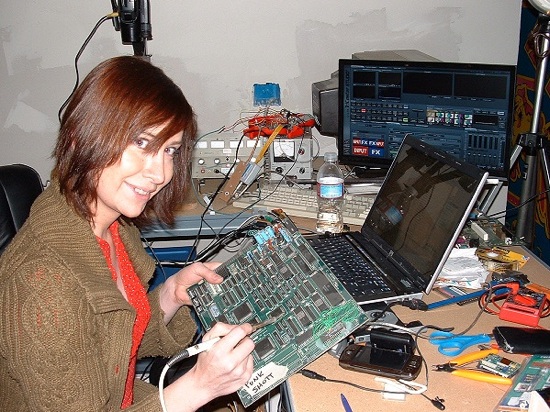
Around 2000, she began teaching herself chip design. The route was books, experiments, mentors, and FPGA boards, not a campus. She traveled to industry gatherings with physical proof: a video controller, a sound controller, joystick interfaces. Conventional interviews could halt when formal education came up. A working board could continue the conversation after the paperwork had run out of things to say.
The work gathered momentum. In 2002, Ellsworth designed the central chip for the C-One, a reconfigurable computer conceived as an enhanced Commodore 64 that could imitate other early home machines. Then came the job that made her name travel beyond hobbyist circles. A toy company wanted 30 retro games inside a joystick. Ellsworth accepted a project larger than anything she had completed alone and designed a Commodore 64-compatible system on a chip.
The C64 Direct-to-TV reached stores in 2004. Plug the joystick into a television and the familiar old machine appeared without a separate keyboard, disk drive, or beige box. More than half a million units sold. It was nostalgia compressed into an object that looked almost too small to contain its own history.
The accident across the room
Valve recruited Ellsworth in 2011 to build a hardware research lab. The brief was unusually human for a company known for games on screens: explore ways to bring a family together in the living room. Her team touched early work around virtual reality, the Steam Controller, and the Steam Box. Yet the decisive moment in her own story came from a mistake.
While investigating why virtual-reality systems made some people uncomfortable, Ellsworth put an optical component in backwards. Instead of sending the projected image toward her eye, it sent light outward. The beam struck retroreflective fabric elsewhere in the room and came back bright and clean. Most laboratory mistakes end with a correction. This one acquired a company.
She began making projected-AR prototypes. One early assembly mounted large projectors on a hard hat and earned the nickname “headcrab,” borrowed from the troublesome creature in Half-Life. The rig was comic, heavy, and clarifying. Tiny projectors could cast separate images onto reflective material; the material could return those images toward each wearer. Several people might look at the same board while seeing different perspectives.
Valve chose another direction and dismissed the AR group in 2013. Ellsworth persuaded Gabe Newell to let her take the work with her. With fellow Valve engineer Rick Johnson, she formed Technical Illusions and developed the system as castAR. Their 2013 crowdfunding campaign met its goal, and the team pursued a consumer product. But ambition grew faster than focus. The company closed in 2017 before fulfilling the larger promise.
Hardware failure is not metaphorical. It has tooling invoices, component lead times, firmware bugs, optics that misbehave outside the laboratory, and backers waiting for boxes. Ellsworth has spoken candidly about the costly lesson: a broad platform can dissolve the very use case that made the invention compelling.
A narrower future with snacks
Tilt Five, co-founded after castAR, kept the optical heart and imposed a stricter social geography. The gameboard is coated with retroreflective material made from microscopic glass spheres. Lightweight glasses project light onto it. The board sends that light back toward the player, producing a stereoscopic scene. A tracked wand handles interaction. Because each pair of glasses receives its own view, one player can hold private cards while another sees the board from the opposite side.
The boundary is the feature. Tilt Five does not promise holograms in every street and kitchen. Its first promise is a table. The table gives the optics a known surface, gives developers a legible stage, and gives players a behavior they already understand. Sit down. Look across. Move a piece. Argue about rules. Reach for pizza without knocking over a lamp.
The 2019 Tilt Five Kickstarter asked for $450,000 and received $1,767,301 from 3,345 backers. Shipping hardware took years, including the disruptions of a pandemic, but the system reached backers and moved into general availability. Ellsworth had returned to the same optical insight with a more precise sentence around it: shared augmented reality for tabletop play.
Carry evidence
A working artifact can open conversations that an unconventional résumé cannot.
Interrogate mistakes
The backwards beam splitter mattered because someone paused long enough to understand it.
Give the platform a place
A table turned an abstract AR platform into a specific reason to gather.
Persist with edits
Keeping the insight did not require keeping every assumption from the first company.
Necessary inventory
Ellsworth’s personal site contains a line worthy of a workshop sign: “Some say I have a messy office. I think it’s populated with necessary inventory.” The joke explains more than her storage system. Her life has accumulated tools that looked unrelated until a difficult product needed all of them.
Race-car fabrication supplied respect for physical feedback. Computer stores supplied commercial scar tissue. Reverse-engineering the Commodore 64 supplied a way to learn complex systems by inhabiting their constraints. Valve supplied resources and an unruly experimental brief. castAR supplied the lesson that a good optical idea cannot protect a company from strategic sprawl. Tilt Five is the shelf where all of this inventory finally meets.
Mentorship belongs on that shelf too. Ellsworth credits mentors with helping her through a career that offered no standard map, and her electronics videos return the favor in public. Her advice to girls interested in technology is practical rather than ceremonial: pursue the field you love, find mentors who believe in you, absorb what they share, and become a mentor yourself.
The formal record eventually caught up with the informal education. Ellsworth is named on patents concerning synchronized fiducial markers, object tracking on surfaces, wearable input, and head-mounted displays. They describe separate mechanisms, but together they reveal her preferred scale of thought. She moves between the chip, the optical path, the controller, and the experience of the person holding it. A product is not a stack of isolated specialties. It is the negotiation among them.
She is equally careful not to cast Tilt Five as a solo act. When asked about the years of development, Ellsworth emphasized the multiple iterations and the engineers required to make them real. That distinction matters in founder mythology, which likes one inspired figure and edits out the long table of people debugging beside them. Her pride in the product is repeatedly expressed as pride in the team.
Away from the company, her rotating collection of hobbies has included pinball, roller derby, amateur radio, and gold prospecting. The pattern is unmistakable. Each offers equipment, hidden signals, patient tuning, or the chance that something interesting is buried just below the visible surface. Even relaxation arrives with instrumentation.
Ellsworth has said she remains fond of dirt-track racing and still enjoys the smell of racing fuel. She watches now rather than drives. The distance between a clay oval and a holographic gameboard is enormous if careers are supposed to move in straight lines. It is much smaller if a career is a series of feedback loops: build, test, notice, adjust.
That is the portable idea in her story. Fearlessness is useful, but not as theater. It works when paired with evidence and revision. Say yes to the unfamiliar problem. Find the books and people that make it less unfamiliar. Put a rough version on your head, even if it resembles a video-game parasite. When the company fails, decide which assumptions failed with it. Bring the surviving insight back to the table.
There is also a quiet argument inside Tilt Five about what the future should feel like. Spatial computing need not erase the room to improve it. A new interface can preserve old pleasures: seeing another face, sharing a surface, hiding a card, offering a slice. The technology may be sophisticated. The aspiration is pleasantly domestic. The people stay in view.