In 2008, when a phone camera was still a small miracle with a large list of excuses, John Lin wrote a practical guide to making one better. More pixels were seductive, he explained, but insufficient. A useful image also depended on sensitivity, noise, dynamic range, color, white balance, lenses and the narrow vertical space inside a sleek handset. The piece reads now like an artifact from a less complicated era. It also contains the blueprint for Lin's next one.
A camera that merely records the room can tolerate a little confusion. A robot navigating the room, or a pair of glasses pinning a digital object to a table, cannot. It must see and locate itself at the same time. It must combine cameras with inertial sensors, reconcile their signals, run the calculation quickly and do all of this without becoming a pocket furnace. The camera has acquired a sense of place. Lin followed it there.
He is the founder, chairman and chief executive of Xvisio Technology, a company built around visual simultaneous localization and mapping, mercifully shortened to VSLAM. The name describes a hard trick in plain clothes: a device maps its surroundings while continuously estimating its own position. Xvisio packages that ability into compact perception modules and mixed-reality glasses for robotics and extended-reality products.
01 / The apprenticeshipOne difficult question, in several disguises
Lin studied electrical engineering at Tsinghua University, completing a bachelor's degree in 1987 and a master's degree in 1989. He began his long industrial apprenticeship in Japan at Nippon Mektron, where he became a director of engineering. Product work at ViOptix followed in California. Then came the image-sensor years: Toshiba, Aptina Imaging and On Semiconductor, in roles that joined application engineering, product decisions and management.
His education acquired a second track along the way. He completed a project-management certificate at the University of California, Berkeley, then earned an MBA at the University of Southern California's Marshall School of Business between 2006 and 2008. Engineering gave him the constraints. Business school gave those constraints a market.
The combination mattered because image sensors are diplomatic objects. They sit between silicon, optics, software, manufacturers and the person who simply wants a photograph that does not look haunted. Lin's technical writing from the Toshiba period moved comfortably across those borders. He discussed the physics of small pixels, the image-processing pipeline and why a lens must match a sensor's sampling rate. The theme was already systemic: no component gets to be brilliant alone.
“The image sensor has to function as part of a camera module system.”John Lin, writing about camera-phone imaging
A former colleague, Andrew Burt, later described the commercial consequence of that detailed approach. Over six years, he watched a CMOS-sensor business grow from zero revenue to more than $120 million a year. Lin's engineering, Burt wrote, supported customer relationships, while his curiosity about product development and business made him central to the team. Burt also remembered a positive, energetic colleague who mentored new members. This is a rarer founder origin story than the garage epiphany: somebody became useful across enough seams that the seams themselves became his field.
02 / The turnWhen the camera learned to move
Xvisio was founded in Silicon Valley in 2016 and established its headquarters in Shanghai the following year. Lin took on the founder, chairman and CEO roles after decades inside other organizations. The timing caught a shift in what the industry expected from cameras. Headsets and robots did not just need images. They needed spatial perception: tracking, depth, mapping and interaction delivered with very little delay.
The compact perception loop
In 2018, Xvisio began mass-producing a VSLAM sensor module and demonstrated six-degree-of-freedom tracking at CES Asia. Lin's pitch was unusually concrete. The tracking could reach millimeter-level accuracy, and the aim was to make it cost-effective enough for broad use. In an industry prone to floating holograms and grand nouns, he spoke in the earthy language of bills of materials.
One early module consumed no more than 1.8 watts and was described as roughly a quarter the size of a cigarette case. For a customer who wanted a solution under 100 grams and five watts, Xvisio produced a glasses-based system reported at about three watts. These figures make a useful portrait of the company Lin was building. Its work lived inside narrow borders: less heat, less weight, less latency, enough accuracy. The future would have to fit.
The shrinking power envelope
Reported consumption compared with one customer's ceiling
03 / The product ladderFrom a module to a point of view
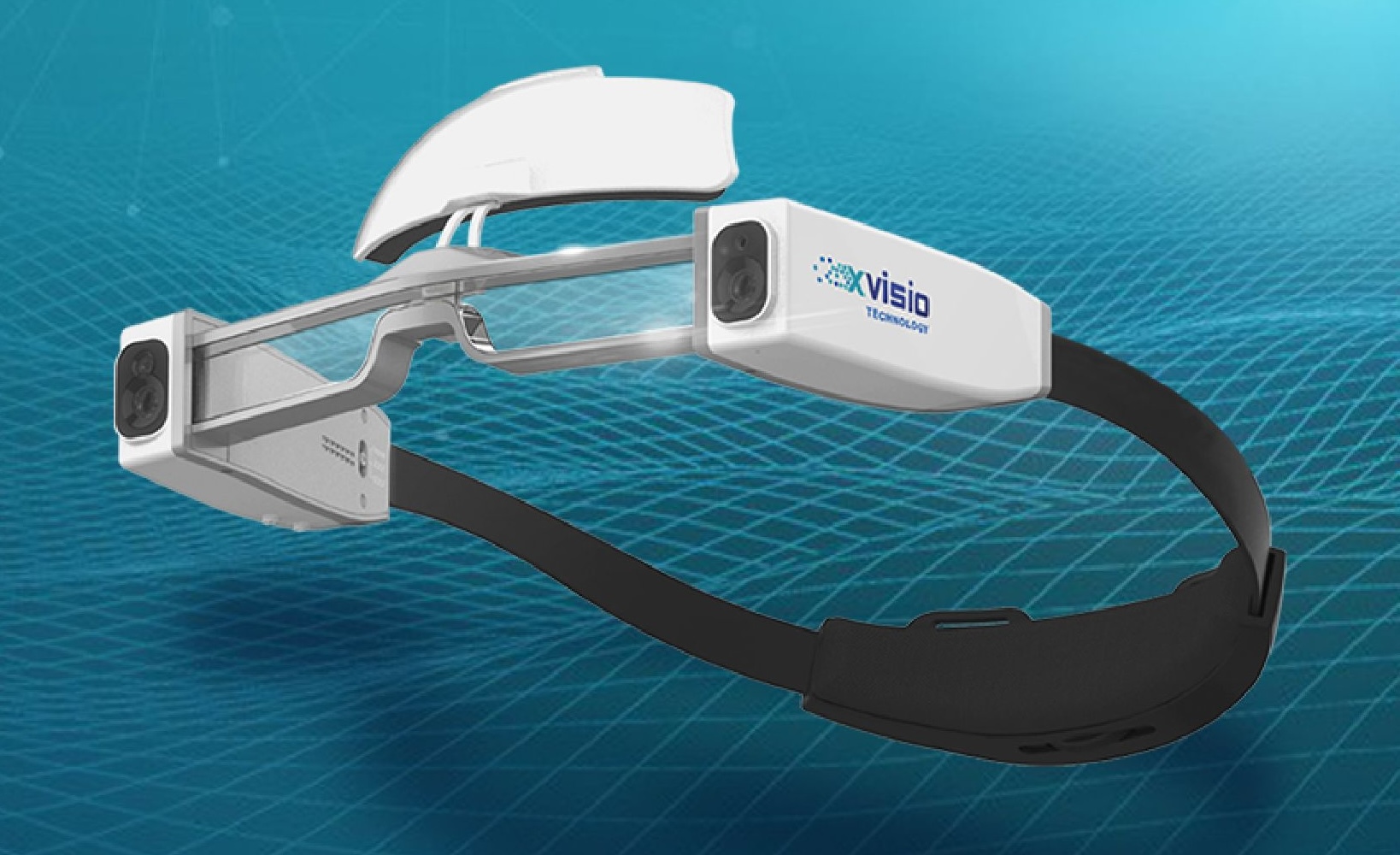
Xvisio's product history climbs outward from the core. The early VSLAM module became the SlimEdge XR platform in 2019, the SeerSense sensing family in 2020 and the SeerLens glasses line in 2021. The SeerSense DS80 later combined binocular depth, time-of-flight, VSLAM, AI inferencing and video encoding. The SeerLens family placed spatial tracking into wearable mixed-reality systems.
The sequence is revealing. A module solves the hardest enabling problem for another builder. A platform makes the solution easier to adapt. A finished pair of glasses tests whether the entire stack can behave as one product. Xvisio also offers customized development and technology licensing, an acknowledgment that spatial perception rarely enters two products in exactly the same way.
VSLAM sensor module reaches mass production.
SlimEdge XR solution platform broadens the core.
SeerSense turns perception into a module family.
SeerLens brings the stack into mixed-reality glasses.
The line expands to an 8K mixed-reality system.
Partners made the stack more legible. Xvisio worked with STMicroelectronics on sensor choices for SeerSense and SeerLens. The companies discussed global-shutter cameras, inertial sensors, thermal stability and the give-and-take between components and computation. Xvisio also demonstrated its VSLAM on NVIDIA's Jetson platform with Leopard Imaging, and signed Mouser Electronics to distribute its modules worldwide.
Lin described the Mouser agreement in the cadence of an operator: it would support both fast proof-of-concept development and volume production. Those two phrases contain a treacherous gap. Many hardware ideas can be demonstrated. Far fewer can be calibrated, documented, manufactured, distributed and supported. Lin's career had given him an unusually long rehearsal for crossing it.
“We are enthusiastic about partnering with Mouser Electronics to roll out our products to the industry worldwide for both fast proof of concept development and volume production.”John Lin, on Xvisio's distribution agreement
04 / The operating ideaOwn the seams
The easiest way to misunderstand spatial computing is to imagine that one clever algorithm supplies the magic. Lin's work argues for a less romantic arrangement. Cameras need the right shutter behavior. Inertial sensors need stability. Their clocks must agree. Calibration must survive manufacturing variance and temperature. Computation must stay inside a power budget. The software development kit must let somebody outside the building use all of it.
This makes Xvisio a company of seams. It works where optical hardware meets algorithms, where an algorithm meets an edge processor, and where a perception engine meets a customer's product. Lin's background also sits at a seam: technical education and business training; engineering in Japan and executive work in the United States; a Silicon Valley founding and Shanghai headquarters.
His public remarks are spare and technical. He talks about camera baselines, power consumption and frames per second. Even the larger ambition is expressed through capability. Xvisio says it wants to advance machine perception and interaction beyond ordinary human capacity. The aspiration becomes credible only when translated downward into the constraints a device can obey.
In July 2024, Lin joined an STMicroelectronics webinar to discuss what spatial computing needs to break through. By then, the story had curved neatly back to sensors. Better signal-to-noise performance, stable inertial data and careful power reduction allowed Xvisio's team to concentrate on its algorithm and computation engine. The old component wisdom had not become obsolete. It had become leverage.
05 / The longer viewA career that compounds
Lin's path offers a useful counterpoint to founder mythology. There is no evidence of a sudden conversion from one unrelated obsession to another. He spent years learning how machines turn light into reliable information, then followed that problem as it grew more demanding. The camera phone wanted a pleasing picture. The spatial computer wants a stable world.
The continuity is almost comic. In 2008, Lin warned engineers that pixel count was only one measure of a camera. Today, the industry can make the same mistake with artificial intelligence, treating a single impressive capability as if it were a complete system. Xvisio's products insist on the rest of the sentence: sensing, timing, calibration, mapping, heat, weight, manufacturing and tools.
A person wearing mixed-reality glasses should be able to move without watching the overlay tremble. A robot should know its pose without consulting a distant server for every step. Success is the disappearance of a great deal of engineering. Lin has spent his career arranging that disappearance.
There is ambition here, but it arrives disguised as reduction: fewer watts, fewer grams, less latency, smaller modules. It is an engineer's way of enlarging the possible. The machine can understand more of the world because its perception system asks less of the machine. After decades of teaching cameras to see, John Lin is working on the more difficult lesson: helping them understand where seeing happens.