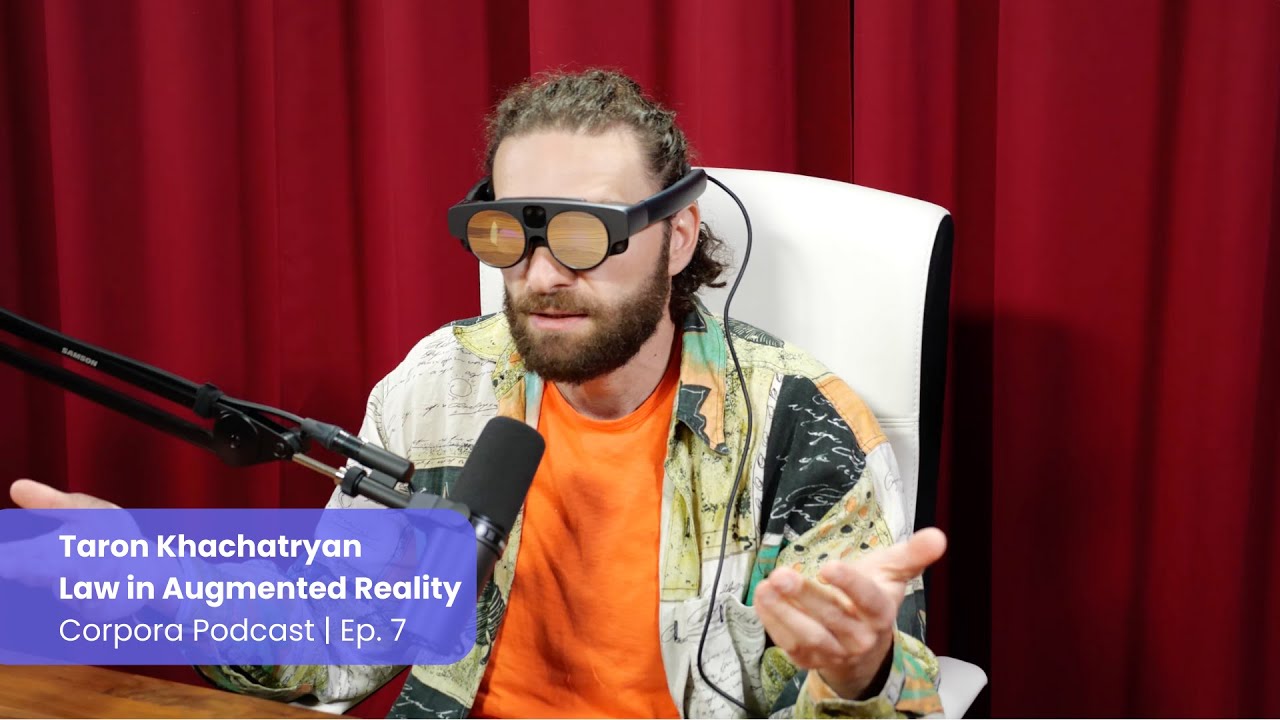
Taron Khachatryan arrived for a conversation about law carrying a black bag. Inside was a Magic Leap headset. Stepan Khzrtian, his host on the Corpora podcast, had prepared questions about augmented reality; his guest had brought a way to try it. It is an economical introduction to a founder whose work keeps returning to the space between explaining a technology and putting it in somebody’s hands.
The resulting conversation ranged across spatial computing, intellectual property, privacy and the practical relationship between founders and lawyers. There was also the business Khachatryan had been building for years: Knoxlabs, a place to discover and buy immersive technology. Even a discussion about intangible rights came with equipment. Some guests bring talking points. Khachatryan had packed optics.
His career has involved manufacturing viewers, building software tools, hosting conversations and contributing to research. The recurring question is how people get started. A person may want to enter a virtual world, make one, learn a language inside one or use its equipment to operate a robot. Each ambition encounters a different obstruction. Khachatryan has kept changing which obstruction he works on.
Before the goggles, Glendale
He was born in Yerevan and moved to Glendale at eleven. In an early biographical introduction, Glendale became “coastal Armenia,” a small joke that makes geography do the work of a family history. He went on to UCLA, graduating with degrees in electrical engineering and mathematics. Those subjects supply a fairly orderly description of his training. His entrepreneurial beginnings were less orderly.
Before Knoxlabs, there were three failed startups. The compact version of this history carries a useful correction to the familiar founder portrait: the venture people recognize was preceded by attempts they probably do not. He had technical training, but a degree could hardly prescribe which product people would want. Finding that out required a separate education.
His public biography also makes room for long beach walks and serious biographies. There is a pleasant tension there: someone concerned with future interfaces still listing two activities that require very little interface at all. His own professional shorthand is more theatrical. On his consultation profile, alongside spatial solutions architect and chief scientist, he calls himself a “Wand builder.”
Five hundred orders, then the work
In 2014, watching Google introduce Cardboard gave him an opening. A phone, lenses and a folded viewer could give people an inexpensive entrance to virtual reality. Before committing to production, he put up a simple page to test demand. It drew 500 preorders. Knoxlabs went on to record $2.9 million in 2015 sales, as he recounted in a founder interview the following year.
The appeal of the episode is its scale of action. A demonstration on a screen led to a small commercial experiment, and customers supplied an answer. Five hundred orders were a concrete obligation. Someone had to turn interest into objects and get those objects out of the door. Cardboard is an accommodating material for a prototype; paying customers are less accommodating about indefinite prototypes.
Knoxlabs became a Google Cardboard partner, and its work expanded to include branded viewers and app development. The customer asking for a viewer might need something to run inside it. That proximity between hardware and software would keep recurring in Khachatryan’s career. Selling the object brought him into contact with the next problem.
A sculptor’s name for a software problem
Rodin approached the other side of access: who could build the experiences? Khachatryan co-founded a platform for developing VR and AR applications across devices. His background included Techstars, and the ambition was to make immersive development available to people who already knew the web.
In December 2017, he laid out the case for JavaScript and browser-based tools. Creating a VR application demanded several specialisms; a web developer faced an expensive course of retraining. Rodin offered an online environment, templates and tools intended to shorten that journey. The work was technical, but the reason for it was straightforward. More people ought to be able to make things.
The name reached beyond software. Khachatryan associated Rodin with sculpting experience and with the role of hands and senses in expression. He imagined richer ways for people to communicate. It is an unusually artistic vocabulary for a developer platform, yet it helps explain the continuity between his ventures: a headset supplies a view, while an authoring tool gives its wearer something to say.
A classroom that could cross borders
By 2022, that interest in communication had a concrete educational setting. Khachatryan was a co-author of the peer-reviewed paper on Virtual Tabadul, a VR exchange project for English and Arabic language learning and cultural exchange. The project described a program for 1,200 college-aged participants in the United States, the Middle East and North Africa.
Its institutional partners were Florida International University, the University of Michigan-Dearborn, Ibn Tofail University in Morocco and Oum El-Bouaghi University in Algeria. The collaboration received Stevens Initiative funding. Khachatryan’s affiliation was Knoxlabs; his author biography connected manufacturing experience with VR development and an interest in language systems.
The paper gives his career an additional setting beyond the shop and the startup. Here the purpose of a virtual environment was conversation across languages and countries. A headset could be part of an exchange program. The important activity happened between the people wearing the equipment. That is a useful way to judge an interface: by the encounter it permits.
Language and cultural exchange in VR
The hands keep coming up
He has also made conversation part of his work. In 2021, he hosted echo3D chief executive Alon Grinshpoon on See You in VR. The interview was recorded remotely inside VR using Oculus Quest. By May 2022, he was discussing the state of virtual reality and the metaverse on EVN Disrupt. He was both using the medium and explaining it.
On Christmas Day 2023, Knoxlabs introduced the first Bend Reality podcast episode, with Khachatryan hosting Maarten Witteveen of Manus. The guest’s business made data gloves for VR and motion capture. Their conversation covered input, interaction, AI and startups. The choice of guest fits a founder repeatedly interested in what a person can do after putting on a headset.
There is a physical specificity to gloves that a phrase like spatial computing can lack. Fingers, objects and gestures bring the discussion back to the body doing the work. His June 2024 hardware webinar with Vahé Karamian likewise ranged from consumer devices to industrial uses and input systems. Across these appearances, he stayed close to the machinery that makes an experience possible.
The shop becomes part of the interface
Knoxlabs has meanwhile grown from making cardboard viewers into supplying broader XR systems. Its catalog encompasses headsets, tracking, haptics, motion capture and accessories. The company describes its work as end-to-end solutions and integration for businesses and academia. For Khachatryan, the business now includes helping customers assemble equipment from an industry with many competing parts.
A manufacturer can make a device available without making a complete setup easy to buy. A customer still has to choose compatible components, understand the intended use and get the pieces working together. A marketplace and an integration service occupy that gap. In this sense, the buying process is itself an interface, one that happens before anyone turns on a display.
The progression gives his chief scientist title a practical setting. The company has to understand the products it offers well enough to recommend a workable combination. The early cardboard business had made one entry point affordable. The later marketplace addresses the growing variety of entry points. The question has become which equipment belongs in which pair of hands.
- Make itCardboard viewers
- Build with itRodin’s developer tools
- Put it togetherKnoxlabs’ XR solutions
A wand with more realistic instructions
His January 2026 writing revisited an older promise: that VR would replace laptops and phones within five to ten years. He now argued for immersive computing as an additional working surface alongside existing screens. That is a narrower forecast, and a revealing adjustment from someone who has spent years building in the field.
He was still thinking ambitiously about creation. His essay explored combining AI services and spatial interfaces so that people could assemble useful processes more intuitively. He treated this as a direction to pursue, rather than a finished capability. The desired destination was familiar from Rodin: less effort between having an idea and making something with it.
His vocabulary remains playful, full of magical allusions. The engineering problem underneath is stubbornly ordinary. Someone wants to do something and has to learn too many procedures first. Removing a procedure may be less photogenic than announcing a new world. It can also determine whether anyone returns to that world after the demonstration.
“Wand builder”
Khachatryan’s self-description on Intro
Now the equipment reaches for the room
In its July 2026 newsletter, Knoxlabs described an expansion into robotics and teleoperation. Headsets, body tracking and gloves had brought the team into contact with another purchasing problem: sourcing robotics components. The company reported helping Sunday Robotics expand a data-collection pipeline using XR and claw hardware to record household tasks for robot training.
Khachatryan described a movement of people and ideas from XR into robotics. “Robotics is where XR gets embodied and the boundary grows again,” he wrote. It was his prediction, grounded in the overlapping equipment and people he was encountering. A virtual interface could help a person direct something with a physical presence.
The black bag from the podcast makes a fitting place to return. It held an argument that could be worn, adjusted and tried. Across Khachatryan’s work, the most interesting moment is often that handover: a piece of technology passes from the person who understands it to someone discovering what to do with it. The wand builder still has to make the handle fit.