There is a photograph every consumer technology company wants: a teenager pointing a phone at herself, grinning at a pair of cartoon ears that are not really there. In 2015, Seerslab had the app for that photograph. Lollicam could recognize a face in real time, smooth it, decorate it and record the result. Nine months after launch it had four million downloads. By 2017, it had ten million. The future looked charmingly ridiculous.
The useful version
- Seerslab builds vision AI, AR software and spatial-computing products from Seoul.
- Lollicam proved the technology; ARGear turned it into an SDK and content business.
- Its customers include app makers, telecom operators, device companies, retailers and public agencies.
- MirrorTown maps real places. AInoon puts multimodal AI into screenless glasses.
- The repeatable lesson: when a consumer category slips away, sell the difficult capability underneath it.
Then Naver's Snow and other latecomers took the consumer market. This is the point where the usual company history becomes discreet. Seerslab's is more interesting because its chief executive has said the quiet part aloud. The startup had created something early and still lost. Google, Apple and much larger platforms possessed more data, more distribution and deeper pockets. Trying to win the general-purpose AR-tool race on their terms would have been a splendid way to become technically admired and commercially irrelevant.
The app lost. The engine travelled.
Seerslab changed the object it sold. Beginning in earnest around late 2017 and launching globally in 2019, it took the face tracking, background segmentation, filters, stickers and virtual makeup beneath Lollicam and packaged them as ARGear. A developer could add Snapchat-like camera behavior without assembling every model, renderer and asset pipeline alone. Seerslab also brought the costumes: a library the company has described as more than 6,000 AR content items, supported by commercialization agreements covering roughly 200 entertainment properties.
Attention is rented from consumers. Distribution decides the winner.
Licensing, content and implementation travel across many products.
“Start-ups like us have to tackle the niche market.”Michael Chong, CEO, in 2020
That niche was not tiny. Samsung and LG could use the SDK or content in devices. Telecom operators could dress up 5G services. A live-streaming app could buy face effects; an online shop could test virtual fitting; a video caller could replace a bedroom wall. Partnerships accumulated with Facebook and Instagram, LG Electronics, TikTok, Hyundai Motor Company and LG AI Research. A 2024 report said apps equipped with ARGear had been installed 180 million times. That is ecosystem reach, not a claim of 180 million active users, but it reveals why infrastructure can outgrow the brand on its box.

A city enters the phone
ARGear understands the person in front of a camera. MirrorTown expands the frame to the street. The platform launched commercially in August 2024 with digital copies of 133 real locations - tourist sites, cultural spaces and city streets in Korea, plus parts of San Francisco. Unlike a fantasy-world metaverse, it begins with somewhere that already exists. The idea is to let a visitor tour remotely, let a merchant attach reservations or commerce to a place, and eventually synchronize useful information such as occupancy, weather or transport.
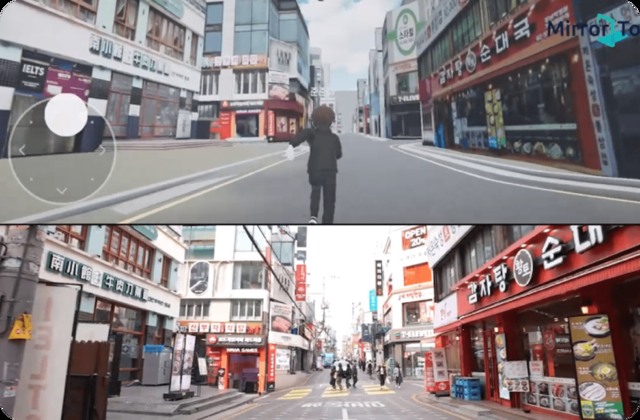
This arrived after the metaverse boom had cooled, which is awkward only if fashion is the product. Seerslab pitched MirrorTown as a cheap test bed for local governments and businesses that could not justify building isolated virtual worlds. Public funding helped develop the platform, and institutions received trial periods and operating instruction. The commercial question remains stern: digital twins need fresh data, reasons to return and enough participating merchants to become more than handsome maps.
The screen they chose to remove
AInoon, Seerslab's first hardware product, follows the same habit of subtraction. The company had spent roughly two years researching AR glasses with a large electronics business. That partner stopped the program. Seerslab concluded that useful display-based AR glasses were still years away: the display pushed device cost to more than five times the screenless alternative, demanded too much battery and had too little content waiting for it.
The decision in one uncomfortable ratio
Relative hardware cost as described by CEO Michael Chong; not retail pricing.
So AInoon sees and hears but does not project an image onto the lens. A camera supplies visual context; microphones take questions; open-ear speakers answer. It can recognize objects and landmarks, translate a sign, capture photos or video and route questions among AI models through a companion phone app. Prescription lenses can be fitted by an optician. The omission makes the product less cinematic and potentially more wearable.
The price has moved with the journey from prototype to shelf. Seerslab announced a $149 target in late 2024, offered a $174 Kickstarter tier in June 2025, and now lists two frames for pre-order at $259 and $279 on the product site. In March 2026, two models reached Korean fashion retailer Musinsa in price bands around KRW 280,000 and KRW 390,000. Hardware is cruel to tidy narratives; components, channels and promises all send invoices.
What to copy - and where it strains
The portable playbook
- Use a consumer product to harden a difficult technical capability at real scale.
- When distribution beats you, separate the capability from the original interface.
- Package code with ready-to-use content, support and rights that reduce a buyer's time to market.
- Carry the same core expertise into adjacent interfaces only when the economics become tolerable.
The recipe depends on owning something genuinely hard. If the buried capability is commodity software, the pivot merely exchanges one crowded market for another. It also needs buyers who prefer a specialist over Apple, Google, Snap, Unity, Banuba, DeepAR or an internal team. Data control, platform dependence, local support and licensable content can justify that choice. Raw scale usually cannot.
A team needs camera effects quickly, values packaged content, and cannot justify building computer vision from scratch.
A platform's native tools are sufficient, customization must be absolute, or recurring license cost outweighs speed.
Real places, live information and local commerce give people a reason to revisit the digital copy.
Audio answers and contextual vision are useful enough that people accept a camera on their face without needing a display.
Seerslab fits awkwardly, and usefully, between categories. It is an enterprise SDK company with consumer hardware, a content licensor with a vision engine, and a digital-twin operator born from a selfie app. The common thread is the camera as an interpreter. First it interpreted a face for fun. Then it became a component inside somebody else's service. Now it interprets a street and, through AInoon, whatever happens to be in front of its wearer.
The winning move was not predicting every interface correctly. Seerslab certainly did not. It was preserving the expensive knowledge from one wrong turn so it could be sold on the next road. Technology companies like to say they see the future. This one has been more interesting when it admits what it failed to see.